
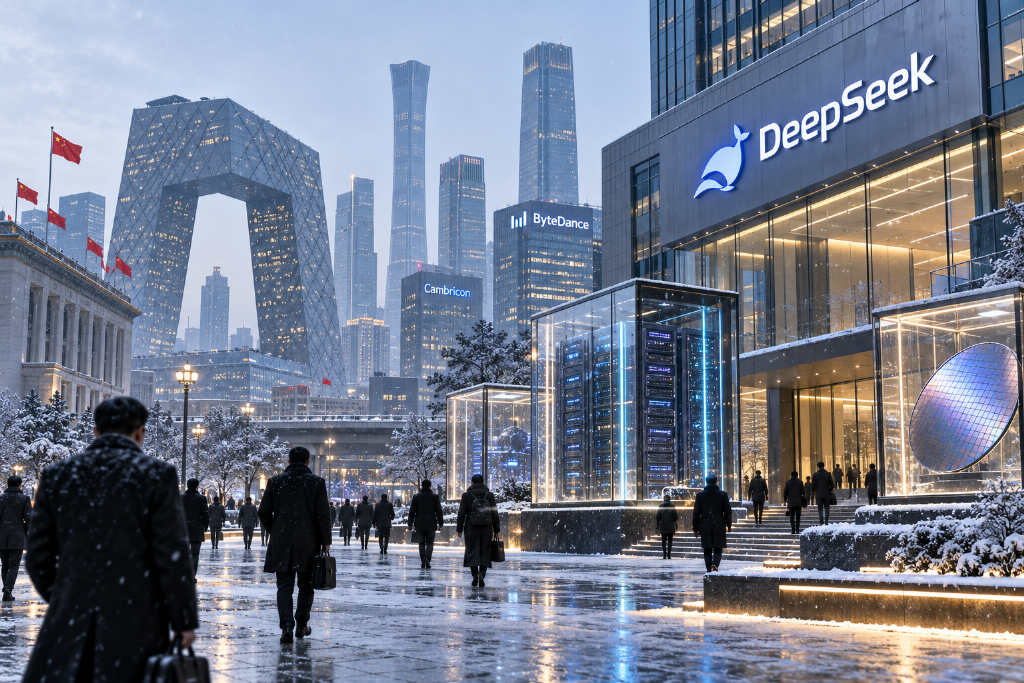
The Hurun Research Institute released the 2026 Hurun Rich List on Oct. 27, with artificial intelligence, semiconductors and computing infrastructure emerging as the main drivers of wealth growth this year. ByteDance founder Zhang Yiming returned as China’s richest person with RMB 670 billion in wealth, setting a new high for the top spot in the ranking’s history. DeepSeek founder Liang Wenfeng debuted on the list with RMB 280 billion and immediately ranked seventh. Cambricon founder Chen Tianshi also entered the top 10 with RMB 205 billion.
Liang Wenfeng debuts at No. 7 as AI becomes the biggest wealth engine
According to Hurun, 1,529 entrepreneurs with personal wealth of at least RMB 5 billion made this year’s list, up by 95 from last year, a 6.6% increase and a record high. Their combined wealth reached RMB 32 trillion, up 7% year over year, an increase of about RMB 2.1 trillion.
That growth was not evenly distributed. Hurun said the 10 entrepreneurs with the largest wealth gains accounted for 56% of the list’s total net increase in wealth, with AI and semiconductors taking a central role.
One of the most closely watched new faces was DeepSeek founder Liang Wenfeng. Liang, 41, entered the Hurun Rich List for the first time with RMB 280 billion in wealth, ranking seventh and moving ahead of several entrepreneurs from traditional industries who had long occupied the upper tier of China’s rich lists.
Rupert Hoogewerf, chairman of the Hurun Research Institute, said Liang was not included last year because he had previously stated that DeepSeek did not prioritize commercialization. As DeepSeek’s valuation climbed rapidly to more than $50 billion, the institute included him in this year’s wealth estimate. In addition to Liang, three other entrepreneurs linked to DeepSeek — Zheng Dawei, Li Huan and Chen Zhe — also appeared on the list for the first time, showing that the wealth created by large AI models was not limited to founders alone.
Hurun said more than 160 entrepreneurs on the list now derive their wealth from the AI industry, meaning more than one in every 10 listed individuals has ties to AI. In Hurun’s view, AI has become the single largest source of wealth growth on the ranking.
Zhang Yiming returns to No. 1 with RMB 670 billion
China’s richest person this year is also a beneficiary of the AI boom. Zhang Yiming, 43, added RMB 200 billion to his fortune and reclaimed the top spot for the second time with RMB 670 billion. He moved ahead of Nongfu Spring founder Zhong Shanshan and set a new wealth record for the No. 1 position in the history of the Hurun Rich List.
Hurun said that beyond Douyin and TikTok, ByteDance has continued to push AI products including the Doubao assistant, prompting the market to reassess the company’s long-term growth potential. By Hurun’s estimate, ByteDance is now valued at RMB 3.3 trillion, and Zhang holds more than 20% of the company.
By comparison, Zhong Shanshan’s wealth fell by RMB 120 billion this year to RMB 410 billion, leaving him in second place. Tencent founder Pony Ma saw his wealth decline by RMB 119 billion to RMB 346 billion, putting him fourth.
The ranking points to a shift in the structure of wealth creation in China’s technology sector, where rising valuations for AI models, computing power and related infrastructure are becoming a major source of new fortunes.
Cambricon enters the top 10 as chips and optical modules gain
Beyond AI model companies, semiconductors and computing infrastructure stood out as one of the strongest sectors on this year’s list. Chen Tianshi, founder of Chinese AI chip maker Cambricon, added RMB 25 billion to his wealth, up 14% from a year earlier, and ranked 10th with RMB 205 billion, eight places higher than last year.
Hurun said Cambricon’s market value has approached $100 billion as demand for AI chips has surged. Unlike DeepSeek, which represents AI model development, Cambricon has benefited mainly from demand for computing hardware used in AI training and inference, as well as investment in domestic AI accelerators in China.
High-speed optical communications was another area highlighted in the report. Wang Weixiu and Wang Xiaodong, the father-and-son pair behind optical module maker Zhongji Innolight, saw their combined wealth rise by RMB 82 billion. The figures reflect demand from expanding AI data centers, which is spreading from GPUs and AI accelerators to optical transceiver modules and high-speed data interconnect equipment.
Memory also benefited from AI-related investment. Hurun said the valuation of Chinese memory chip company CXMT at one point reached RMB 4 trillion, exceeding the estimated market values of ByteDance and Tencent and showing the level of market attention on the memory sector.
Elsewhere, Li Hu and Tian Hua of memory module company Delai saw their wealth nearly triple. Zhou Chaonan of data center operator Range Technology benefited from demand for AI computing centers, with wealth rising 43% to RMB 62 billion.
Hurun added that these figures are based on its own estimates of market value and personal wealth. Some of the companies involved are still unlisted, so the numbers are not directly comparable with real-time valuations in public markets.
AI startups continue to mint new fortunes
The 2026 Hurun Rich List included 263 new entrants, with large AI models, robotics and chips taking a prominent share. Wang Xingxing, the 36-year-old founder of Unitree, ranked as the second-richest new entrant this year with RMB 69.5 billion, behind only DeepSeek’s Liang Wenfeng.
Hurun said Unitree completed its listing in August. On its first trading day, the company’s market value briefly climbed to RMB 440 billion, and Wang’s personal wealth at one point exceeded RMB 130 billion. As market valuations later pulled back, the wealth figure used in the ranking fell to RMB 69.5 billion.
Zhipu founders Liu Debing and Tang Jie made the list for the first time with RMB 39.5 billion and RMB 27.5 billion, respectively. Chen Weiliang of AI chip company MetaX also debuted with RMB 37.5 billion. MiniMax founder Yan Junjie entered the ranking with RMB 22.5 billion. In addition, Moonshot AI founder Yang Zhilin was named as one of the most prominent self-made entrepreneurs under the age of 35 in terms of wealth performance.
From model developers such as DeepSeek, Zhipu and MiniMax, to AI chip companies including Cambricon and MetaX, and then to embodied intelligence represented by Unitree, the ranking shows AI expanding from software models and computing hardware into physical robotics.



