
“HYPE should at least surpass SOL by the end of this bull market,” declared BitMEX co-founder Arthur Hayes at the end of May, the most vocal supporter of Hyperliquid. The statement came amid a public dispute with Kyle Samani, former co-founder of Multicoin Capital, which escalated into a $100,000 bet on HYPE outperforming all top-10 tokens for the rest of the year. HYPE subsequently surged, hitting a fresh high of $75. While fear of heights and short-selling attempts have begun, on-chain buying patterns indicate a dramatically different reality, fueled by ETF inflows, protocol repurchases, and institutional accumulation.
Spot ETF Records 14 Straight Days of Net Inflows, Absorbing 0.9% of Market Cap
Two HYPE spot ETFs currently trade in the US. 21Shares launched the first Hyperliquid ETF (THYP) on Nasdaq on May 12, followed by Bitwise's BHYP on the NYSE on May 15. By June 2, the two products had enjoyed 14 consecutive days of net inflows totaling over $136 million, representing roughly 0.9% of HYPE's total market cap. Bitwise's BHYP alone attracted $82.96 million, making it the largest HYPE ETF.
This stands in stark contrast to Bitcoin and Ether ETFs. Since May 15, BTC spot ETFs have recorded 12 straight days of outflows, losing over $2.43 billion in May; ETH spot ETFs have suffered 16 consecutive days of outflows since May 11, losing over $540 million. Among the 12 US crypto spot ETFs, HYPE now ranks fifth by cumulative net inflows, behind only BTC, ETH, XRP, and SOL products.

The two-week debut performance is even more telling. BTC spot ETFs drew $1.46 billion in their first two weeks, but that only accounted for 0.2% of BTC's market cap at the time. SOL spot ETFs saw $380 million, or 0.47% of SOL's market cap. By contrast, HYPE ETFs absorbed nearly 1% of the token's market cap in the same time frame, signaling institutional FOMO that surpasses any previous launch.
AF Repurchases and ETF Flows Create a Double Buffer
Beyond ETFs, Hyperliquid's Assistance Fund (AF) mechanism acts as a massive and sustained buyer. Currently, 99% of protocol trading fees—derived from perpetuals and spot markets—are automatically channeled into AF to repurchase HYPE. Daily protocol revenue ranges from $1 million to $3 million, and the AF has cumulatively bought back over $1.1 billion worth of HYPE. While ETF inflows are smaller in absolute terms, their growth rate is impressive: in just half a month, net ETF inflows reached roughly one-tenth of the AF's total repurchases, with a single-day record of $31.62 million on May 29.

A team token unlock worth about $38.7 million is scheduled for June 6, as part of a monthly linear unlock. However, ETF investors—who seek pure exposure without necessarily understanding tokenomics—tend to be insensitive to such events. As long as the project's fundamentals do not deteriorate, the inflows from ETFs and the AF are likely to offset any unlock-related selling pressure.

Whales Accumulate: a16z Emerges as Possibly Largest Non‑Ecosystem Holder
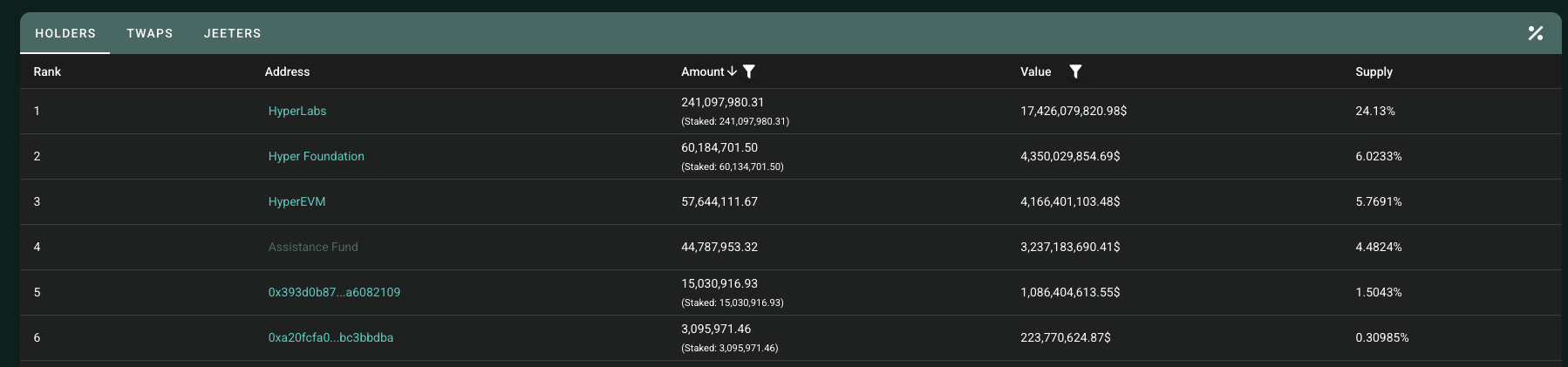
On-chain data tracked by analyst Ai Yi (@ai_9684xtpa) indicates that a16z has grown into the sixth-largest HYPE holder overall and the largest outside Hyperliquid's own ecosystem. One address linked to a16z holds 3.095 million HYPE, worth over $223 million. Additionally, the firm has been buying via multiple associated addresses: on May 28, an address starting with 0x4c6 withdrew 253,947 HYPE from exchanges and market makers at an average price of $59.2; on May 30, another address starting with 0xb5E purchased 226,121 HYPE, bringing its total since April 14 to 3.9 million tokens at an average of $49.4.
Galaxy Digital is also hoarding HYPE. On June 3, it withdrew 179,000 HYPE (approximately $12.62 million) from Coinbase, following a purchase of 158,100 HYPE (approximately $8.8 million) by another wallet on May 21. Bitwise CIO Matt Hougan has gone further to characterize HYPE not as a mere altcoin but as a “second-generation” cryptocurrency, citing its real value capture, buyback mechanism, and genuine institutional demand.

New ETFs and Russell 3000 Inclusion Open Fresh Inflow Channels
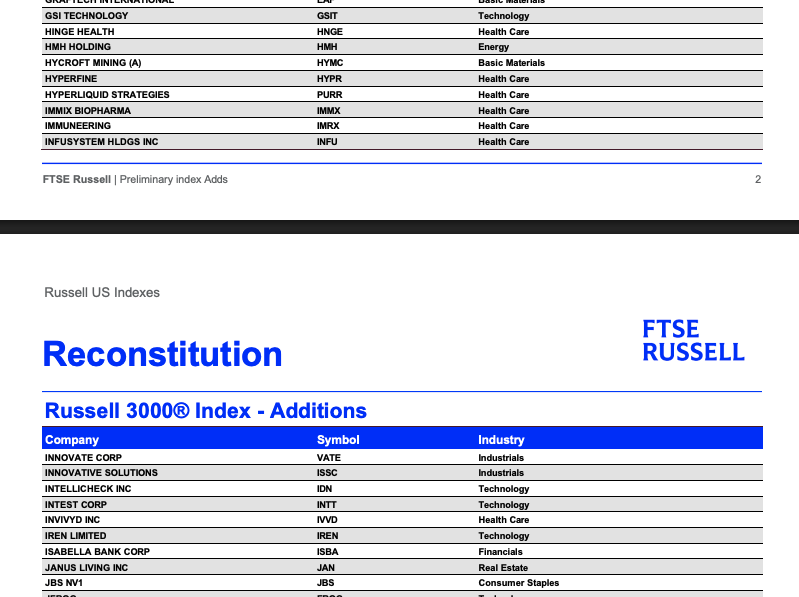
On June 2, Grayscale filed an amended S-1 for its Hyperliquid Staking ETF (ticker HYPG), seeding it with about 2 million HYPE, with trading set to begin on June 4. More ETF launches mean deeper liquidity and broader institutional access. Meanwhile, FTSE Russell included PURR on the preliminary addition list for the June 2026 Russell 3000 reconstitution, effective June 26. The Russell 3000 benchmarks approximately $10.6 trillion in assets; if PURR is officially added, it could attract significant passive fund allocations. This may also encourage DAT companies to replicate the “finance-to-buy” playbook, adding another layer of structural buying demand for HYPE.

As institutional FOMO intensifies and new catalysts emerge, the buying structure underpinning HYPE appears increasingly robust. The interplay of ETF inflows, protocol repurchases, whale accumulation, and potential index-driven buying is creating a multi-layered demand base that could continue to absorb supply and push the asset toward new highs.