
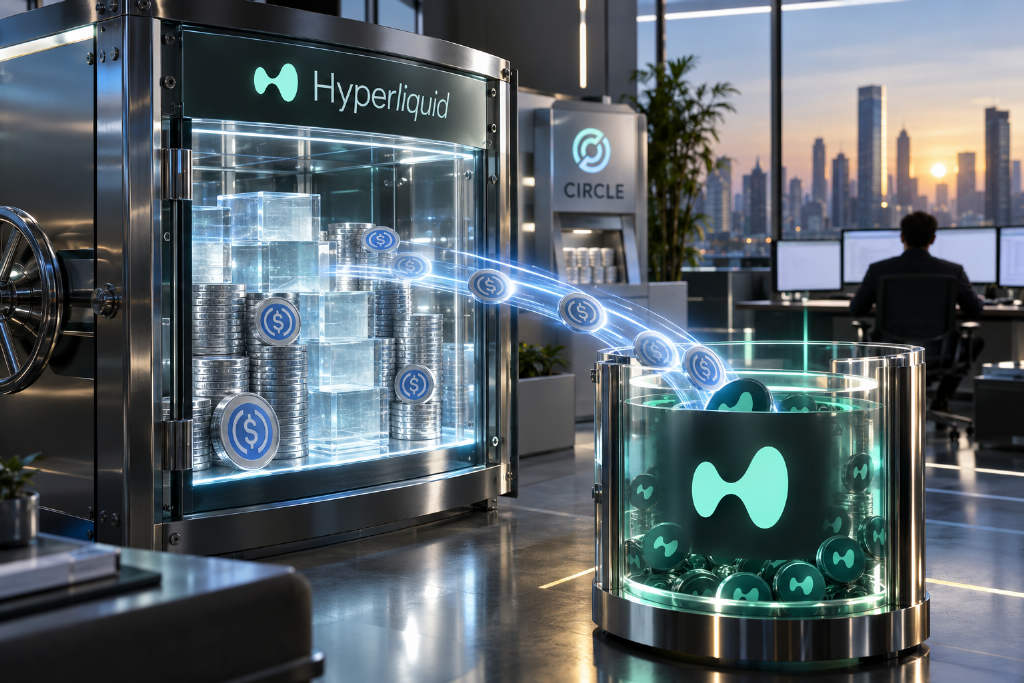
Hyperliquid has started generating a new stream of revenue through its AQAv2 mechanism, according to a post cited by BlockBeats from Hyperdash co-founder Hans.
Hans said the AQAv2 treasury wallet made its first payment on Oct. 3, paying $14.58 million tied to the trading platform’s USDC reserves held over the prior 30 days. The funds will go into the assistance fund and be used to buy HYPE.
Under the mechanism, after users bridge USDC to Hyperliquid, Circle mints the corresponding asset on HyperEVM. The treasury balance is then charged daily and settled once every 30 days. Coinbase and Circle have each staked 500,000 HYPE. If payment is not made on time, Coinbase could lose 2% of its staked amount per day.
Hans said Hyperliquid’s revenue had previously come mainly from trading fees. AQAv2 adds another source by letting the platform earn from margin deposits themselves, regardless of whether those funds are used in trades.
The first payment covered the period from Aug. 26 to Sept. 24. Hans said that implies an average rate of about 3.14%, which would translate into roughly $193 million in annualized revenue at the current scale.
He also shared several operating metrics for this year. From Jan. 1 to Sept. 30, Hyperliquid’s open interest rose from $7.72 billion to $16.4 billion, while platform margin increased from $4.34 billion to $7.22 billion. Over the same period, cumulative perpetual futures volume reached about $2 trillion, and the protocol collected $493.3 million in fees, equal to about 2.46 basis points per dollar traded.
Using this year’s average trading velocity and the current AQAv2 rate, each $1 of margin would contribute about $0.154 in annual revenue to the protocol, Hans said. Of that amount, around $0.125 comes from trading fees and about $0.028 comes from AQAv2.
Hans added that under a base-case scenario in which stablecoin supply grows 20% a year and Hyperliquid maintains its current market share of about 8.7%, annual protocol revenue could rise from about $1.11 billion now to $2.4 billion by the end of 2030.