
HYPE rose above $80 on Aug. 22, setting another all-time high and pulling attention back to Hyperliquid. The move also reignited meme trading on HyperEVM, where egg and joff surfaced as two high-market-cap names.
The burst of activity faded quickly. That pattern has become familiar on HyperEVM. During the first meme season in June last year, BUDDY briefly reached a market capitalization of $35 million, but the chain has struggled to produce a follow-up token with staying power. Retail participation has not been the missing piece. The bigger gap has been trading infrastructure that can absorb and organize speculative demand.
HyperEVM’s bottlenecks go beyond meme volatility
HyperEVM uses a dual-block architecture. It connects to HyperCore, but that setup also leaves developers and traders dealing with added complexity. When the network gets congested, gas for a simple swap can climb above $10 and, in extreme cases, reach $20.
Launching a new token also means stitching together separate pieces: an AMM, spot liquidity and a perpetual market. HyperEVM does not have a unified launch platform that ties those steps together.
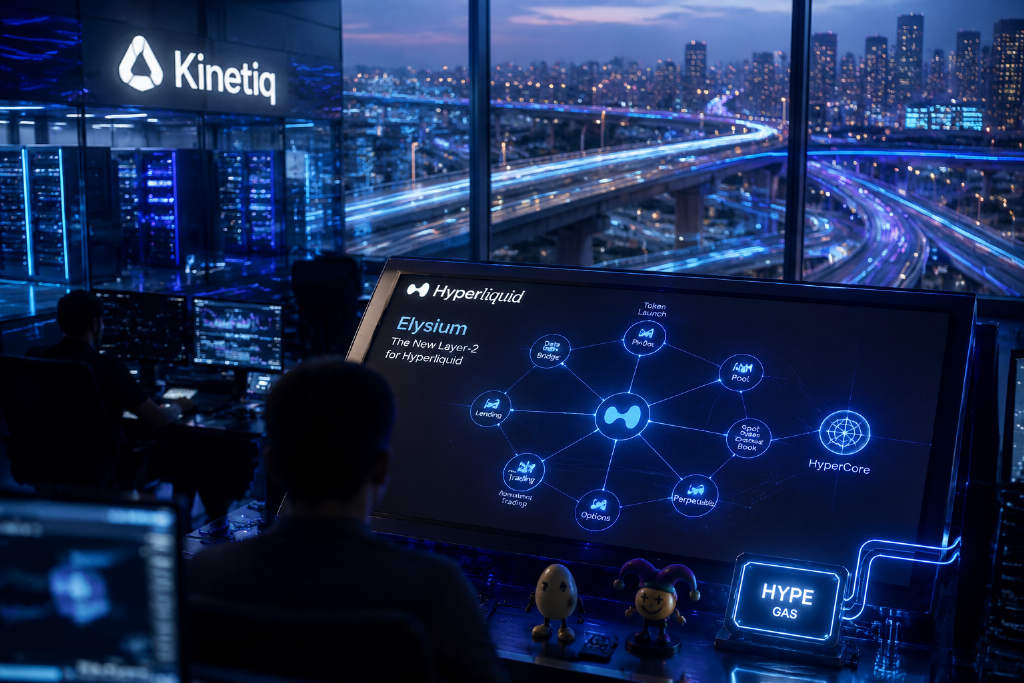
Kinetiq says that gap is large enough to build around. The protocol, which is the biggest liquid staking project on Hyperliquid, has announced Elysium, a Layer 2 for the ecosystem. After the announcement, community discussion quickly turned to KNTQ repricing, HYPE value capture and whether new applications could migrate there.
From liquid staking to base-layer infrastructure
Kinetiq first focused on the liquidity problem created by staking HYPE. Users stake HYPE through the protocol and receive kHYPE, a token that continues to accrue staking yield. That token can then move into DeFi use cases such as lending and yield strategies, letting the same asset serve both staking and liquidity roles.
Kinetiq’s TVL currently stands at about $1.214 billion. Alongside kHYPE, the protocol has also launched products including Earn, kmHYPE, Launch and Markets.
According to Kinetiq’s design outline, Elysium will continue using HYPE as gas. Users would not need to buy a second base asset to enter the new network, and any transaction demand generated on Elysium would directly add to HYPE’s utility inside the broader system.
Performance is the first major change Kinetiq is targeting. The team said Elysium is expected to launch with block speed and throughput several orders of magnitude above HyperEVM, with a longer-term goal of pushing block times closer to HyperCore. The idea is to create an execution environment that can actually support high-frequency spot trading, automated market making and applications that need constant state updates.
Elysium’s key pitch is a tighter data link to HyperCore
The more important piece may be how Elysium connects back to HyperCore.
Today, HyperEVM’s L1 Read precompile lets smart contracts read data from HyperCore, but the visible order-book information is largely limited to the best bid and ask. Elysium is supposed to extend L1 Read so developers can access richer market depth and pricing that is much closer to the top of the block.
For ordinary traders, that may sound like just a few extra levels on the book. For market makers, it changes the operating model. They could keep quoting on an AMM inside Elysium while reading HyperCore depth and prices to hedge those positions.
Kinetiq sees Prop AMMs as one of the first application types Elysium needs to attract. These AMMs quote with proprietary capital from professional market makers, so latency and hedge efficiency matter a great deal. Kinetiq said spot volume handled by Prop AMMs on Solana has long been well above HyperCore. Elysium is trying to pull in that slice of spot demand that Hyperliquid has not captured.
A full token path from launch to perps
Hyperliquid’s weakness in spot markets is not only about execution speed.
To issue a spot asset on HyperCore, a team must enter a ticker auction and build a new order book. On HyperEVM, token issuers still have to find a launch platform, an AMM and market makers on their own. Even when a new coin attracts short-term attention, it is difficult to keep pushing that liquidity into HyperCore. Spot and perpetuals may look like they belong to one ecosystem, but in practice they still run on separate tracks.
Elysium lays out a full pipeline. A new token would first launch on Elysium and use a long-tail AMM for cold start liquidity. As liquidity grows, it would move into a Prop AMM, then choose to establish a spot order book on HyperCore, and eventually list a perpetual market through HIP-3.
That structure is what Kinetiq calls a “value-accretive L2.” Ethereum Layer 2s are often criticized for retaining activity and fees that might otherwise stay on the main chain. Elysium is being presented in the opposite way: as a network that routes newly created onchain activity back into HyperCore. It uses HYPE for gas, lets assets build spot markets on HyperCore, and sends derivatives activity back through HIP-3. Under that model, a busier Elysium should translate into more trading volume for HyperCore.
KNTQ, Kinetiq’s token, also has its own value-capture design. The planned sequencer revenue split allocates 25% to applications consuming block space, 25% to the Kinetiq treasury, and the remaining 50% to buying back KNTQ on the open market and sending it to the Hyperliquid Assistance Fund for burning.
PaperTrade is one of the clearest test cases
Meme trading may be the easiest use case to understand, but it is not the one that best tests Elysium’s ceiling. A more demanding example is a new type of perp DEX such as PaperTrade, which relies on more complex settlement logic.
As described in the article, PaperTrade reads prices from the Hyperliquid order book and lets users settle profit and loss directly against a public LP pool. Trades do not enter HyperCore matching. Instead, the profit queue, LP balances and PAPER token minting logic all run in HyperEVM smart contracts.
That design depends on high-frequency state updates. Every open, close, profit-queue entry and later payout needs onchain execution. Slow confirmation and high gas on HyperEVM can damage the user experience almost immediately. There is also a competitive problem: any high-performance chain with an external price oracle could reproduce PaperTrade’s mechanics and offer lower gas plus more aggressive token incentives. PaperTrade chose Hyperliquid because of native pricing and native users, but HyperEVM performance has been weakening both advantages.
Elysium offers another route. PaperTrade could continue reading HyperCore prices, use the expanded L1 Read to access deeper order-book data, and move settlement and token logic into a faster execution environment. That would let it stay on Hyperliquid for performance while keeping its most important price source away from external oracles.
Kinetiq founder Omnia highlighted that point directly after unveiling Elysium, saying of PaperTrade: 「It has a home now.」
Kinetiq argues that similar openings could appear in options, automated trading and lending protocols that need real-time hedging. HyperCore already has active onchain traders and deep liquidity. Elysium’s job, in that framing, is to let developers run more complex financial logic right next to that liquidity instead of somewhere else.