

By Nancy, PANews
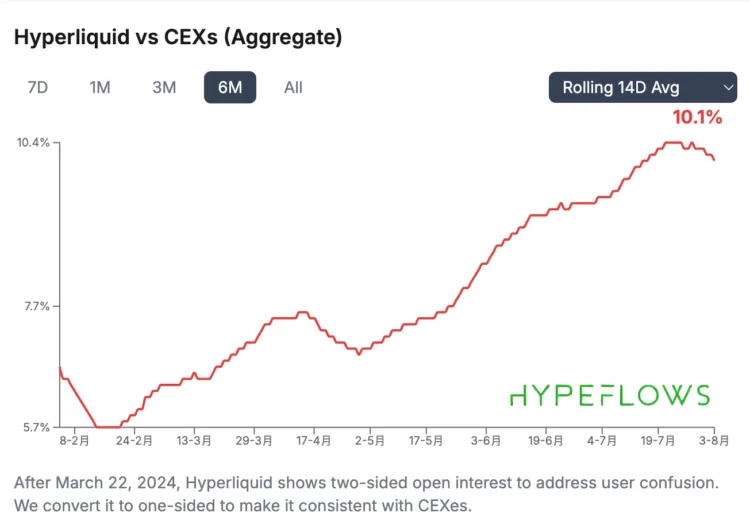
HYPE has kept pulling back since hitting a local high roughly two months ago, but Hyperliquid’s ecosystem expansion has not slowed. The report argues that the platform’s current growth is being driven less by trading in crypto-native assets such as Bitcoin and Ether, and more by rising demand for RWA-linked products under HIP-3.
RWA activity is taking a larger role in Hyperliquid’s growth
The article says the bear market has not stopped Hyperliquid from expanding quickly. What has changed is the engine behind that growth. Instead of relying mainly on crypto trading, the platform is increasingly benefiting from HIP-3 and the demand it has created for real-world-asset exposure.
According to Hypeflow data cited in the piece, Hyperliquid had reached 10.1% of the global perpetual futures market on a 14-day rolling average basis using open interest as of Aug. 3. Six months earlier, that share was 7.1%.
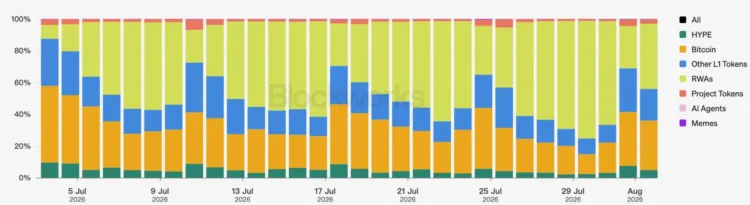
Blockworks data cited in the report shows that, as of Aug. 1, HIP-3-related RWA names made up 41% of perpetual trading volume on Hyperliquid, with the share recently rising as high as 74%. At the same time, the share of trading tied to traditional crypto assets such as Bitcoin has continued to decline. In the report’s framing, Hyperliquid’s growth model is shifting from crypto-native trading toward an on-chain perpetual market that covers stocks, commodities, and a broader set of real-world assets.
Trade.xyz leads, but HIP-3 gateway competition is intensifying
As the HIP-3 ecosystem expands, more deployers are entering the field. For now, Trade.xyz remains the market leader thanks to its head start, and the report says several of its trading metrics continue to set records.
Based on figures disclosed by the project, Trade.xyz has reached $408.4 billion in cumulative volume. Weekend turnover has topped $26 billion, and peak daily unique traders have exceeded 60,000.
Still, rivals are moving in with lower entry barriers and more differentiated strategies. Paragon is one of the clearest examples in the article.
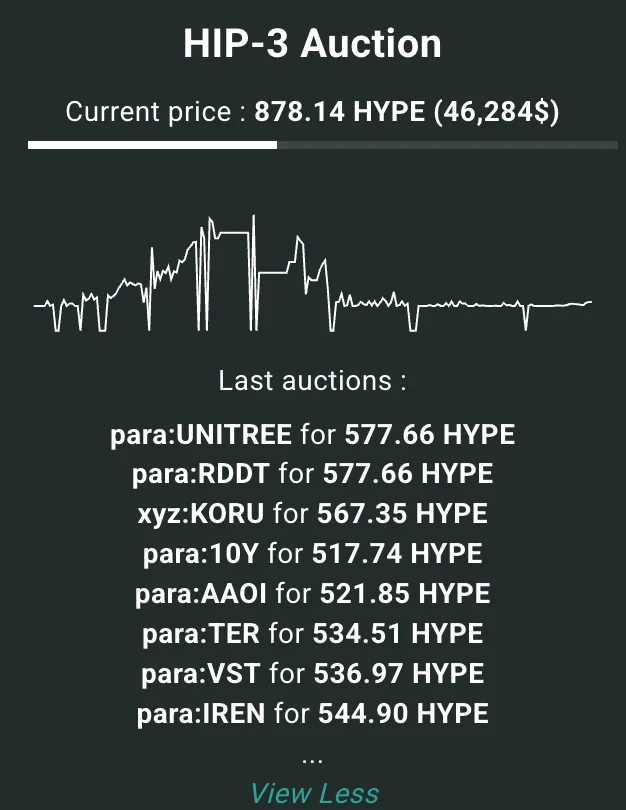
Data from hl.eco cited in the report shows that since July 15, Paragon has secured 13 tickers in a row, spending about 6,328 HYPE in total, worth roughly $333,000. Before that, ticker auctions in the HIP-3 ecosystem had been almost entirely dominated by Trade.xyz.
Paragon is leaning into AI-linked names
On asset selection, Paragon is taking a different route. The report says its recently acquired tickers span several parts of the AI supply chain, including fiber and optical module names GLW, CRDO, AAOI, and CIEN; semiconductor equipment makers LRCX and TER; storage name STX; compute and energy-related names IREN, VST, and NET; as well as more recent additions tied to the humanoid robot name Unitree and the social platform ticker DTDT.
While Trade.xyz is described as leaning more toward large-cap mainstream equities, Paragon is said to be focusing on assets that are less liquid in traditional markets but carry stronger narrative appeal and may fit on-chain perpetual trading better. The report says some community members view that strategy as a lower-cost way to secure early exposure to higher-growth themes.
Scale remains the issue. ASXN data cited in the article shows Paragon’s latest weekly trading volume at about $15.55 million, up 12.8x from early July, but still below 0.01% of Trade.xyz’s trading scale over the same period. During that time, Paragon’s weekly trader count rose from 1,260 to 12,760, while Trade.xyz’s trader count reached 18.7 million.
High staking requirements remain, but capital partnerships are lowering the barrier
The threshold for joining the HIP-3 ecosystem is also starting to come down. Previously, deployers needed to stake 500,000 HYPE, a requirement that kept some projects out. As the ecosystem develops, more teams are turning to capital and resource partnerships to reduce that cost.
One example in the report is Hyperion, described as the second-largest HYPE DAT company. It is providing support for the 500,000 HYPE stake requirement and has partnered with Skew Technologies to launch an institutional-grade perpetual futures product. According to the article, Hyperion gains equity participation in Skew and a share of listing-service revenue, while Skew avoids locking up a large amount of HYPE on its own and can focus on product development and user distribution. The report adds that the business could later expand into HIP-4-related markets.
Another financing example involves Trasia. The article says Multicoin Capital invested $1.75 million in Trasia’s seed round and became its only seed investor, while the project also received more than $35 million.
HYPE has retreated from its high as ETF flows cool and whale activity draws attention
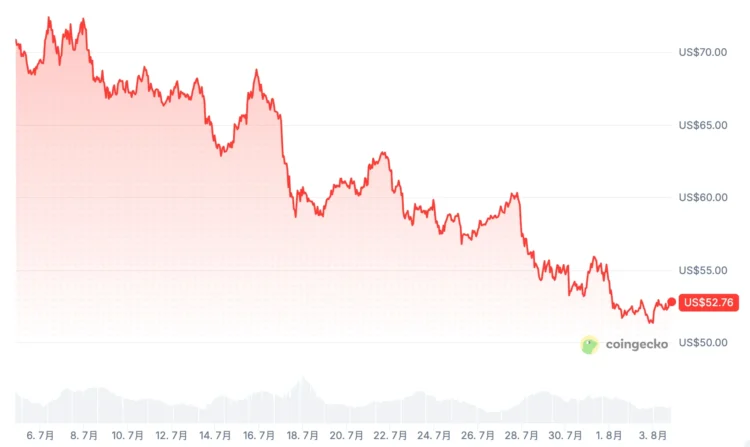
Even with the ecosystem still expanding, HYPE has not maintained its earlier price momentum. The article says the token climbed to nearly $77, its record high, in mid-June before entering a sustained pullback. CoinGecko data cited in the report shows HYPE is down 26.8% over the past 30 days.
The piece points to two main factors behind that move: weaker spot ETF flows and large on-chain activity from major holders.
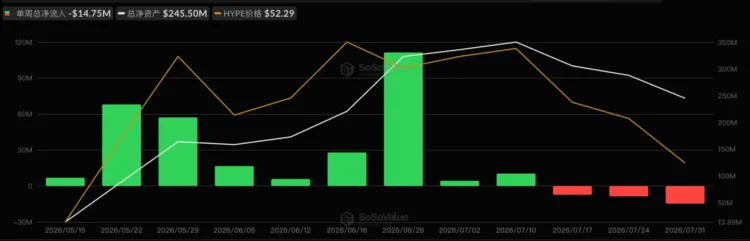
According to SoSoValue data cited in the report, inflows into HYPE spot ETFs started cooling in late June and then turned into net outflows. In the week of June 26, weekly net inflows briefly exceeded $110 million. After that, inflows kept shrinking. In July, the ETFs posted consecutive outflows, with cumulative net outflows for the month topping $15.16 million.
On-chain, several institutional wallets made large moves. Multicoin Capital unstaked 1.96 million HYPE on July 22, worth about $120 million, and sent part of the tokens to exchanges. A wallet linked to Paradigm unstaked about 2.92 million HYPE on July 24, worth around $171 million. The article also says an address tied to a16z moved about $437,830 to multiple trading platforms in mid-July, 838328383 million dollars. In addition, addresses linked to Selini Capital, Bitwise, and market maker Cumberland also transferred HYPE to exchanges, with sizes ranging from the millions to the tens of millions of dollars.
The report also stresses that such transfers do not automatically mean selling. It says Multicoin Capital co-founder Tushar Jain previously stated that the unstaking was mainly for wallet rotation and privacy management, not token sales. Selini Capital’s founder also responded that there was no dumping and that HYPE was still being used across several business scenarios. The article adds that an a16z-linked entity appeared to have bought back about $7.335 million worth of HYPE after selling higher.
Buybacks have weakened, but team unlocks are not presented as the main overhang
Beyond shifts in fund flows, the report says lower Hyperliquid revenue has reduced HYPE buyback strength and weakened short-term support. ASXN data cited in the article shows HYPE buybacks in July were about $244,000, down 72.4% from $886,000 in June.
At the same time, the report argues that team token unlocks have not created the large selling pressure the market had feared. Citing MLM, the article says that since HYPE team tokens started unlocking in December 2025, about 4.93 million HYPE has been allocated to team members. At current prices, that would be worth about $270 million, or roughly 0.493% of total supply.
Of that amount, about 1.19 million HYPE was sold on the secondary market for around $32.5 million, while another 3.14 million HYPE was transferred to OTC venues, valued at about $132 million at the time of transfer. In total, around 4.33 million HYPE was sold for roughly $165 million.
Over the same period, the assistance fund is said to have bought back about 9.8 million HYPE, spending around $364 million. That works out to roughly 1.23 million HYPE per month and about $46 million in monthly buybacks on average, a pace more than twice as fast as selling by current and former team members.
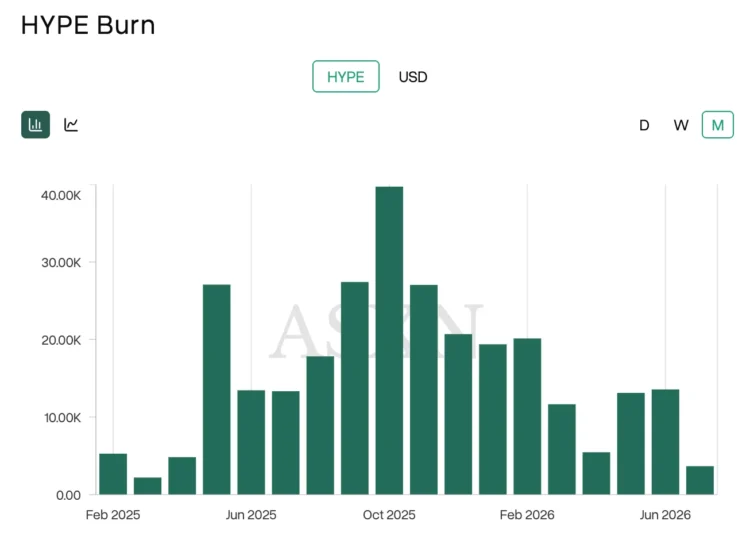
In the article’s view, the main pressure on HYPE now is not team unlocks but changes in market demand. It also says the Hyperliquid team appears to be using OTC channels more actively to reduce the impact of unlocks on secondary-market liquidity, while ongoing buybacks by the assistance fund have eased some supply pressure in circulation.
HIP-3 still has room to expand
In the near term, the article says Trade.xyz remains the clear leader in the HIP-3 ecosystem because of its liquidity, user scale, and first-mover advantage, and other deployers are not yet in a position to challenge it directly.
Over a longer horizon, though, the report says the ecosystem could grow much larger as asset coverage expands, participation costs continue to fall, and more infrastructure providers and capital enter the market. For Hyperliquid, a broader ecosystem and a wider set of listed assets could increase trading demand, strengthen network effects on the platform, and open up new room for value capture around HYPE.
The content above was excerpted and republished with authorization from PANews. The original article was first published by Blockcast.