
By Matteo
Compiled by TechFlow

Hyperliquid’s long-tail liquidity advantage is losing ground. An analysis built on 18 months of full order-book data found that dollar depth within 5 basis points of the midpoint fell 84.6% over the past year. The retreat was concentrated close to the best bid and offer, where traders are most likely to execute, rather than across the entire visible book.
The decline cannot be explained by falling token prices alone. A comparison with Binance and OKX showed that Hyperliquid lost more liquidity in the core quoting range than its peers for the same group of altcoins. Fee differences, congestion-related allocation rules and a greater concentration of near-market quotes are placing pressure on smaller market-making firms.
Binance and OKX provide the comparison
To separate market-wide weakness from a platform-specific problem, the analysis selected 86 assets that traded on the two major platforms between Nov. 1, 2025 and Nov. 1, 2026 and offered leverage of no more than 10 times. The sample was used as a proxy for long-tail altcoin liquidity.
Among 38 markets that could be compared within a 10-basis-point range, Hyperliquid’s median dollar depth declined 82%. The corresponding declines were 61% on Binance and 78% on OKX. Liquidity became thinner on all three venues, but the move on Hyperliquid was larger.
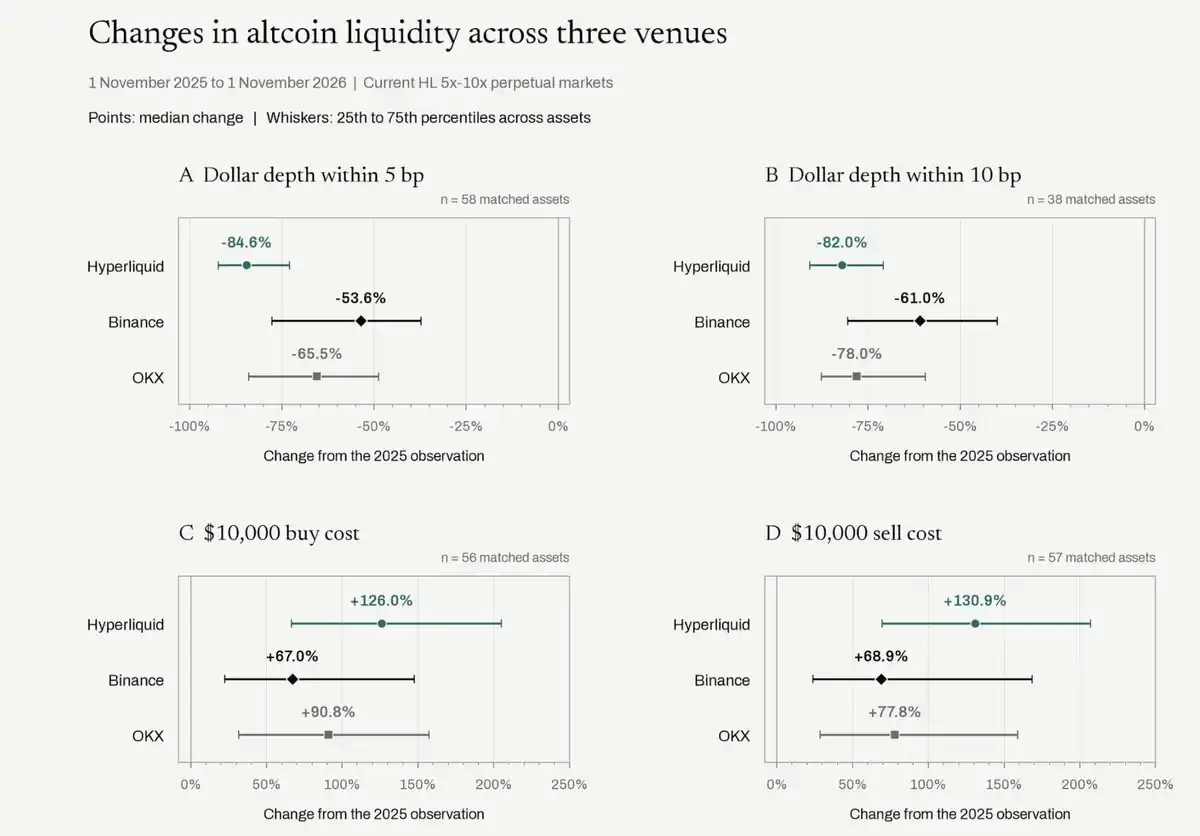
A fall in token prices can reduce dollar depth even if the number of tokens resting in the book stays unchanged. To remove that effect, the study divided each asset’s Hyperliquid depth by its Binance depth and compared the ratio one year apart. At 5 basis points, the median ratio fell 57.5%. The calculation was performed separately for each market before taking the median; it was not a direct division of the two platforms’ median figures.
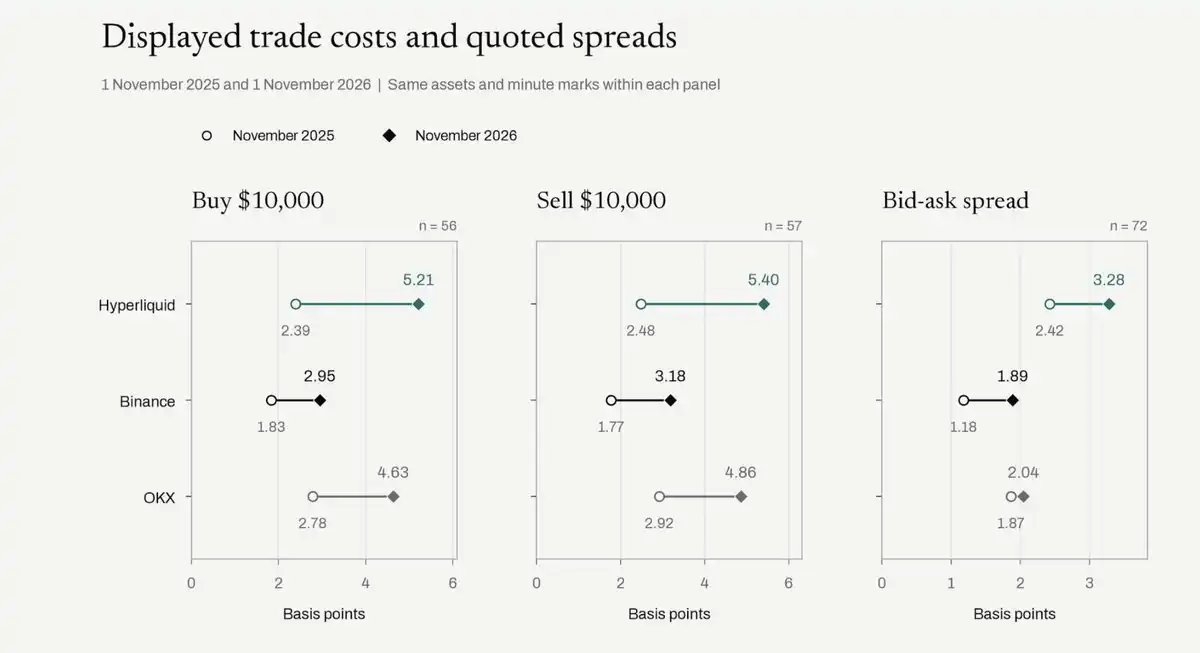
Execution costs also diverged. In the later sample, buying $10,000 through the displayed book produced a median market impact of 5.21 basis points on Hyperliquid, before fees, versus 2.95 basis points on Binance. On that order size, the quoted impact was $5.21 compared with $2.95.
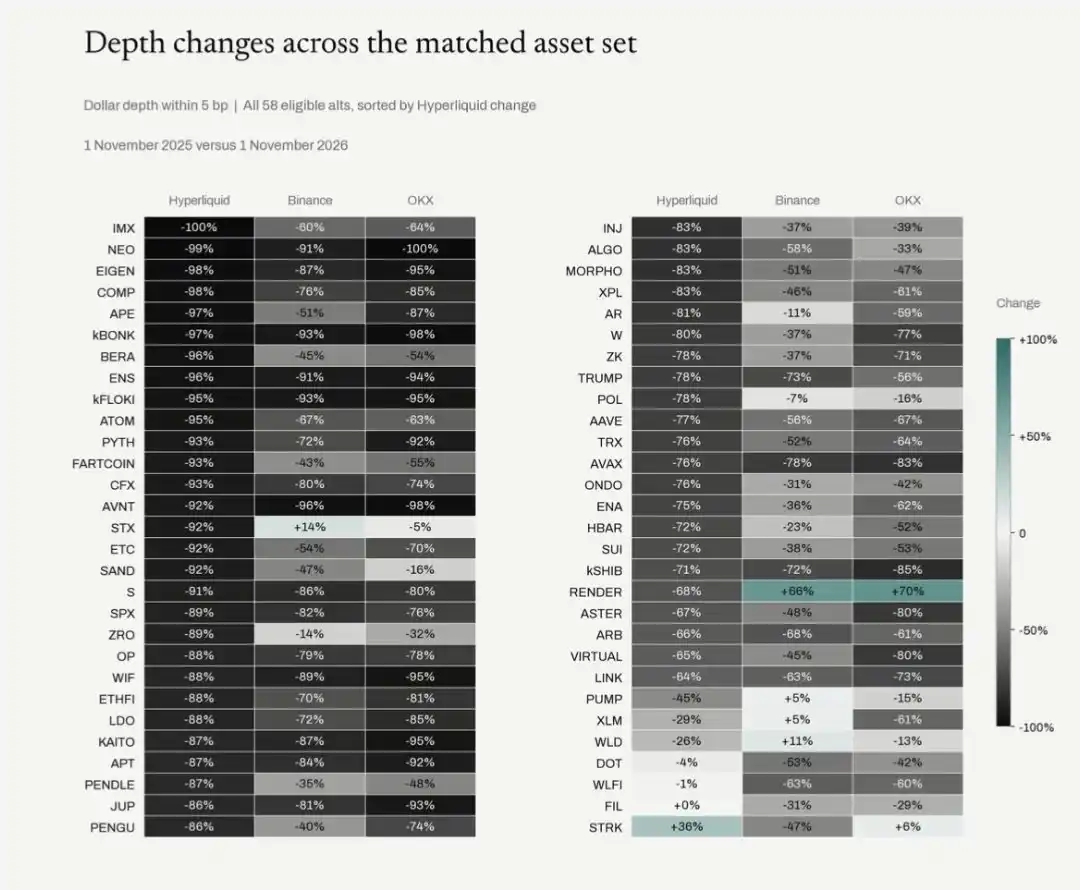
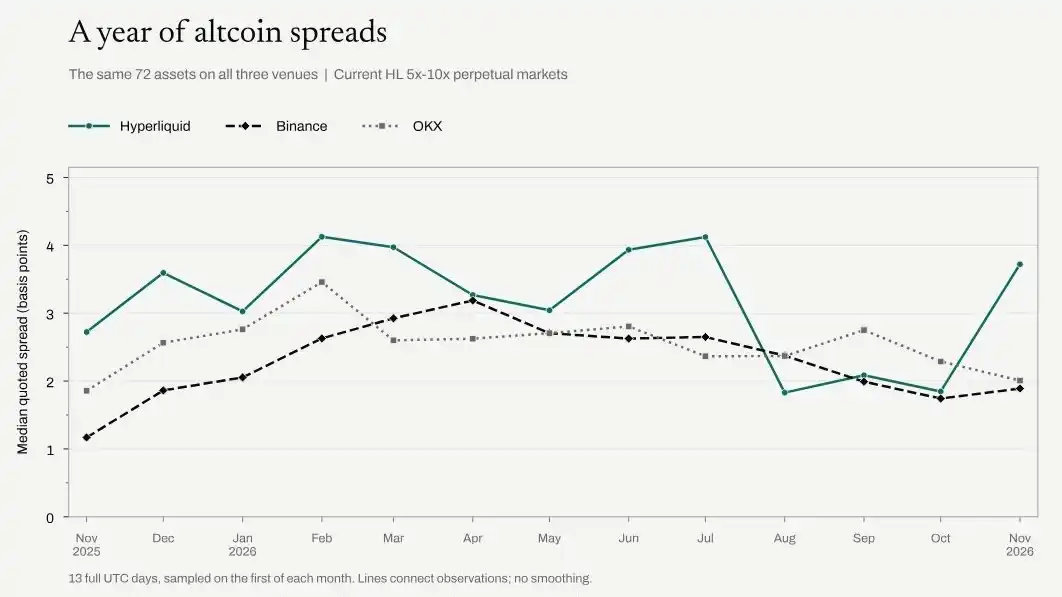
The spread data offers a less straightforward comparison. Binance’s spread widened slightly more in percentage terms, but it started from a narrower level and still ended with a narrower spread than Hyperliquid. A separate heat map covered 58 matched altcoins and ranked them by the decline in Hyperliquid’s dollar depth within 5 basis points.
The missing liquidity is concentrated near the midpoint
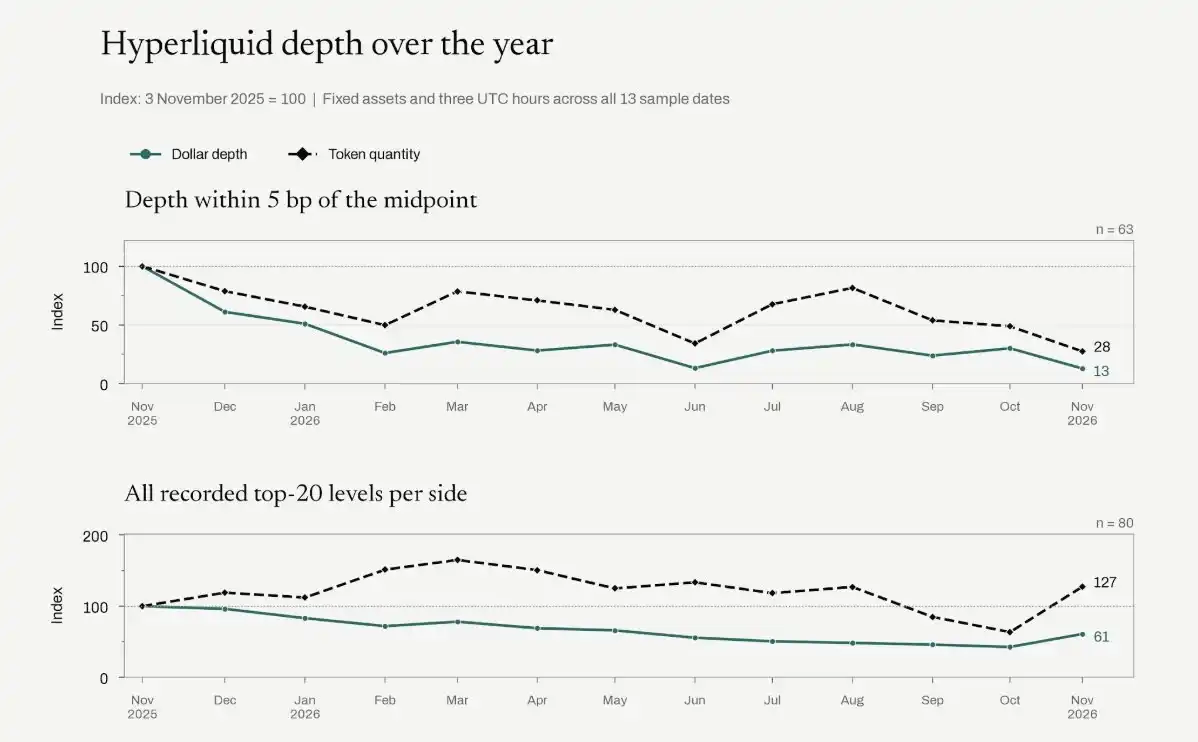
Dollar-denominated depth can make an order book look weaker than it is when token prices fall sharply. The study therefore tracked both dollar depth and the number of tokens quoted. Its Hyperliquid time series held the asset set and observation period constant across 13 sampling dates. The 5-basis-point panel covered 63 markets, while the broader first-20-level panel covered 80.
The selection criteria for this series were stricter than those used in the two-date cross-platform comparison. The final values in the chart therefore cannot be substituted directly for the earlier centralised-exchange comparison.
Each market was assigned a starting index of 100 in November 2025. One year later, the median dollar-depth index within 5 basis points had fallen to about 13, while the token-quantity index stood at 28. Even after removing the effect of token prices, most of the orders near the centre of the book had disappeared.
The picture changed when the observation range was expanded to both sides of the first 20 levels. The final median dollar-depth index was 61 and the token-quantity index was 127. The typical market therefore had more tokens quoted across the wider range than it did a year earlier. The sharp reduction was near the best bid and offer.
There is still size in the order book, but much less of it is sitting where an immediate trade would normally occur.
Recent improvement has appeared farther from the market
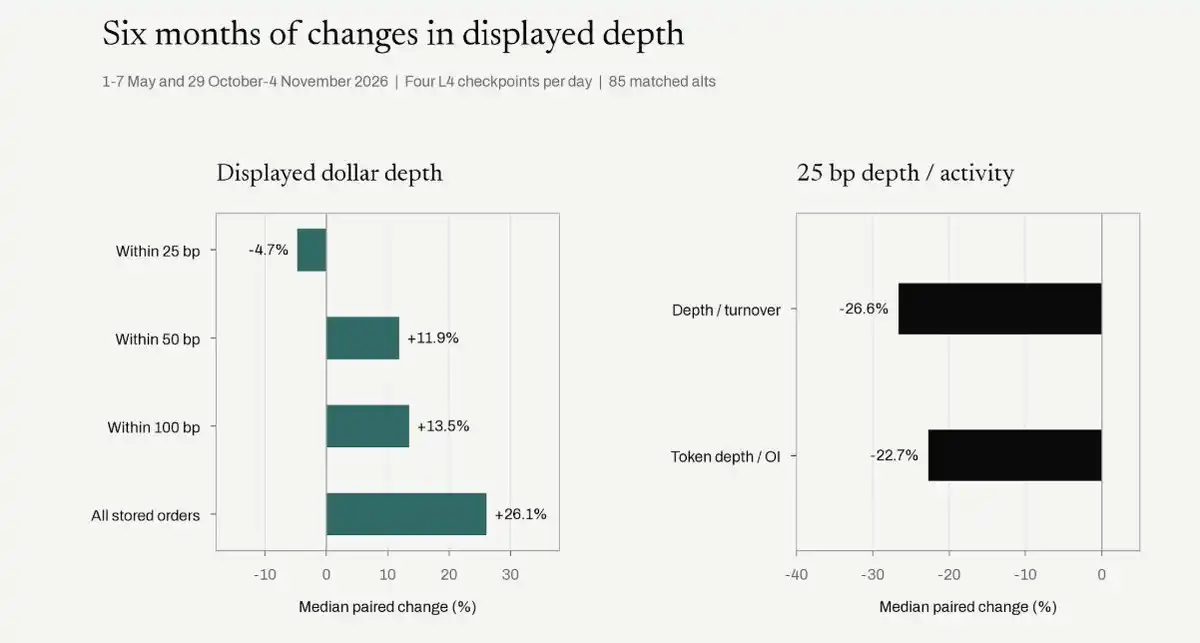
Across the past six months, Hyperliquid’s depth improved to some extent. The improvement was concentrated in wider ranges away from the midpoint rather than in the area next to the best bid and offer. The analysis compared dollar-depth changes for 85 matched altcoins from early May through late October and early November 2026, along with the changes in the ratio of 25-basis-point depth to trading volume and open interest.
The spread curve over the past year provides another detail. Hyperliquid had been steadily closing the gap with Binance and OKX, only to diverge recently. The available data does not establish whether this is a lasting turning point or a short-lived episode. The order-book pattern does match the recent increase in market concentration described in the analysis.
The largest market maker did not take all the volume
To examine the structure of competition, the study grouped each main account with its explicitly linked subaccounts. That avoided counting one account family several times and allowed related groups to be identified without knowing which institution controlled them.
The initial hypothesis was that a small number of large market makers had absorbed most trading activity. The year-on-year volume data did not support it. Across the same 80 markets, the median share of executed resting-order volume held by the largest account family fell from 25.2% in one week a year earlier to 14.6% in a recent week.
The full-year depth decline therefore cannot be attributed simply to one market maker dominating the venue. The shorter recent window, however, showed a more concentrated shift.
Using the 72 matched assets from the spread comparison, the study compared Oct. 8-14 with Oct. 31-Nov. 6. The median share of depth within 25 basis points held by the largest account group rose from 34.5% to 38.6%, while the median quoted spread widened from 2.13 basis points to 3.55 basis points. The change became visible around Oct. 30.
The period also included Binance’s security incident on Oct. 29. The curves alone are not enough to assign the move to priority fees or network congestion. Account-level data showed that one large liquidity provider sharply reduced its quotes around Nov. 3, after which several other account families took over part of the share. That may be another explanation for the recent change, but it requires more observation.
Fee tiers create a structural disadvantage
The fee schedule adds a basic disadvantage for smaller firms. Historical maker fees were measured across 54 account families and weighted by trading volume. The lowest-volume quartile paid 0.961 basis points, while the highest-volume quartile received a 0.236-basis-point rebate.
Before hedging costs and adverse selection are included, the smaller group was already carrying a gap of about 1.20 basis points. That is a significant burden in a market where the total spread is often only a few basis points.
The number of quoting account families also fell. Across the same 72 markets, the median number of account families placing at least $1,000 on each side within 25 basis points dropped from 7.64 during Oct. 8-14 to 6.39 during Oct. 31-Nov. 6.
After recalculating with token prices held constant, 58 of the 72 markets still showed a decline in active market-making accounts. The reduction therefore remained visible after the effect of token selling and lower prices was removed.
HIP-4 also depends on smaller market makers
Network congestion creates another obstacle. Hyperliquid’s current congestion-limiting rules allocate capacity according to an address’s weighted resting-order share on the previous UTC day. During periods of heavy congestion, an address can use block space equal to twice that share.
The mechanism can create a circular problem: an account needs volume to receive capacity, but it needs capacity to generate volume. Traders active in HIP-4 markets have said that they cannot quote normally when Hyperliquid becomes congested.
Those smaller firms are already supplying a large part of the available liquidity. In a sample of 256 HIP-4 contracts taken on Nov. 10, just four professional market-making wallets provided 47% of the displayed depth within 25 basis points of the midpoint.
The markets are still relatively small, but most binary-option markets begin at that scale. If Hyperliquid wants a liquid long-tail prediction-market ecosystem, smaller market makers must be able to keep quoting.
The analysis’s central argument is that deep long-tail liquidity was one of the main reasons traders chose Hyperliquid. In the matched-market comparison, that advantage has weakened against Binance. Preserving a competitive order book will require enough market-making teams to afford the cost of quoting.
If firms outside the largest market makers continue to struggle, Hyperliquid risks giving up the liquidity advantage it built in the long-tail market. For HIP-4 to develop, smaller market makers need a stable and reliable environment from the start, and the rules need to leave room for them to participate.



