
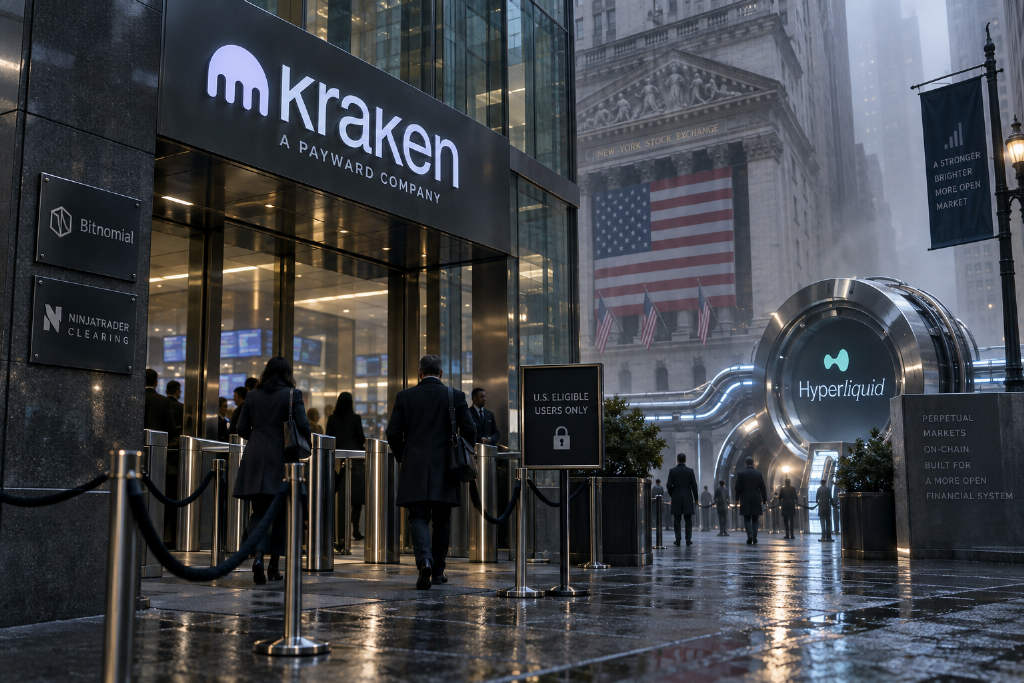
Payward, the parent company of Kraken, formally disclosed on Sept. 16 how it plans to work with Hyperliquid and how that structure could bring part of Hyperliquid’s product stack into the United States.
According to the announcement, Payward plans to use its exchange and clearing firm Bitnomial and futures broker NinjaTrader Clearing to build a custom perpetual futures market on the Hyperliquid mainnet through HIP-3, then offer access to eligible U.S. users.
How the arrangement is set up
Payward is not introducing Hyperliquid in its entirety into the U.S. market. Instead, it is starting with HIP-3 and deploying a permissioned perpetuals venue on Hyperliquid’s public chain for U.S. users.
Under the structure described in the announcement, Bitnomial, which is regulated by the Commodity Futures Trading Commission, will deploy the HIP-3 market on Hyperliquid and take charge of market creation, ownership, administration, as well as contract clearing and settlement. NinjaTrader Clearing, also under Payward and registered with the CFTC as a futures broker, will manage U.S. customer accounts. Each entity will carry the compliance and regulatory obligations tied to its role.
Trading itself would still occur on Hyperliquid’s public blockchain. Orders would continue to be matched and recorded through Hyperliquid’s onchain order book. What changes for U.S. users is the access layer: accounts, clearing arrangements, and compliance would be handled by regulated Payward entities.
Payward said U.S. customers would be able to open futures accounts through its registered broker and then trade these new perpetual futures contracts on Hyperliquid. The products would launch under Bitnomial’s rules once they receive regulatory approval.
In practical terms, the arrangement creates a way to fit Hyperliquid’s blockchain and trading infrastructure into the existing U.S. framework for regulated derivatives. Hyperliquid supplies the base chain, order book, and trading rails. Payward and its regulated affiliates supply the broker, customer account, clearing, and compliance side.
Signals had been building for weeks
The first public clue about Hyperliquid’s path into the U.S. market dated back to a White House speech by Donald Trump last month. Before that, Hyperliquid’s offshore profile had often been treated as a weak point from a compliance perspective. Trump said that “Michael (CFTC Chair Michael Selig) is also working to help Hyperliquid enter the United States in a fully compliant and lawful way,” which set off fresh speculation about how such an entry could actually happen.
The day after Trump’s speech, Blockworks analyst Shaunda Devens reported that a deployer called “Kraken HIP-3 test DEX” had enabled permission management, or Star gating, on the Hyperliquid testnet and had begun testing on Aug. 19. Devens said that pointed to Kraken as a possible early U.S. centralized exchange partner for Hyperliquid.
Then, on Sept. 1, Bloomberg reported that Hyperliquid was in advanced talks with Payward. If the partnership won regulatory approval, U.S. users would be able to trade perpetual contracts via Bitnomial that track the prices of certain tokens on the Hyperliquid blockchain.
Payward’s Sept. 16 statement was the first formal confirmation of the structure.
What U.S. users still cannot do
The announcement also made clear that there are sharp limits on what this U.S. rollout covers.
First, Hyperliquid’s open trading model does not carry over to the U.S. in the same form. Payward said only accounts that pass NinjaTrader review and are placed on both the NinjaTrader and Bitnomial whitelists will be allowed to trade in these markets.
That means U.S. users will not be able to simply enter Hyperliquid and trade freely the way users in other regions can. They must first come through a regulated account structure.
Second, the disclosed scope covers only the HIP-3 market deployed by Bitnomial, not the full set of perpetual contracts already live on Hyperliquid mainnet.
Even if the products are approved, the range of assets U.S. users can trade, the leverage they may use, and whether they can later access other Hyperliquid markets will depend on Payward, Bitnomial, and the U.S. regulatory framework rather than on the Hyperliquid protocol alone.
The description in the source frames the arrangement as a compliance-only zone built by Payward on top of Hyperliquid. What has been opened here is a connection between U.S. regulation and Hyperliquid’s onchain trading infrastructure, not a full opening of Hyperliquid to the U.S. market.
CLARITY stalls, agencies keep moving
The same day Payward detailed Hyperliquid’s U.S. route, another development pointed to the limits of broader legislative progress. In the early hours of Sept. 16 Beijing time, the U.S. Senate failed to advance the CLARITY Act in a procedural vote, with the tally ending 49-50.
The bill had aimed to clarify the regulatory boundaries for digital assets through congressional legislation and to divide oversight responsibilities between the Securities and Exchange Commission and the CFTC across different digital asset markets.
Still, the report notes that regulatory movement in the U.S. has not stopped at the agency level. This year, the SEC and CFTC have continued to define parts of the regulatory perimeter for digital assets and derivatives through interpretations, guidance, and no-action letters.
Viewed together, the two developments show a market where full congressional rules are still not in place, yet regulators are already using existing authority to carve out workable paths for products such as onchain trading and perpetual contracts.
For Hyperliquid, the Payward deal is one example of that approach. Rather than waiting for a new statute to open the U.S. market, it is trying to enter through existing licenses and infrastructure at Bitnomial and NinjaTrader, fitting onchain trading into a framework current rules can accommodate.
So the better way to describe this step is not that Hyperliquid has fully entered the United States. It has found a route it can try. How far that route goes will still depend on regulatory approval, the eventual range of tradable assets, and the shape of the U.S. crypto market that emerges next.