
Hyperliquid is setting fresh records in trading activity, but the share of fees the platform can actually keep is shrinking.
On July 13, leveraged positions held on Hyperliquid, or open interest, climbed above $11 billion, the platform’s highest level in 2026. Over the past 30 days, total perpetual futures volume came in near $178 billion. Counting centralized exchanges as well, Hyperliquid now handles about 9% of global perpetual open interest, up from less than 7% at the end of May.
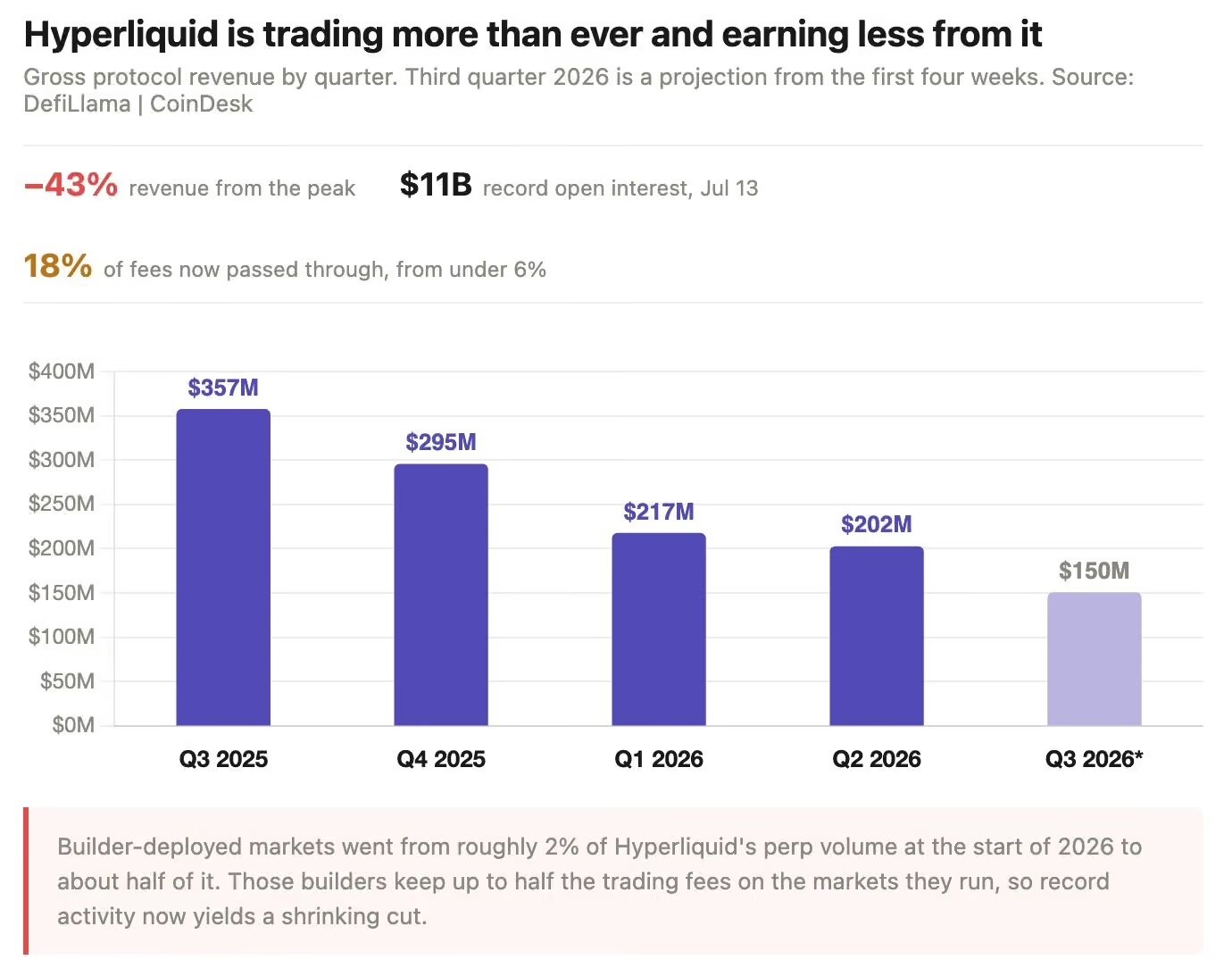
Revenue, though, has been moving the other way. DeFiLlama data shows Hyperliquid protocol revenue peaked at about $357 million in the third quarter of 2025, then fell to $295 million, $217 million and roughly $202 million in the second quarter of 2026. That leaves revenue down 43% from the peak even as transaction counts continue to rise.
HIP-3 changed where fee income goes
Hyperliquid Improvement Proposal HIP-3 helps explain why the exchange is no longer keeping the full benefit of its own growth. Since October 2025, anyone staking 500,000 HYPE, worth roughly $28 million at current prices, has been able to deploy a perpetual market on Hyperliquid’s order book and keep as much as half of the trading fees.
At the start of 2026, markets launched by outside developers accounted for only 2% of Hyperliquid perpetual volume. That share is now close to 50%. The business has expanded, but a larger portion of fee income no longer stays with the platform.
The revenue mix makes that clear. Fees paid directly to developers, market makers and the platform liquidity vault represented just 6% of total revenue in the second quarter of 2025. One year later, that share had reached 18%.
In the second quarter alone, developer fee revenue generated through front-end routers such as Phantom was about $16 million. That amount flowed out in full as an expense and did not remain with Hyperliquid.
RWA perpetuals are driving the volume surge
Much of the new trading demand has come from products listed by third-party markets, especially real-world asset, or RWA, perpetuals. Contracts linked to crude oil, gold, Nvidia, Tesla, Nasdaq 100 trackers and even private companies such as SpaceX pushed open interest in that segment to a record $3.6 billion this month. That made it larger than bitcoin and the biggest market on the platform.

From July 13 to July 19, tokenized stock and commodity contracts generated $25 billion in volume, or 52% of the week’s total, the first time they overtook crypto perpetuals. These contracts are settled in stablecoins and have no expiry, which means they can trade over the weekend even when the New York Stock Exchange is closed. For someone looking to trade a leveraged Nvidia contract at 2 a.m. on a Sunday, there are few comparable options elsewhere.
Growth is concentrated in one deployer
That expansion is heavily tied to a single participant. Trade.xyz accounts for more than 90% of open interest under the HIP-3 model. In practice, that means many of Hyperliquid’s strongest metrics depend on one deployer’s oracle choices, margin settings and risk controls.
The weakness in that structure surfaced last Monday. A large trade on a thinly traded exchange before the Korean market open caused Trade.xyz’s SK Hynix contract to plunge 19%, triggering widespread liquidations. The firm later agreed to compensate affected users.
Lower retained revenue also means weaker buybacks
Hyperliquid sends about 97% of trading fees to its assistance fund, which buys back and burns HYPE on the open market. So far, about 44.5 million HYPE has been burned from total supply.
Because the size of those buybacks is tied directly to platform earnings, lower revenue has reduced that support. In the third quarter of 2025, the fund bought back nearly $290 million worth of HYPE. In the second quarter of 2026, the figure was about $149 million, almost half as much.
CoinDesk data shows HYPE traded near $55 last Friday, down 5% on the week. Against its record high of about $77 on June 16, the token was down roughly 28%. Based on annualized earnings of about $785 million, HYPE was trading at around 16 times circulating market cap earnings and about 70 times fully diluted earnings.
Over the past month, institutional holders including Multicoin Capital and Bitwise have transferred large amounts of HYPE to exchanges.
The ecosystem remains concentrated in HYPE
Hyperliquid’s broader ecosystem is still thin. Among the 48 Hyperliquid ecosystem tokens tracked by CoinGecko, almost all of the value is concentrated in HYPE. The second- and third-largest assets are Ethena’s USDe and USDT0, at about $4.5 billion and $4 billion, both externally issued stablecoins connected through cross-chain routes.
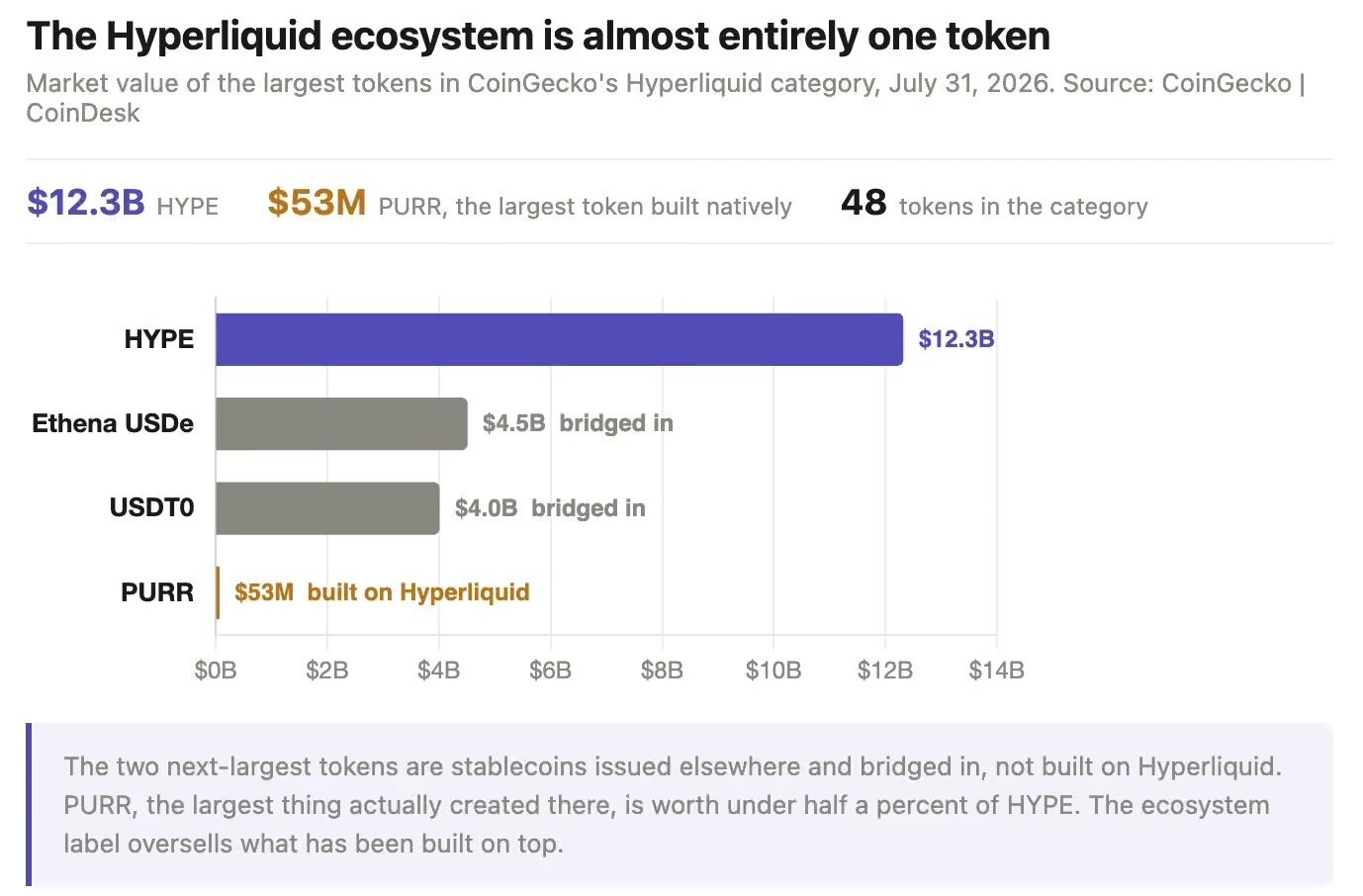
The largest native token issued on the platform is PURR, with a market capitalization of just $53 million, less than 0.5% of HYPE’s market value. That leaves HYPE’s valuation tied mainly to Hyperliquid’s exchange model rather than to a deep base of native applications.
Unlocks, fund flows and regulators are adding pressure
Token supply is also set to rise. On Aug. 6, nearly 10 million HYPE is scheduled to unlock for core contributors, worth about $550 million at current prices. Additional unlocks are set to continue monthly through 2027, while circulating supply stands at 222 million HYPE.
In the week ended July 17, the HYPE spot ETF posted its first weekly net outflow since launch, with about $7 million leaving the product after nine straight weeks of inflows.
Regulatory attention is picking up as well. The Monetary Authority of Singapore, or MAS, added the platform to its investor alert list in late June. The U.K. had already issued a risk warning. Executives at CME and ICE have also urged the U.S. Commodity Futures Trading Commission to review Hyperliquid’s commodity perpetuals business.
Competition is emerging from outside crypto-native venues
Pressure is also coming from a less expected direction. One month after Robinhood launched Robinhood Chain, the daily cleared volume of its meme-coin-focused decentralized exchange segment rose above $600 million. By some measures, its daily speculative trading activity has already surpassed Hyperliquid.
That does not mean Hyperliquid has failed. ARK research says Hyperliquid and Pump.fun together accounted for 67% of total crypto app revenue as of July 31. Grayscale has also compared Hyperliquid to Amazon Web Services, arguing that outside developers build on top of the platform while the platform takes a cut from all transactions.
Still, the comparison also points to the current problem. In the first four weeks of the third quarter of 2026, Hyperliquid generated about $45 million in total revenue. If that pace holds, quarterly revenue would come in near $150 million, which would mark a fourth straight quarterly decline and weaken the buy-side support for HYPE further.