


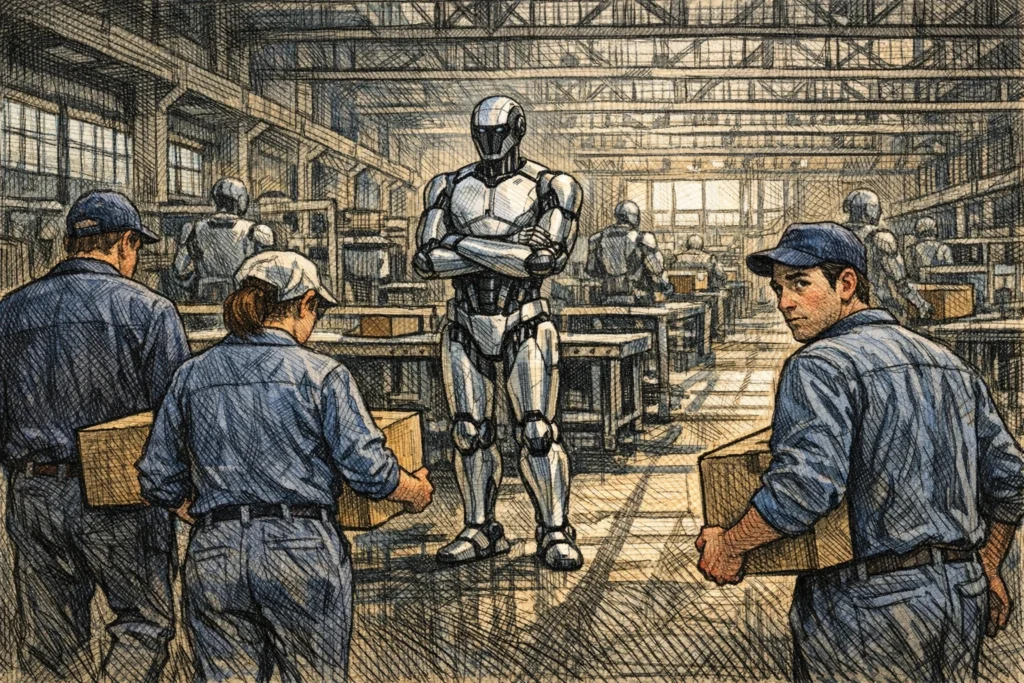
Hyundai Motor’s labor union has begun a partial strike at the company’s Ulsan complex after negotiations with management collapsed, with workers protesting the planned rise of humanoid robot automation tied to Atlas. The Wall Street Journal described it as the first stoppage in auto industry history in which workers directly walked out over a humanoid robot issue.
At the center of the dispute is a cost calculation that has unsettled the union. One Atlas robot is estimated to cost about $130,000 and could pay for itself in roughly two years. If the price falls to $100,000, its operating cost could drop below the U.S. federal minimum wage of $7.25 an hour. For workers, the bargaining table is no longer only about management. It is also about a machine that does not tire and does not ask for a raise.
Workers cut shifts short for three straight days
Hyundai’s Ulsan complex is the company’s largest single production base worldwide. Any disruption there can affect more than one factory’s output and can ripple through the broader supply chain.
From July 13 to 15, day-shift and night-shift workers at Ulsan ended work two hours early each day in a protest over the issue. According to The Korea Times, the two sides went through 15 rounds of negotiations without reaching an agreement. The union plans to intensify the action from July 20 to 22 with four-hour partial stoppages each time.
The tension had been building since Hyundai Motor Group unveiled the latest version of Atlas earlier this year. Built by Boston Dynamics, the bipedal robot stands more than 6 feet tall, can lift more than 100 pounds, and has reached a level of agility that the report said is close to human capability.
No Atlas units have been deployed at Ulsan
The strike is taking place before any large-scale production deployment of Atlas. The report said Hyundai has not actually installed a single Atlas unit at the Ulsan complex, and the earliest planned rollout in a U.S. plant is not until 2028.
That makes this a preemptive labor response. The union is not protesting jobs already lost to robots. It is trying to place pay and employment protections on the negotiating table before mass deployment begins.
Hyundai plans more than 25,000 Atlas robots across factories
According to The Korea Herald, Hyundai plans to deploy more than 25,000 Atlas robots across multiple Hyundai and Kia plants, starting with U.S. factories in 2028. A timeline for other regions has not been disclosed.
Another major development is Hyundai’s move to take full ownership of Boston Dynamics, the maker of Atlas, from SoftBank. Reuters reported that the transaction was finalized on July 16.
That would leave Hyundai not only as a buyer of humanoid robots but also as their manufacturer, giving the automaker direct control over pricing power and production timing.
Analyst estimates sharpen labor concerns
Bloomberg cited Samsung Securities analyst Esther Yim, who estimated that each Atlas robot costs about $130,000 and can break even after around two years of operation.
Macquarie Securities analyst James Hong said that if the cost falls to $100,000, the actual operating cost of the robot could slip below the U.S. federal minimum wage of $7.25 an hour. That would place it well under the effective wage level of ordinary auto workers.
For the union, the issue is not only job replacement. It is also the possibility that robots could reset the floor for what companies treat as a reasonable labor cost.
The union is asking for income protection, not a robot ban
The Hyundai Motor union, which represents 39,000 workers in South Korea, has not called for a ban on robots. Its demands are to switch production-line workers from hourly pay to fixed salaries, extend the retirement age from 60 to 65, and secure higher bonuses.
In practical terms, the union wants a pay structure that would shield workers from income losses if automation reduces their hours.
Humanoid robots are becoming a common bet across automakers
The report said Hyundai is not alone in facing this issue. Tesla’s Optimus, Mercedes-Benz, BMW, Toyota, and BYD were all named as major automakers investing heavily in humanoid robots and AI-driven automation.
The Ulsan strike has brought a broader industry tension into plain view: the push to make humanoid robots part of real factory procurement plans, not just a future concept.