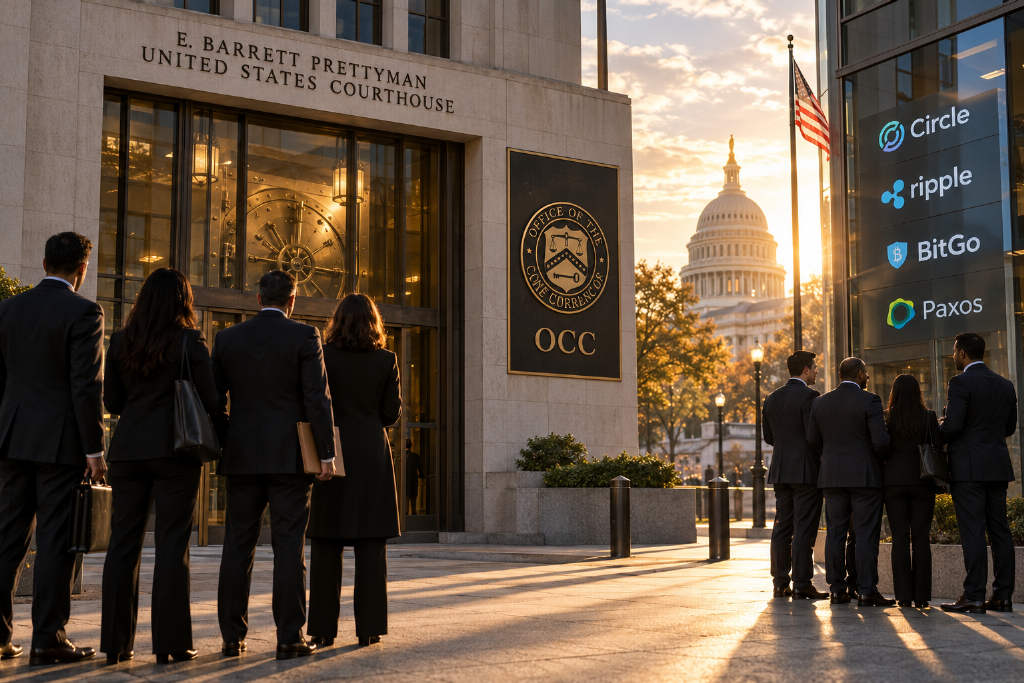
The Independent Community Bankers of America, or ICBA, has sued the Office of the Comptroller of the Currency over rules that allow crypto companies including Circle, Ripple, BitGo and Paxos to obtain national trust bank charters. The group argues Congress never intended the charter to serve as a backdoor for crypto firms to gain the credibility associated with a federal bank charter while avoiding requirements such as deposit insurance. In the lawsuit, ICBA asked the U.S. District Court for the District of Columbia to declare the OCC’s final rule and Interpretive Letter 1176 unlawful. The filing comes after Circle, Ripple and other companies received final OCC approval in recent months to establish national trust banks, according to CryptoPotato as cited by Techub.
The Independent Community Bankers of America (ICBA) has sued the Office of the Comptroller of the Currency (OCC), challenging rules that let crypto companies such as Circle, Ripple, BitGo and Paxos obtain national trust bank charters.
ICBA said Congress never intended national trust charters to become a backdoor for crypto firms to gain the credibility of a federal bank charter while sidestepping requirements including deposit insurance.
Lawsuit targets OCC rule and Interpretive Letter 1176
The suit asks the U.S. District Court for the District of Columbia to declare the OCC’s final rule and related Interpretive Letter 1176 unlawful.
In the past several months, Circle, Ripple and other companies have already received final OCC approval to establish national trust banks, according to CryptoPotato as cited by Techub.
This article was originally published by Bit.Fan. For more cryptocurrency news and market insights, visit www.bit.fan. Disclaimer:
The market information, project data, and third-party content displayed on this platform are for industry information sharing only and do not constitute any form of investment advice or return commitment.
Cryptocurrency trading carries high risks. Users should fully assess their risk tolerance and make independent decisions. All profits, losses, and legal responsibilities are borne by the users themselves.