
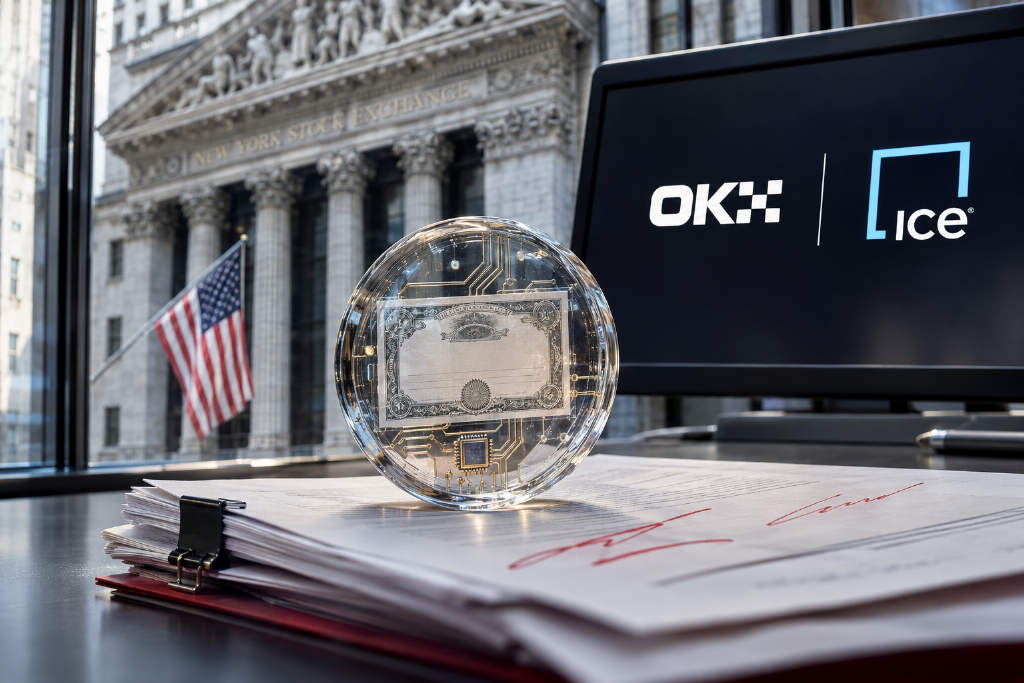
Intercontinental Exchange (ICE) and OKX plan to launch their tokenized stock venue on Nov. 23, the companies said Wednesday. The platform, called OKXICE, is expected to list more than 70 assets under a temporary U.S. Securities and Exchange Commission exemption. At least 67 issuers have already submitted written objections, including Apple, Tesla and Meta.
OKX said the proposed listings include securities from Better.com, BitGo, Circle, Coinbase, Robinhood, Securitize and Strategy (MSTR). The venue is also expected to offer 59 exchange-traded funds from Direxion. Strategy plans to list preferred shares such as STRC alongside its common stock. The companies did not disclose how many of the more than 70 assets will trade on the first day, or how much liquidity will be available in the pools at the open.
Launch access limited to eligible U.S. customers
Access at launch will be limited to eligible U.S. customers of OKX Inc. Customers must activate a CeDeFi Wallet, pass identity checks and complete onboarding with the joint venture. ICE and OKC USA Holding Inc., an OKX affiliate, each own half of OKXICE. Trading will run around the clock through the OKX app.
Former New York Gov. Andrew Cuomo will co-chair OKXICE with Trabue Bland. Cuomo said in the announcement: “The future of finance is onchain, and we have an opportunity to build it here in America, with the standards, safeguards and ambition that investors expect.”
The companies also said the venue is not a registered exchange or broker-dealer and has not been approved by the SEC.
AMM pools will handle trading on X Layer
Trading will run through automated market maker pools built on Uniswap v4 and deployed on X Layer, the Ethereum layer-2 network operated by OKX. Only approved wallets can trade or add liquidity. Securitize will provide the tokenization infrastructure.
Each token represents a security entitlement backed one-for-one by a U.S. share held by a registered broker-dealer, according to the venue. Holders retain the usual shareholder rights, including dividends, voting and corporate actions. The terms were set out in a public notice published on Nov. 5 as required under the exemption.
Customers will hold the tokens in their own wallets. OKXICE will not custody the assets or the private keys. The tokens will be paired with payment stablecoins such as USDC and USDG. The notice said the venue will not operate an order book, extend credit or conduct primary offerings.
Objections rise from 50 to 67 issuers
The Nov. 5 notice listed 67 issuers that had sent written objections by that date. The list included Apple, Amazon, Tesla, Meta, Netflix, Nvidia, Microsoft, JPMorgan, Goldman Sachs, Costco, Nike and Home Depot. The Oct. 30 notice had listed 50 objectors.
The objections relate to the SEC’s five-year “Innovation Exemption,” issued on Sept. 17. The exemption allows tokenized securities venues to trade blockchain versions of U.S. stocks through automated market makers without registering as exchanges. If an unaffiliated third party tokenizes a company’s stock, the venue must notify the issuer. The issuer then has 30 days to object in writing.
The SEC’s Innovation Exemption page lists OKXICE TSV as having submitted a notice of intent on Oct. 4. The issuers highlighted by the companies are mostly linked to the crypto sector. Strategy, described in the announcement as the largest public bitcoin treasury company, is expected to list both its common stock and preferred shares.
“Tokenization on the OKXICE TSV is a natural next step toward making Digital Credit accessible to investors around the world, 24 hours a day, seven days a week,” Strategy President and Chief Executive Phong Le said in the announcement. He referred to preferred shares such as STRC and also called bitcoin “Digital Capital.”
A tokenized stock is a blockchain token backed one-for-one by a real share. Under the SEC’s Innovation Exemption, the venue can list these tokens without the issuing company’s consent unless the company objects within 30 days.
The venue is scheduled to open in 12 days. The immediate question is whether a platform that has lost Apple, Tesla, Nvidia and most of the other largest U.S. companies can attract enough trading to matter when it opens, and whether more issuers will object before then.
Source: Bitcoin Magazine. Written by Micah Zimmerman.



