
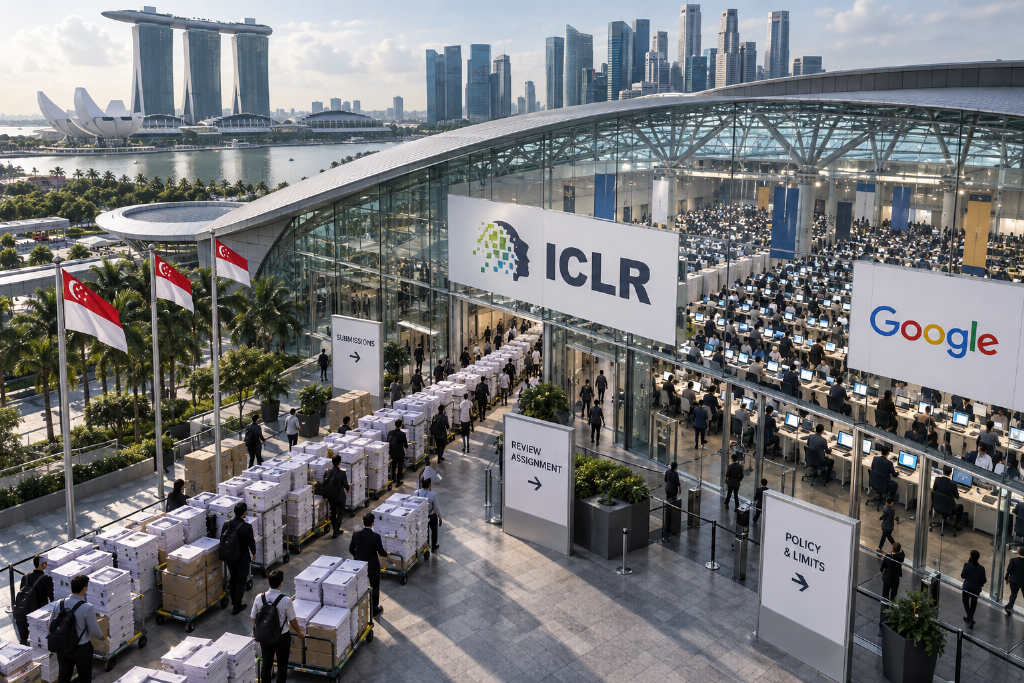
ICLR 2027 has recorded more than 60,000 abstract submissions, a single-cycle total that is higher than the combined submission count for ICLR from 2013 through 2026.
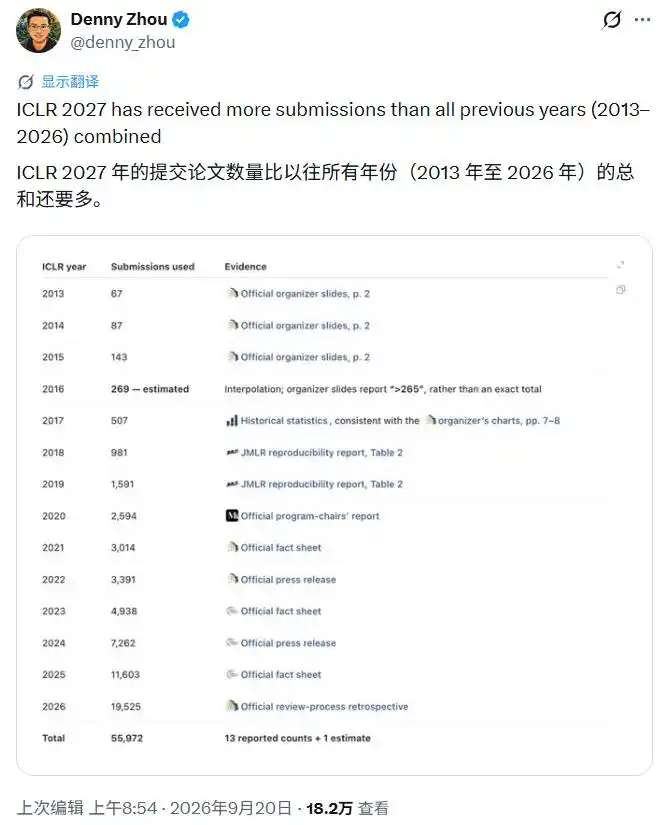
According to the source article, the first ICLR received 67 submissions. By ICLR 2026, that number had climbed to 19,525. Add together the 14 conferences held from 2013 to 2026, and the total comes to about 56,000 submissions. ICLR 2027 has already moved past that mark at the abstract stage alone.
What a 60,000-plus submission count could imply
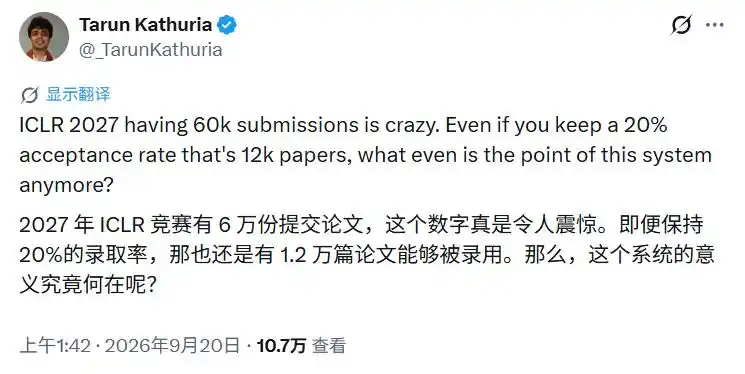
One immediate point of discussion is the possible acceptance volume. The article notes that, if a 20% acceptance rate is used as a simple assumption, 60,000 submissions would translate into roughly 12,000 accepted papers.
For comparison, ICLR 2026 accepted 5,355 papers. NeurIPS 2025 accepted 5,290, CVPR 2025 accepted 2,872, and ICML 2025 accepted 3,260. On that purely mathematical basis, the article says a possible ICLR 2027 acceptance count would be equivalent to two editions of NeurIPS 2025, four editions of CVPR 2025, or nearly four editions of ICML 2025.
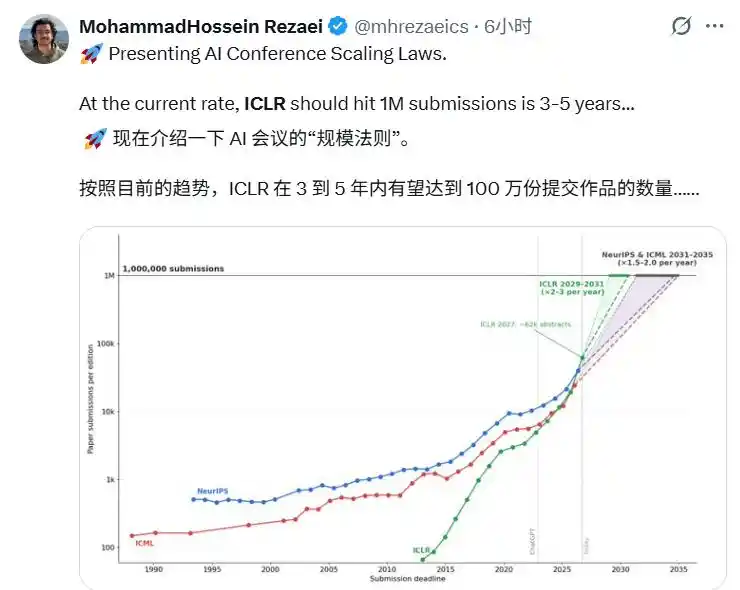
The article also makes clear that the “60,000+” figure being discussed in the community refers more precisely to the submission scale visible after the abstract deadline. It is not the same as the final number of papers that will enter formal review.
This year’s abstract deadline was Sept. 18, and the full paper deadline is Sept. 25. Organizers require abstracts to be genuine and valid. Duplicate abstracts and placeholder abstracts will be cleared out, and the process still includes full-paper submission, withdrawals and format checks. That means the final number entering official review can still change.
Reviewer pressure is now central to the discussion
With the top-of-funnel number moving toward 60,000, the review burden has become impossible to ignore. The article mentions JEV, a recently discussed high-efficiency judgment model, and says some readers joked that “ICLR review may be saved.”
One scenario where JEV has gained attention is as a Judge for agents: given an execution result, the model quickly decides whether a task has been completed, whether the output meets requirements and what should happen next. In the ICLR context, the question becomes blunt: who will judge 60,000 papers? The article frames that as a problem top AI conferences have been facing for years.
ICLR 2026 offers a benchmark. The conference received 19,525 valid submissions. Of those, 779 were desk rejected and 5,042 were later withdrawn, leaving 13,763 papers that reached the accept-or-reject decision stage. To process that volume, 18,054 reviewers submitted 76,139 reviews.
That is, once submissions reach the 20,000 range, the conference already needs a reviewer network approaching 20,000 people. With the entry figure now jumping past 60,000 at the abstract stage, the organizational strain is much larger.

ICLR 2027 has already rolled out throttling measures
ICLR appears to have anticipated the pressure. In early September, the ICLR 2027 Program Chairs published a post outlining new submission policies and highlighted one idea in particular: limiting inflow.
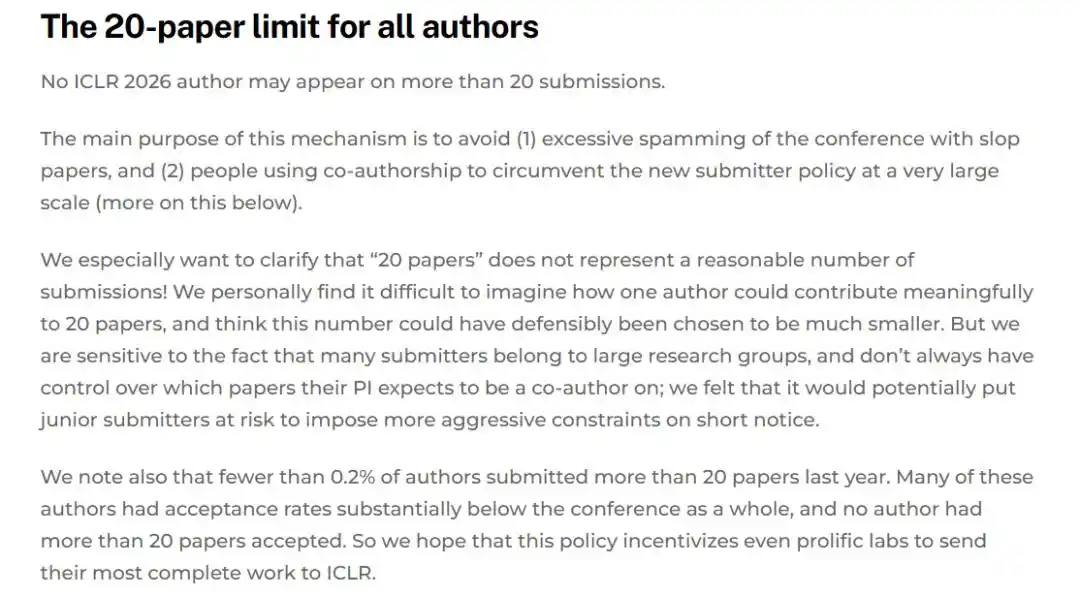
Under the policy described in the article, each author may appear on no more than 20 submissions this year. For papers where all authors lack qualified reciprocal reviewer status, each author may participate in at most one submission. Authors appearing on three or more submissions must take on at least six reviews. In principle, each submission also needs at least one author to register as a reviewer.
The source links to the official policy post published on Sept. 2, 2026: https://blog.iclr.cc/2026/09/02/submission-policies-for-iclr-2027/
The Program Chairs also explained the backdrop. The policy note says competition for AI and industry jobs is pushing researchers to increase paper output, while AI tools are accelerating that trend. It also says some conferences have observed that many new submissions come from author groups without qualified reviewers. In ICLR 2026, about 20% of submissions had no reciprocal reviewer.
This year’s Call for Papers even included a dedicated note for first-time ICLR submitters. According to the article, organizers said better AI tools are expanding the researcher base. Coding assistants, progress in theoretical research, improved research infrastructure and the spread of machine learning into more disciplines are all driving faster growth in research output. The committee said it hopes researchers will use the time saved to pursue more complete and more ambitious projects.
AI tools are also being used before submission
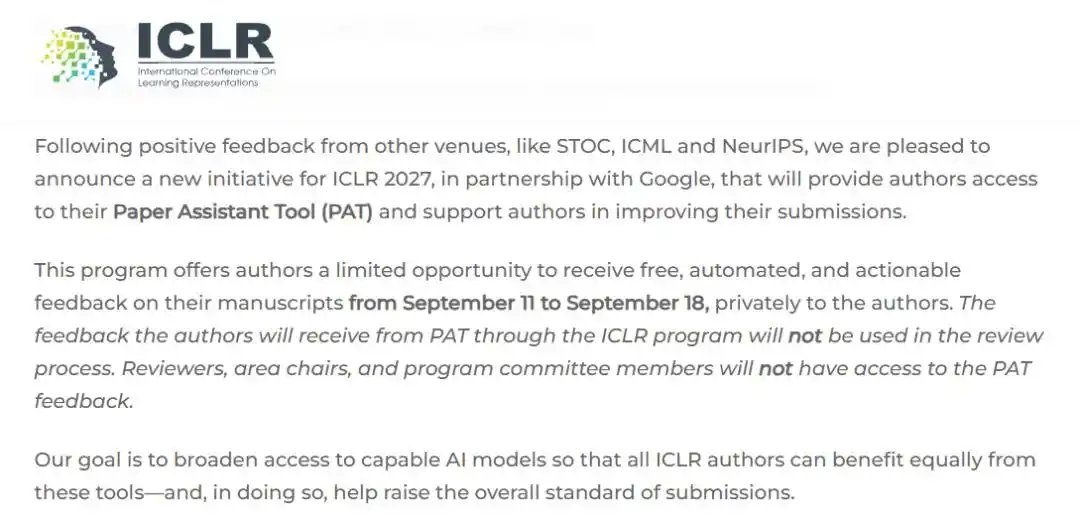
On Sept. 10, ICLR announced a partnership with Google to make the Paper Assistant Tool, or PAT, available to submitters. Authors can use the system before formal submission to receive automated feedback on their papers.
The article says ICLR stressed that the feedback is private to authors and will not enter the formal review process. The linked announcement was published on Sept. 10, 2026: https://blog.iclr.cc/2026/09/10/making-googles-paper-assistant-tool-pat-available-to-iclr-submitters/
The source describes this year’s ICLR as something close to a large-scale experiment in AI-driven research productivity. Over the past two years, large models have moved into multiple parts of the paper-production chain: topic selection, coding, experiments, paper polishing and rebuttal writing. On the reviewer side, AI-assisted review has also started to appear.
That has fed a broader complaint loop in the community: AI writes papers, AI reviews papers, and authors then use AI to write rebuttals. As paper counts rise and review becomes more competitive, criticism that top conferences are becoming “watered down” has also become more common, according to the article.
The community is now debating possible fixes
After the “60,000+” figure surfaced, discussion quickly shifted to remedies. The article says some people suggested canceling ICLR 2027 altogether and redesigning the mechanism from scratch to restore the prestige of top-tier conferences.

Others proposed more concrete changes: cap each author at three to four submissions; compress the main paper to three to four pages so key results appear earlier; require code, data and intermediate results to be released with the submission; then use agents to verify reproducibility. Another suggestion was to give reviewers either direct monetary compensation or academic credit with real value.
One more proposal mentioned in the article was to charge a non-refundable $10 fee per submission. At 60,000 submissions, that would amount to $600,000.
The article was originally published by the WeChat public account Jiqi Zhixin, ID almosthuman2014, and edited by Ava.