
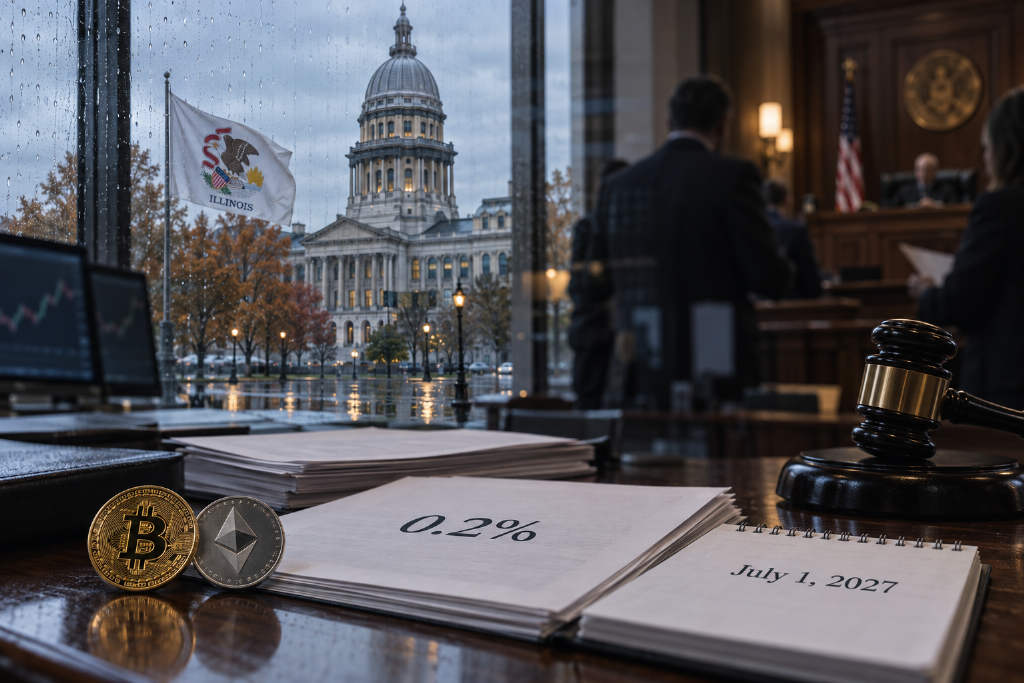
Illinois’ disputed crypto tax has taken a new turn. Digital Chamber and the Illinois Blockchain Association said they have reached an agreement with the state government to delay the planned 0.2% tax on digital asset transactions by six months, moving the effective date from Jan. 1, 2027 to July 1, 2027. The change still needs approval from a judge in Sangamon County Circuit Court.
The agreement is set to be filed with the court on Thursday morning, Oct. 2. In their joint petition, the parties will argue that the delay "serves the interests of justice" and would allow the case to be resolved on the merits over time. If the court approves it, the industry and the state would skip a prolonged fight over temporary injunctive relief and move directly into the next stage of litigation over the constitutionality and enforceability of the Digital Asset Tax Act.
The 0.2% tax and who it would affect
Illinois passed the crypto tax in June this year. Under the measure described in the report, businesses with annual revenue above $100,000 would face a 0.2% levy on crypto asset transaction and storage activity.
The scope is broad. It covers buying and selling, transfers, and even holding tokens on behalf of customers. Industry groups argue that the structure would impose disproportionate compliance costs on small and mid-sized crypto service providers.
Digital Chamber CEO Cody Carbone said the state’s decision to delay the tax "provides relief to digital asset businesses and users from continued high compliance burdens, while we continue to pursue permanent repeal of this tax through the judicial process."
Three legal arguments are at the center of the case
The challenge to the Illinois crypto tax is focused on three legal tracks.
- First, whether the tax is valid under Illinois state law.
- Second, whether it violates the U.S. Constitution, including possible arguments tied to the Commerce Clause or the Equal Protection Clause.
- Third, and in the industry’s view the most important, whether the tax is preempted by the federal Internet Tax Freedom Act, or ITFA.
The report says ITFA bars state governments from imposing discriminatory or multiple taxes on internet access. Crypto advocacy groups argue that digital asset trading and storage are fundamentally internet-based economic activity, and that a unilateral state tax conflicts with federal legislative intent.
Those groups had already sought a temporary restraining order on Sept. 9, asking the court to freeze the tax. Their argument included the claim that companies had already begun spending heavily to prepare for compliance, and that the uncertainty itself was harming the industry even before the tax took effect.
State-level pressure grows as federal legislation stalls
The report contrasts the Illinois case with the collapse of the Clarity Act at the federal level. It says the bill stalled in the Senate after Democrats raised concerns about Donald Trump’s crypto-related conflicts of interest, pushing the industry to focus more attention on state-level battles.
At the same time, the Illinois dispute shows how state regulation can be less predictable than federal legislation. The report notes that the Clarity Act at least went through bipartisan negotiations and public hearings, while the Illinois crypto tax appeared suddenly, leaving the industry to realize late in the process that it had been placed on the tax list. In the absence of a unified federal framework, that leaves crypto firms exposed to the risk of states moving in different directions.
Court approval is the next immediate question
Whether the delay takes effect now depends on how the Sangamon County court views the parties’ agreement. The report says judges in civil cases often approve terms when both sides agree, but because this case touches on the public interest, the court may also examine whether a delay would harm taxpayers or state finances.
The main litigation over the coming months remains the bigger issue. If the industry makes headway on its ITFA preemption argument, the Illinois crypto tax may face more than a delay. It could be struck down altogether.