
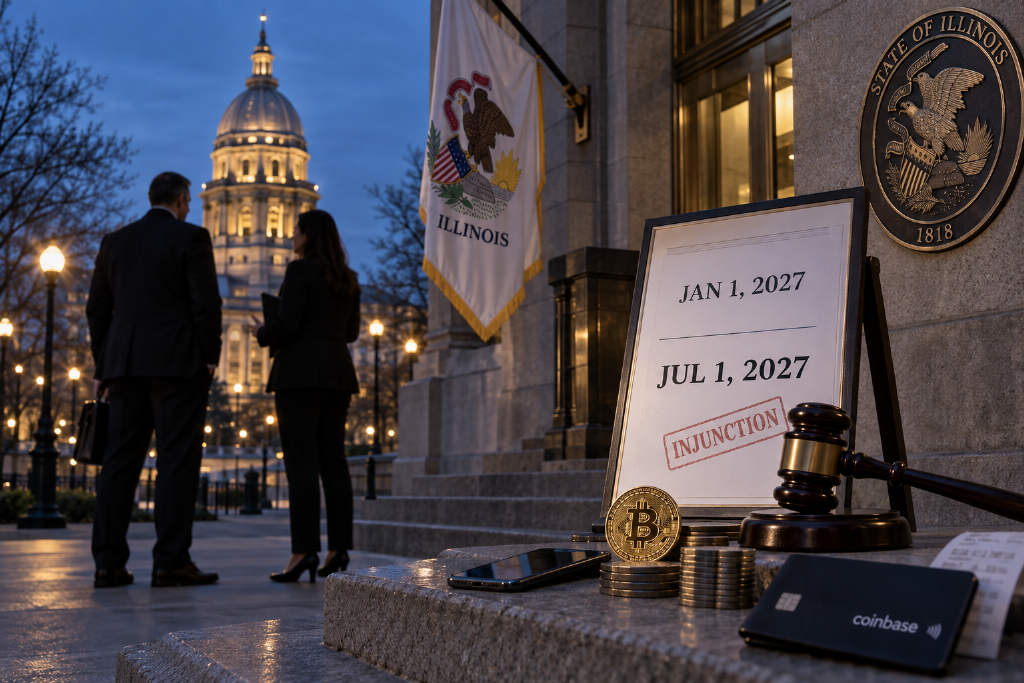
Illinois crypto users may get a six-month reprieve, if a judge approves it.
State officials have agreed to push back the start of Illinois’ Digital Asset Tax from Jan. 1, 2027, to July 1, 2027, according to a joint motion filed Thursday in Sangamon County Circuit Court. The filing asks the court to issue a preliminary injunction blocking the tax for now and to stay its effective date until July.
Lawsuit led to the proposed delay
The motion grew out of a lawsuit filed by the Chamber of Digital Commerce, known as The Digital Chamber, and the Illinois Blockchain Association against Illinois Department of Revenue Director David Harris and Attorney General Kwame Raoul.
Because the motion is stipulated, both sides are asking the judge for the same result. Court approval is still required before the delay takes effect.
The Digital Chamber said on X that Illinois had agreed to delay implementation of the tax and credited its attorneys at Bellementis PLLC. The group also said the delay does not resolve the case, and that the industry plaintiffs are still challenging whether the tax is constitutional and enforceable.
What the Illinois tax would do
Governor JB Pritzker signed the Digital Asset Tax Act in June as part of the state’s 2027 budget. The law imposes a 0.2% levy on crypto activity in Illinois, including purchases and transfers. Collection would fall to digital asset brokers such as major exchanges.
The Crypto Council for Innovation called it the “most punitive digital asset tax” in the country. Lawmakers estimated the measure could raise as much as $60 million in 2027.
Critics have focused on the breadth of the levy. The Digital Chamber has argued that the tax reaches users whether or not they realize any gain.
Separate challenge is also underway
The Blockchain Association and the Crypto Council for Innovation are pursuing a separate challenge of their own. On Sept. 9, they asked the same court to block the tax, arguing that firms were already spending millions of dollars to build compliance systems without meaningful guidance from the state.
Federal tax bill moved ahead in Washington
In Washington, the House Ways and Means Committee advanced the Digital Asset Tax Certainty Act last month. Among other changes, the bill would remove gain-or-loss calculations on qualifying network fees of $10 or less starting in 2028.