
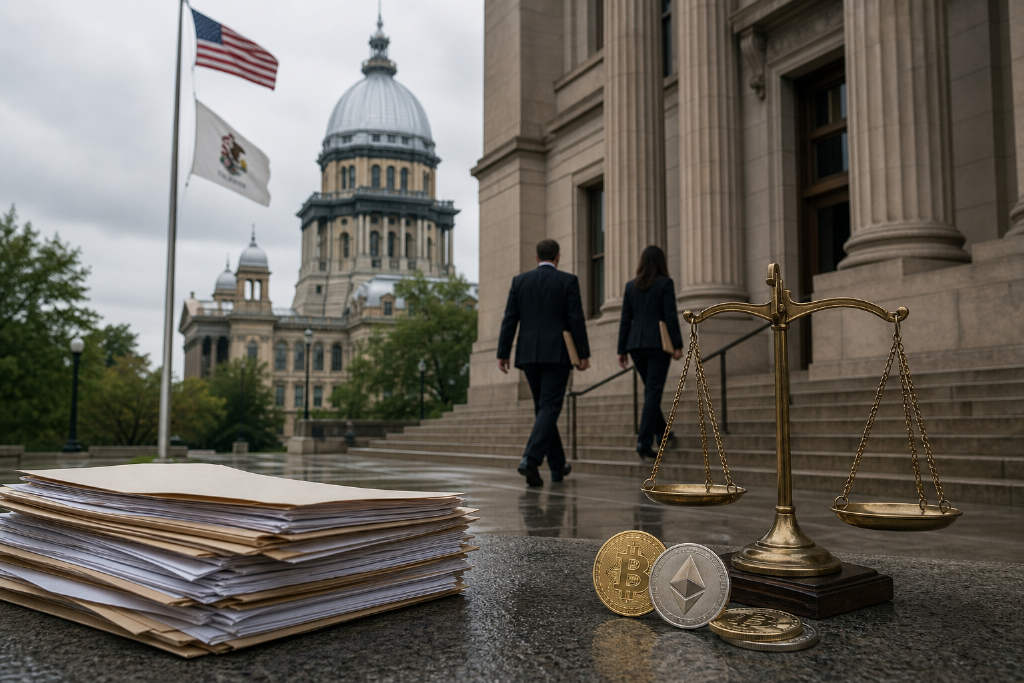
The Crypto Council for Innovation (CCI) and the Blockchain Association (BA) have sued Illinois officials over the state’s 0.2% tax on cryptocurrency. The measure is expected to be enforced starting in January 2027.
The groups filed the lawsuit on Friday in the Circuit Court of the Seventh Judicial Circuit for Sangamon County. Their lawyers argued that Illinois’ digital asset tax violates the US Constitution, the state constitution, federal and state due process laws, and the federal Internet Tax Freedom Act. Illinois Governor JB Pritzker signed the measure into law in June as a “privilege tax” as part of the state’s fiscal year 2027 budget. Under the law, crypto users would be taxed based on transaction volume rather than income.
Constitutional and due process claims
On the due process issue, CCI and BA said the tax is “unconstitutionally vague” because it places the burden on residents and brokers to determine what digital assets are taxed and how the tax applies. The complaint says that burden comes “under the threat of serious civil and criminal penalties.”
The two organizations also challenged the measure under the US Constitution’s protections for interstate commerce, arguing that the state tax creates the prospect of duplicative taxation.
“States have an important role to play in fostering innovation, but that authority has constitutional limits,” said Summer Mersinger, CEO of the Blockchain Association and a former commissioner at the US Commodity Futures Trading Commission. “Illinois cannot impose a novel tax regime that discriminates against digital commerce, creates uncertainty for consumers and businesses, and threatens to fragment a rapidly growing national market.”
The source for that statement was the Blockchain Association.
Follows a similar July case from the Digital Chamber
The CCI and BA complaint came after a similar lawsuit filed by the Digital Chamber in July. That organization argued that the Illinois tax “discriminates against people who transact in digital assets.”
The cases show digital asset advocacy groups taking a more direct stance against laws passed by US state officials during an election year in which crypto policy, legislation, and regulation could influence voters.
Illinois is also facing a separate fight over prediction markets
Opposition to the crypto tax has unfolded alongside another lawsuit involving Illinois officials. Prediction market platform Kalshi challenged a law that took effect on July 1.
According to the company, the legislation “expressly bans sports event contracts” in violation of federal law by requiring state licensing.
Separately, Pritzker signed an executive order in April barring state employees from betting on the platforms. The order said the move was intended to “prevent insider trading amid the rapid growth of online prediction markets and event-based gambling contracts.”