
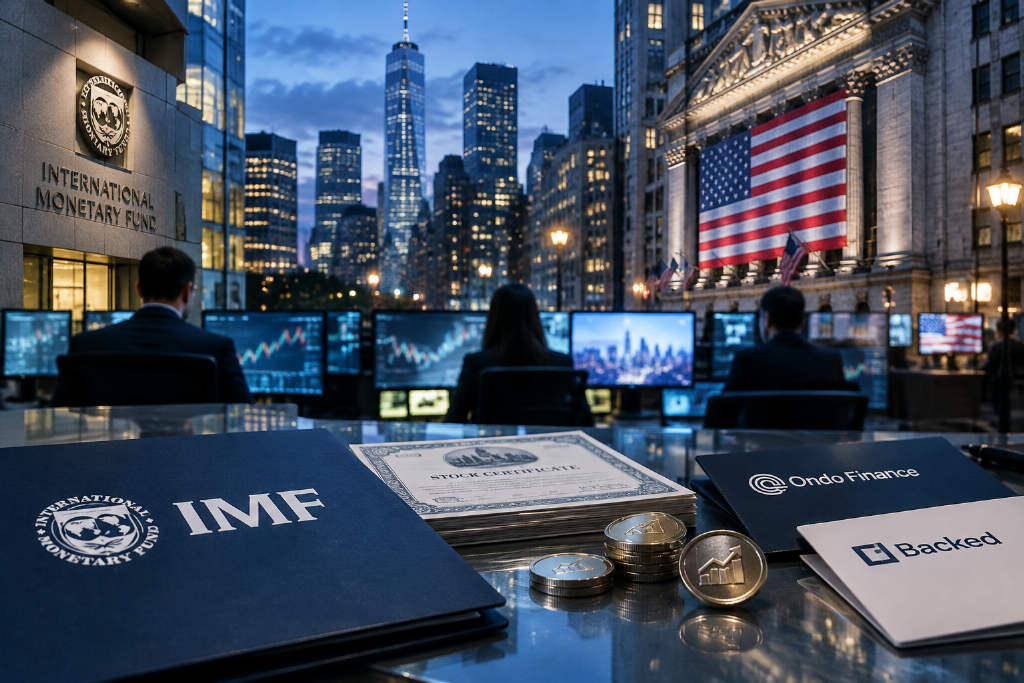
More than half of all trading in tokenized U.S. stocks happens while Wall Street is closed, according to new data from the International Monetary Fund.
The figure appears in the tokenization chapter of the IMF’s Global Financial Stability Report, released on Oct. 8. In that chapter, titled "Scaling Tokenization: New Efficiencies, New Vulnerabilities," the fund estimated the tokenized equity market at about $2.3 billion as of July 31. That is a small portion of the roughly $65 billion in publicly tokenized real-world assets, excluding repo.
IMF reviewed five liquid tokenized equity products
To assess how the market behaves, IMF staff studied five of the most liquid tokens issued by Ondo Finance and Backed Finance’s xStocks. Those products track the S&P 500, the Nasdaq, Tesla, Google, and Nvidia.
The sample covered 11 venues and 365 trading days and was worth about $345 million, or roughly 15% of the market. The report also said Ondo and Backed together account for more than 70% of tokenized equity value, and that their products are aimed at investors outside the United States. Ondo, for instance, expanded its tokenized stock platform to BNB Chain for users in Asia and Latin America.
Retail-sized trades dominate activity
About 80% of the trades in the sample were for less than a single share, which the IMF interpreted as a sign that small retail investors dominate this market.
The fund said round-the-clock access is not just a technical feature. It is also a source of demand, especially for investors in time zones far from New York.
The report also found that tokenized versions appeared to contain useful price information. Within five minutes of the U.S. opening bell, the underlying stocks absorbed more than 87% of the overnight move seen in their tokenized counterparts.
Higher volatility and weaker liquidity than traditional shares
Realized volatility on tokenized venues ran at about 1.5 times that of traditional shares, according to the IMF. Liquidity was weakest on decentralized exchanges, while centralized exchanges sat in between.
Even so, prices still tracked the underlying stocks closely, especially on busier venues. The IMF said tokenized equity markets are, so far, less liquid, more volatile, and more fragmented than traditional ones, mainly because the market remains small.
IMF says systemic risks remain limited for now
The IMF said its empirical findings should be interpreted with caution. For now, systemic risks remain limited, it said.
On policy, the fund recommended that authorities design circuit breakers and liquidity safeguards for tokenized trading environments. It also called for regulation under the principle of "same activity, same risk, same regulatory outcome."
The report said the central question is whether tokenized market infrastructure, legal foundations, liquidity arrangements, and risk controls would be adequate if tokenization were to see broader adoption.



