
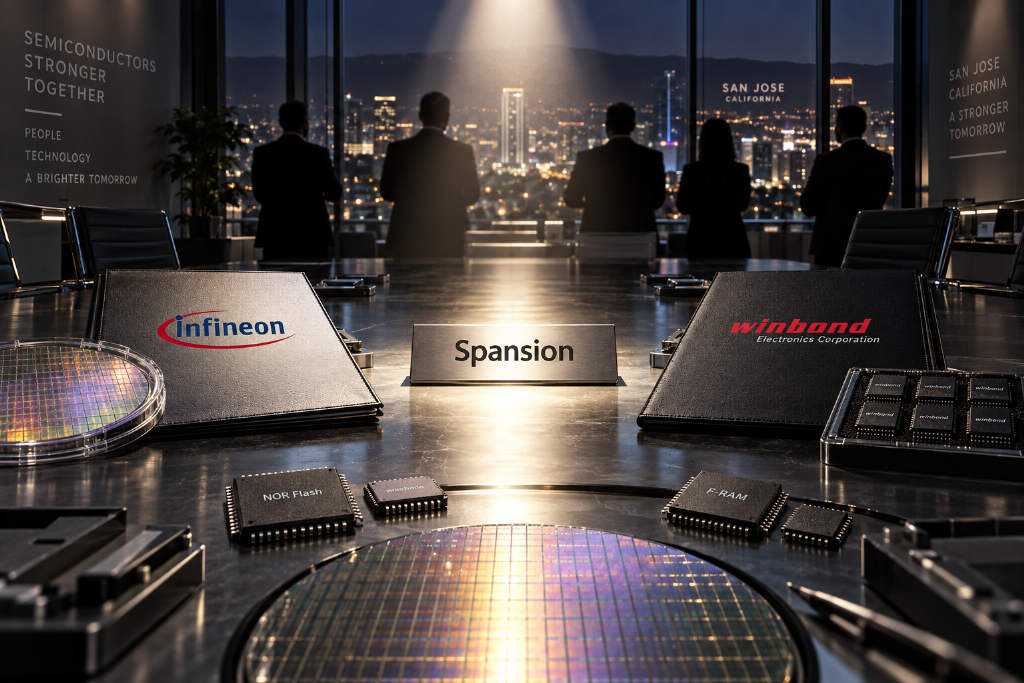
Infineon Technologies said on Sept. 16 that it will sell its NOR Flash and F-RAM business to Winbond Electronics for $1.12 billion. The two companies expect to complete the transaction in the second half of 2027.
Winbond plans to keep the business operating as a standalone company headquartered in San Jose, California, and will revive the Spansion name. Spansion was once a familiar brand across the semiconductor industry, but it disappeared after being absorbed into Cypress in 2015.
Spansion returns after a decade off the stage
The brand traces back to 2003, when AMD and Fujitsu combined their Flash businesses and later launched Spansion. The company went on to become a major supplier in the NOR Flash market. In 2015, Cypress merged with Spansion. In 2020, Infineon acquired Cypress in a deal valued at about 9 billion euros in enterprise value. With the new sale, those memory assets are being separated again and transferred to Winbond.
Winbond Chairman and Chief Executive Officer Arthur Chiao said Spansion had been a pioneer in the memory industry and had delivered multiple innovations and technological breakthroughs. He said Winbond was honored to carry that mission forward again under the Spansion name.
What Infineon is selling
The sale covers NOR Flash and F-RAM, not Infineon’s full memory business. SRAM, HYPERRAM, nvSRAM, and radiation-hardened memory based on SONOS technology will remain inside Infineon. Those products will continue to serve automotive, industrial, infrastructure, aerospace, and defense markets.
NOR Flash is mainly used to store program code and can execute code directly, which is why it has long been used in automobiles, industrial control systems, communications infrastructure, and a wide range of embedded devices.
F-RAM follows a different path. It uses ferroelectric materials to provide non-volatile storage, with fast write speeds, high write endurance, and data retention after power loss. That makes it suitable for applications that frequently log status information, metering data, and key operating parameters.
Most of the NOR Flash assets involved in the deal can be traced back to Spansion. AMD and Fujitsu combined their Flash operations in 2003 through FASL and then introduced the Spansion brand. Spansion later merged with Cypress in 2015.
The F-RAM business largely came from an even earlier Cypress acquisition. In 2012, Cypress bought Ramtron for about $109 million and added F-RAM to its non-volatile memory lineup. When Infineon acquired Cypress in 2020, that business moved into Infineon as well.
Why Winbond is buying
For Winbond, NOR Flash is already a core business. Citing Omdia data, the report said the global NOR Flash market will be about $3.4 billion in 2025. Winbond holds a 23% share, ranking first, while GigaDevice and Macronix each hold 17% and Infineon holds about 11%. Combined, the Winbond and Infineon businesses would account for about 34%.
The timing also comes with strong operating momentum at Winbond. In the second quarter of 2026, the company posted consolidated revenue of TWD 59.843 billion, up 184.7% from a year earlier. Gross margin reached 66.2%, net income attributable to parent shareholders was TWD 24.317 billion, and earnings per share came in at TWD 5.4.
According to the report, the growth was driven mainly by AI-related demand. Customized memory made up 53% of quarterly revenue, and blended average selling prices rose about 100% from the prior quarter. Flash contributed 33% of revenue, with stronger sales from 24nm and 32nm SLC NAND products.
That momentum continued into the third quarter. Winbond reported July consolidated revenue of TWD 26.773 billion, up 291.55% year over year, and August revenue of TWD 27.309 billion, up 289.43%. For the first eight months of 2026, cumulative revenue reached TWD 152.178 billion, up 177.39%.
Winbond said Infineon’s memory business brings more than 30 years of experience, along with a broad base of automotive, industrial, and infrastructure customers, as well as an established supply chain and R&D organization. In those sectors, customer qualification cycles are long, so acquiring a mature operation is faster than building access from scratch. Reusing the Spansion name also preserves recognition tied to the original business.
Where Infineon plans to focus capital
Infineon did not disclose revenue or profit for the NOR Flash and F-RAM operations in its announcement. It said only that it would further focus its product portfolio and capital allocation on core growth areas.
The company’s recent moves give a clearer picture of those priorities. Automotive remains one of its largest businesses, while SiC, GaN, and IGBT power devices continue to expand. Power demand from AI data centers has also become a new growth driver. In August, Infineon acquired C2i Semiconductors to strengthen its AI data center power management offering. Earlier, it also bought Marvell’s automotive Ethernet business and AMS-OSRAM’s sensor business.
The article noted that NOR Flash is currently facing tight supply and sharp price increases. Selling the business at this point while concentrating on power and automotive is presented as a favorable choice for Infineon.
This article was sourced from the WeChat public account EEworldbbs, written by Ji Kai.