

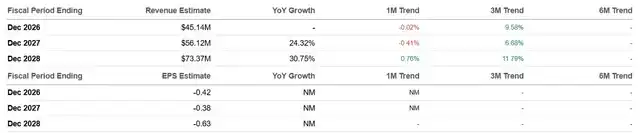
Infleqtion’s commercial narrative in quantum computing is getting more attention, but the valuation case is drawing just as much scrutiny. In the source article, Juxtaposed Ideas argues that the company has built a compelling story around its neutral-atom architecture, modular laser systems, government deployments, and partnerships with Eaton and Nvidia. The problem, the article says, is that FY2026 revenue is expected to be only about $43 million while forward EV/Sales stands at 53.01x, leaving limited margin of safety.

The author notes that they wrote about IonQ (IONQ) in December 2025, focusing on the company’s future monetization path and large total addressable market. This time, the discussion shifts to Infleqtion (INFQ) while staying on the broader theme of quantum computing stocks.
Neutral-atom design sits at the center of the INFQ pitch
For readers less familiar with the company, Infleqtion is described as a vertically integrated neutral-atom quantum company with products spanning quantum computers, sensing systems, and software. Management has framed the neutral-atom approach as the best route to commercial advantage relative to trapped-ion, superconducting, and photonic systems.
The article says the company builds optical systems that use light to trap, move, and control atoms. That setup can create large atomic arrays, change geometry depending on the computation, and connect qubits without locking the machine into one permanent layout.
Infleqtion also layers in modular laser systems and related technology that can rearrange atoms while a program is running. In the article’s view, that helps explain why the company repeatedly highlights how compact its cabinet footprint can be.
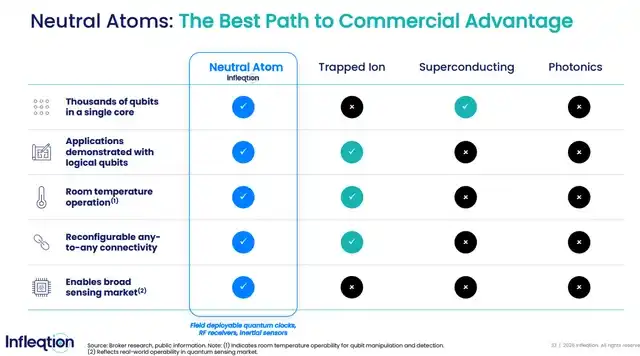
Power consumption is another part of the pitch. The article quotes the company as saying its machines use roughly the same amount of power as a few household hair dryers, putting them in a very different category from systems that would require power-plant-scale support.
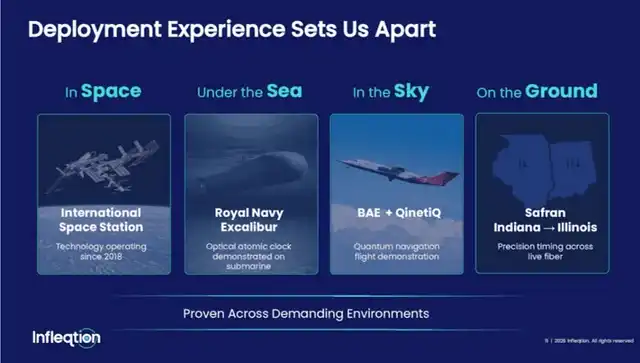
Those features may also explain why Infleqtion has seen multiple government-side deployments since 2018. At a stage when quantum computing is still early, the company has been able to deliver proof-of-concept work while also pushing toward commercial use cases.
Partnerships and projects are filling out the commercialization case
Looking ahead, management has made clear that it wants to stimulate demand for quantum compute capacity. The company has announced several partnerships with Eaton (ETN), Nvidia (NVDA), and others to develop customer applications in end markets such as energy and AI.
The Eaton relationship led to three new projects under the U.S. Department of Energy’s Genesis mission, covering AI, nuclear applications, and quantum sensing. The article treats that as another sign that Infleqtion’s quantum computing and sensing capabilities are usable in practice.
Separately, the company’s quantum sensing system is set to be deployed in NASA’s Quantum Gravity Gradiometer Pathfinder project, which the article says is expected to become the world’s first space-based quantum gravity sensor.
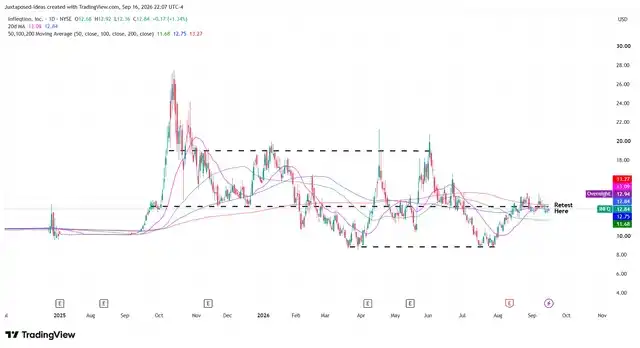
The source also links stronger commercial interest in quantum products to the stock’s ability to find support around $12 after a positive response on the FQ2'26 earnings call.
Beyond Nvidia, Infleqtion is said to be working closely with a leading AI foundry lab. The article adds that a recent company-wide hackathon supported by OpenAI allowed the quantum company to complete in 24 hours projects that previously would have taken months to move forward.
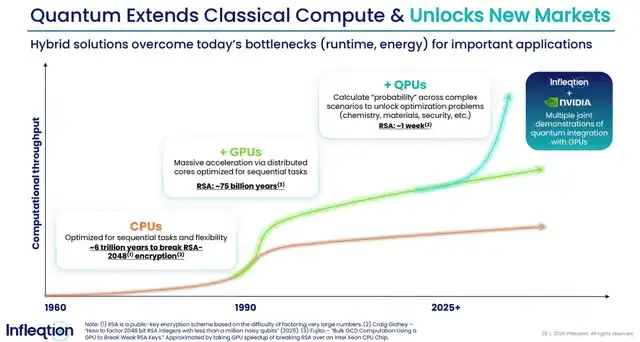
Those developments support management’s argument that CPU, GPU, and QPU are complementary platforms that can help overcome runtime and energy bottlenecks in important applications today.
Roadmap targets 30 logical qubits in 2026
The article also spends time on the technical roadmap. It says AI is speeding up data and theorem exploration by about 2x and could move the path toward 1 million logical qubits forward.
Infleqtion’s current roadmap calls for 2 logical qubits in 2024, 12 in 2025, and 30 in 2026, based on management guidance cited in the piece.
According to the article, 30 qubits are expected to bring reliability close to the level of a laptop, server, or smartphone. The next target, 100 qubits, is described as the threshold where the system could begin solving important problems in materials science, chemistry, and perhaps AI that classical computers cannot solve.
On that basis, the author says Infleqtion appears to be making solid progress on its technology roadmap. If quantum sensing and quantum computing reach a real inflection point and broader adoption follows, the article says revenue and profit could benefit.
Revenue growth is improving, but losses and cash use are rising too
The financial section is where the tone turns more cautious. Because revenue recognition on two government contracts shifted in timing, Infleqtion posted 157% year-over-year revenue growth in FQ2'26. Manufacturing leverage improved, and gross margin rose to 15.9%, up 3.2 percentage points from a year earlier.
At the same time, technical headcount increased 25% year over year, and R&D expense surged 138%. That pushed adjusted operating losses in FQ2'26 to more than double from the prior-year period.
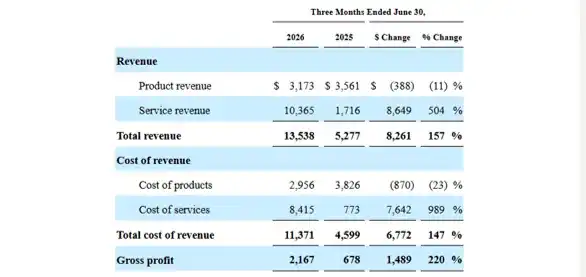
The article says this means operating results could remain uneven until manufacturing and operating leverage improve in a more durable way. It also acknowledges the other side of the argument: heavier R&D spending could accelerate the timeline for broader commercial adoption, matching the faster roadmap discussed earlier.
After management raised FY2026 revenue guidance to $43 million, up 32.3% year over year, consensus estimates moved higher as well. The company is now expected to sustain revenue CAGR of about 31.1% through FY2028.
Outside product and service monetization, management also suggested that future access by hyperscale cloud providers to its quantum computers could create more durable and repeatable revenue streams. That idea rests on the fact that the company is already offering private cloud access to some customers.
Still, the article argues that Infleqtion may remain in the startup phase for a while longer. Cash burn continued to widen in FQ2'26, and management guided to another prudent increase in annual cash burn for 2027, which has widened the range of views on where the floor may be.
Using H1'26 adjusted operating losses of $30.2 million and net cash outflow from operating activities of $5.97 million, the article says the company may continue drawing down its $582 million net cash balance, which was up 2.2% quarter over quarter.
Stock-based compensation stands out as well. SBC reached $20.35 million in H1'26, up 982% year over year, and SBC as a share of revenue climbed to 92.1%, up 78.9 percentage points. The author sees that as a meaningful medium-term dilution risk.
Customer concentration adds another layer of risk. Customer A accounted for 82% of FQ2'26 revenue and 74% of H1'26 revenue. If that customer changes its purchasing strategy, the concentration issue could show up quickly.
Hold rating rests on valuation and trading setup
On the trading side, the article says buyers have defended the area around $8 twice. But after a double-digit rebound from the July 2026 low, momentum has faded, and the stock has been consolidating near $12 since mid-August 2026.
Valuation is the main reason the author stays cautious. Infleqtion is trading at 53.01x forward EV/Sales, compared with a recent trough of 32.46x, while the sector median is only 3.43x.
The article compares Infleqtion with several quantum-related names:
- IBM (International Business Machines): about 4.14x / +4.4%
- D-Wave Quantum (QBTS): about 132.18x / +81.8%
- IONQ: about 27.83x / +101.3%
- Rigetti Computing (RGTI): about 199.94x / +126.7%
- Quantum Computing (QUBT): about 29.94x / +443.6%
The conclusion drawn in the piece is that Infleqtion’s premium valuation already prices in its startup profile and high-growth trajectory.
The article also points to a relatively elevated short interest of about 10.78%, which could add volatility, and notes that the stock has not been able to break through resistance at $14. Taken together, those factors support a Hold rating in the source piece.
The author’s final view is that Infleqtion does not look weak structurally in quantum sensing monetization, but quantum investing is still early and the growth already priced into the stock leaves little room for safety. For investors interested in the name, the article says it may make more sense to wait for another pullback and revisit the stock closer to the $8 trading floor that has already been tested twice.
Disclosure
The disclosure at the end of the article says the author or the author’s team holds a beneficial long position in NVDA through stock ownership, options, or other derivatives. The piece says it was written independently and reflects the author’s own views, that no compensation was received other than from Seeking Alpha, and that there is no business relationship with any company mentioned. It also states that the analysis is for informational purposes only and does not constitute professional investment advice, and that investors should conduct their own research and due diligence because trading involves many risks, including loss of principal.