

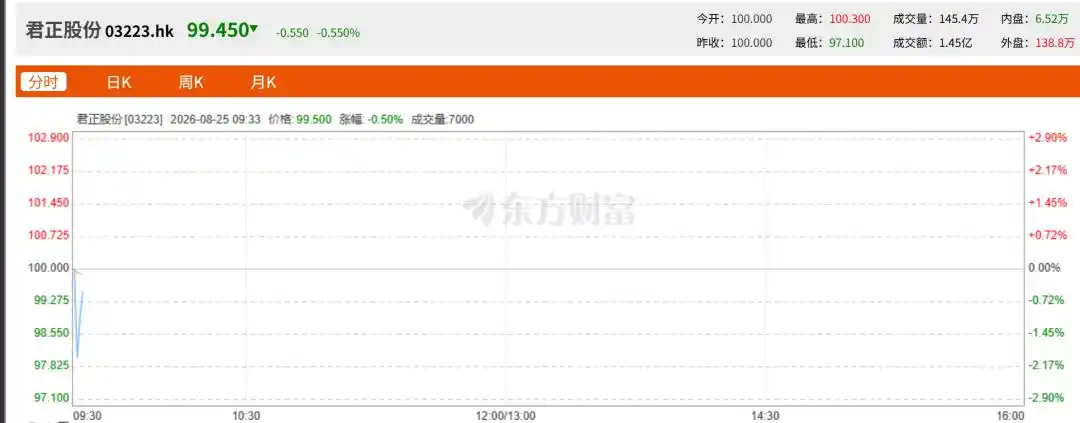
Ingenic began trading in Hong Kong on Aug. 25 at HK$100 per share, giving the company an opening market capitalization of about HK$51.5 billion. The chipmaker was first listed on the ChiNext board of the Shenzhen Stock Exchange on May 31, 2011, under stock code 300223. At that time, it sold 20 million shares at RMB 43.80 each and raised RMB 876 million. With the Hong Kong debut completed, Ingenic has joined the group of semiconductor companies with both A-share and H-share listings.
Unlike many chip companies that stay tightly focused on a single segment, Ingenic has built operations across three product lines: memory, compute and analog. The company’s current structure traces back to a 2020 deal, when it completed the acquisition of Beijing Silicon, consolidated the business in its financial statements and indirectly took control of Integrated Silicon Solution Inc. (ISSI). What had been known mainly as an embedded CPU company expanded into a broader chip platform spanning three tracks.
First-quarter 2026 figures showed a sharp rebound
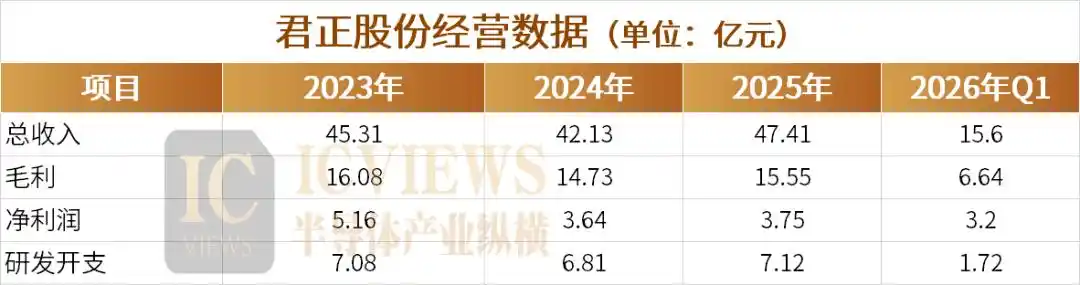
According to the prospectus, Ingenic posted revenue of RMB 4.531 billion in 2023. That slipped to RMB 4.213 billion in 2024 during an industry downturn, then recovered to RMB 4.741 billion in 2025. In the first quarter of 2026, revenue reached RMB 1.560 billion, up 47.1% from RMB 1.060 billion a year earlier.
Profit recovered faster than revenue. Net profit stood at RMB 516 million in 2023, with a net margin of 11.4%. It fell to RMB 364 million in 2024, leaving net margin at 8.6%. In 2025, net profit edged up to RMB 375 million, though net margin narrowed again to 7.9%. The first quarter of 2026 marked a stronger turn: net profit rose to RMB 320 million from RMB 74 million a year earlier, and net margin reached 20.5%. The latest financial report also showed first-half net profit is expected to increase by more than 531% to RMB 1.28 billion.
Gross margin followed the same direction. It was 35.5% in 2023, 35.0% in 2024 and 32.8% in 2025, then jumped to 42.6% in the first quarter of 2026. Gross profit climbed from RMB 371 million in the first quarter of 2025 to RMB 664 million in the same period of 2026, a 79% increase.
Memory remained the largest business line
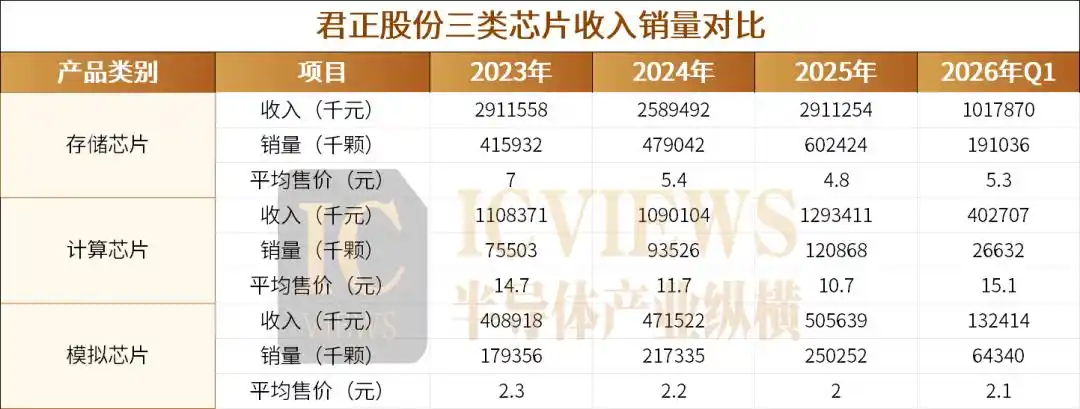
Memory chips still account for roughly 60% of Ingenic’s revenue. Sales from that segment came in at RMB 2.912 billion in 2023, RMB 2.590 billion in 2024 and RMB 2.911 billion in 2025. First-quarter 2026 revenue from memory chips was RMB 1.018 billion. Unit shipments rose from 416 million chips in 2023 to 602 million in 2025, with another 191 million shipped in the first quarter of 2026.
Pricing moved through a sharp cycle. Average selling price for memory chips was RMB 7.0 per unit in 2023, RMB 5.4 in 2024, RMB 4.8 in 2025 and RMB 5.3 in the first quarter of 2026.
Compute-chip revenue was more volatile. The business generated RMB 1.108 billion in 2023, RMB 1.090 billion in 2024 and RMB 1.293 billion in 2025. First-quarter 2026 revenue was RMB 403 million. Shipments increased from 75.5 million units in 2023 to 121 million in 2025. Average price dropped from RMB 14.7 per unit in 2023 to RMB 11.7 in 2024 and RMB 10.7 in 2025, then rebounded to RMB 15.1 in the first quarter of 2026.
Analog chips were the steadiest line. Revenue rose from RMB 409 million in 2023 to RMB 472 million in 2024 and RMB 506 million in 2025, with RMB 132 million recorded in the first quarter of 2026. Unit sales increased from 179 million to 250 million over the same period. Pricing stayed relatively stable at RMB 2.3, RMB 2.2 and RMB 2.0 per unit from 2023 through 2025, then held at RMB 2.1 in the first quarter of 2026.
Customer and supplier concentration has been easing. Revenue contribution from the top five customers fell from 54.5% in 2023 to 50.3% in the first quarter of 2026, while the largest customer’s share dropped from 21.0% to 15.6%. On the procurement side, the top five suppliers accounted for 58.3% in 2023 and 41.6% in the first quarter of 2026. The largest supplier’s share fell from 26.5% to 12.3%.
R&D spending stayed at a high level. Ingenic spent RMB 708 million, RMB 681 million and RMB 712 million on research and development from 2023 to 2025. As a share of revenue, that moved from 15.6% to 15.0%. In the first quarter of 2026, R&D expense was RMB 172 million, equal to 11.0% of revenue. As of the end of March 2026, the company had 822 R&D staff, representing 65.7% of total employees.
The three-brand chip platform took shape after the 2020 acquisition
Ingenic’s current product map was formed after its acquisition of ISSI in 2020. Before the deal, the company was mainly focused on compute chips. Afterward, it added memory and analog product lines. That brought together three brands under one structure: ISSI for memory, Ingenic for compute and Lumissil for analog.
The ISSI line includes DRAM, SRAM, NOR Flash and NAND Flash, all aimed at automotive electronics, industrial and medical applications. Based on 2025 revenue, Ingenic ranked seventh globally in niche DRAM and second among mainland Chinese companies. It ranked second globally and first in mainland China for SRAM, and seventh globally and third in mainland China for NOR Flash. These are not standard consumer memory products. They are built to run reliably in temperatures from minus 40 degrees to 85 degrees Celsius and face stricter requirements for data retention, endurance and defect rates.
The Ingenic compute line is built on the company’s self-developed CPU cores. It started with the XBurst series in 2005 based on the MIPS architecture. In 2014, the company moved into RISC-V with the Victory series, which is now used in its compute-chip lineup. That business is split into three categories: smart vision SoCs, embedded MPUs and AI-MCUs. Among them, the company said its IP-Cam SoC ranks second globally. These chips integrate ISP, video encoding logic and other dedicated modules into a single semiconductor device for network cameras.
Lumissil covers analog products, mainly LED driver chips and Combo chips. LED drivers are used in automotive exterior and interior lighting systems, and in non-automotive applications such as high-end gaming devices and household equipment. The Combo products integrate MCU, LED drivers, touch sensors and LIN/CAN buses onto a single chip for functions such as automotive ambient lighting and touch applications.
The company’s pitch is that the three lines can work together in one system. In an automotive electronics setup, ISSI memory chips store code and data, Ingenic compute chips handle vision and AI workloads, and Lumissil analog chips manage power and communications. Customers can choose memory, compute and analog components within the same supplier system, lowering multi-vendor management costs and improving hardware-software coordination.
Niche memory and edge AI are highlighted as visible growth drivers
In memory, Ingenic has chosen to target niche markets instead of competing head-on with Samsung and SK hynix in standard DRAM. Its focus is on automotive-grade, industrial-control and aerospace applications where reliability requirements are stricter and supplier relationships tend to last longer once a product enters the chain.
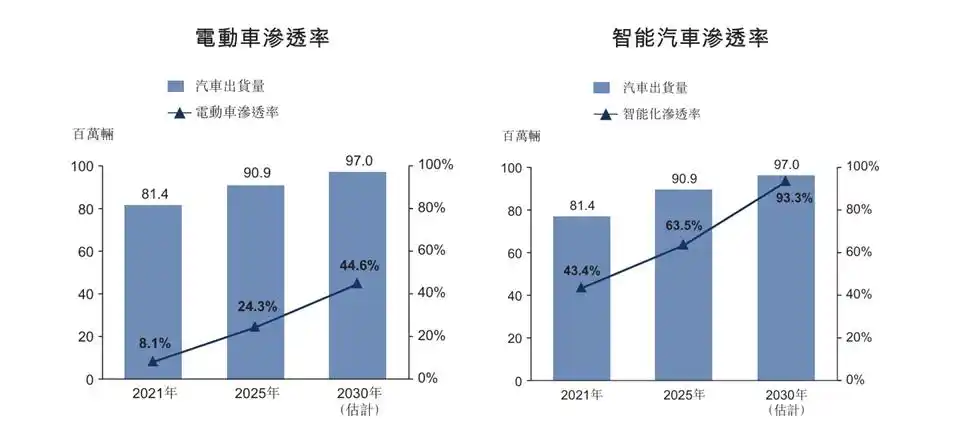
The article cited Frost & Sullivan data showing that global passenger vehicle shipments reached 90.90 million units in 2025. Electric-vehicle penetration is projected to rise from 24.3% in 2025 to 44.6% in 2030, while smart automotive system penetration is expected to increase from 63.5% to 93.3% over the same period. It also said L2+ autonomous-driving vehicles generate more than 1TB of data per day, raising the bar for storage chips that must handle intensive read and write cycles in harsh conditions.
Edge AI is presented as the incremental demand driver for compute chips. Citing Frost & Sullivan in the prospectus, the article said edge AI device shipments are expected to reach 1.9 billion units by 2030. Ingenic said compute-chip revenue rose 49.1% in the first quarter of 2026, partly because demand from security, AIoT and edge AI devices expanded.
Robotics is another market mentioned for the company’s chips. The article said the robotics market is expected to grow at a compound annual rate of 10.5% from 2025 to 2030. Ingenic chips are already used in robot vacuums, industrial robots and service robots. As those products become more intelligent, demand for motor control, power analog and low-power memory is expected to increase.
On forward-looking product development, the company said its 1x-nm high-density LPDDR4 products have already been sampled to customers, began ramping in the second half of 2025 and entered mass production in the first quarter of 2026. LPDDR5 is under planning. The company is also investing heavily in 3D DRAM for AI servers and edge computing workloads that require high bandwidth and large-capacity memory. In NAND Flash, it has established serial NAND and parallel NAND lines in 2D NAND, while development of high-bandwidth 8IO serial NAND Flash is under way. In 3D NAND, its eMMC and UFS product solutions are aimed at automotive cockpit and autonomous-driving use cases.
Hong Kong proceeds are set for R&D and acquisitions
Ingenic priced its Hong Kong offering at HK$100 per H share and expects to raise HK$3.13 billion. The allocation plan was disclosed in the filing: 50% for technology innovation and product development across the company’s three core product lines, 25% for strategic investments and acquisitions involving chip design companies and businesses across the semiconductor value chain, including IP or EDA suppliers, wafer manufacturers, and packaging and testing service providers, 15% for expanding the sales network, and 10% for working capital and other general corporate purposes.
The article said the Hong Kong listing gives Ingenic another financing channel and offers access to a more international capital market. For a company that sells products to more than 50 countries and regions across Asia, the Americas and Europe, that could help raise overseas brand recognition and support future cross-border transactions and cooperation.
The filing also pointed to cyclical and cost-related risks
The article noted several risks around the business. The semiconductor sector is cyclical, and falling average memory-chip prices in 2024 directly weighed on revenue. Ingenic operates on a fabless model, which leaves it exposed when upstream wafer capacity tightens. The consumer-facing compute-chip market also remains highly competitive, with price competition a constant factor.
First-quarter 2026 gross margin reached 42.6%, but the article said part of that reflected inventory purchased at lower prices before key materials such as KGD became more expensive. That inventory effect helped control costs for a period, but it was described as non-recurring. Whether margins can hold from here, according to the article, will depend on product competitiveness and market supply-demand conditions.
This article was sourced from the WeChat public account "Semiconductor Industry Review" (ID: ICViews) and written by the ICVIEWS editorial team.