
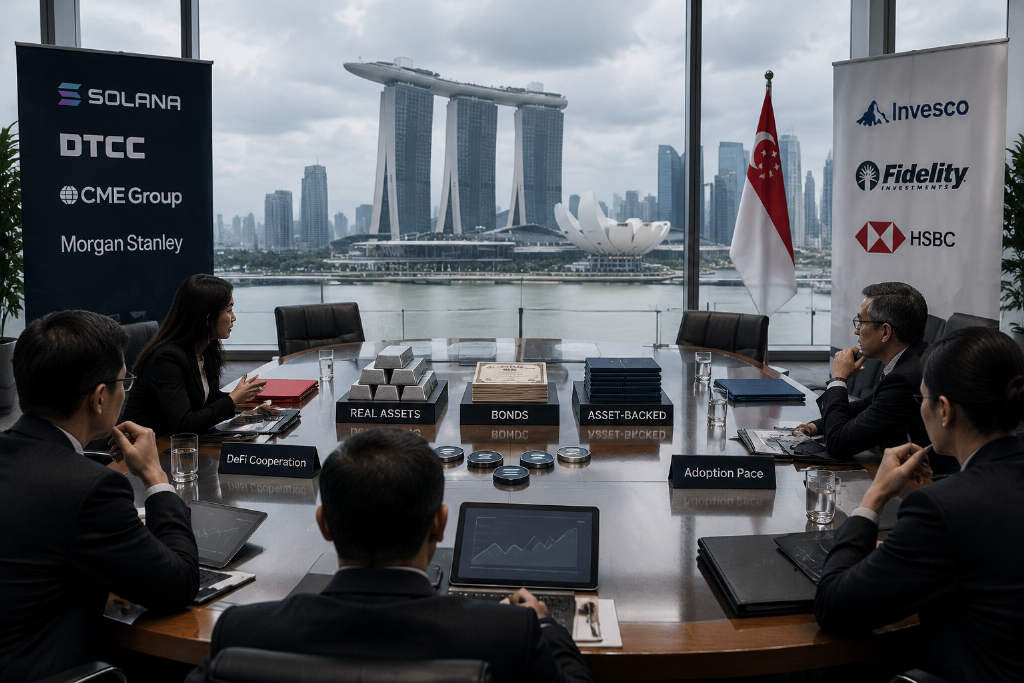
On Oct. 6, one day before TOKEN2049 opened, the Solana Foundation held the Solana Capital Forum in Singapore, an invitation-only event for asset allocators. Participants included the Depository Trust & Clearing Corporation (DTCC), CME Group, Morgan Stanley, Invesco, Fidelity and HSBC, and discussion through the afternoon centered almost entirely on tokenization.

According to data published by the Solana Foundation in late August, the value of real-world assets, or RWAs, on Solana has exceeded $4 billion since the start of 2026, and Solana accounts for more than half of all tokenized stock trading volume across the market.
The shift in tone from last year was clear. The conversation no longer focused on whether tokenization is needed. The harder questions came after issuance: who will use these assets, what will they be used for, and what happens when investors need to exit. One panel moderated by Kamino head of strategic expansion Cheryl Chan made that point explicit in its title: Tokenized. Now What?
Across the sessions, institutions showed broad agreement on three issues and clear disagreement on two others.
Agreement one: tokenization is only a starting point
Some issuers still treat tokenization as a legal wrapper, assuming that once an asset is placed onchain, buyers will follow. The discussion onstage suggested otherwise. Passing suitability checks is only the first step. The larger task comes after that: connecting assets to onchain applications, building secondary liquidity, and making sure there are buyers when lending markets force liquidations.
Traditional users are not drawn in by the technology alone. Superstate said recent conversations with 25 treasury heads at Fortune 100 companies showed limited interest in stablecoins and DeFi as such, but a strong interest in settlement windows. If a bank requires an order before 2 p.m. and $1 billion arrives on a Friday night, that cash can sit idle until Monday, creating a real balance-sheet drag. Tokenized assets with 24/7 settlement can fill that gap. Treasury teams rarely ask which chain a product runs on and may not care much whether it is labeled tokenized. They care whether settlement is immediate and whether funds can be deployed when needed.
Asset management products face the same test. For a traditional client to move into a tokenized version, there has to be a concrete reason: faster settlement, lower cost, or functionality the legacy format cannot provide. Crypto ETPs, or exchange-traded products, illustrate the limit of the old model. A new technology wrapped in an old delivery system can work on wealth platforms without changing how the asset itself operates.
Some of the tougher questions sit deeper in the asset life cycle. Can fundraising itself be done in tokenized form? How should tokenized private shares settle once a company goes public? The broad view from the forum was that issuance-side technology is largely in place, but putting assets onchain does not create a buyer base on its own. Tokenized assets need real utility if they are going to scale.
Agreement two: collateral is the clearest early use case
If tokenized assets have one application that looks the most certain today, it is collateral.
Anchorage Digital pointed to demand arising at the edge of traditional rule sets. In Japan, U.S. securities cannot be used as margin. A tokenized version that can serve as collateral therefore has more value to clients than improvements in distribution alone. Once distribution is handled, composability and practical use become the main drivers.
Market infrastructure is moving in the same direction. CME Group and DTCC have completed a pilot showing that tokenized Treasurys can be used as margin at CME. Crypto futures already trade around the clock, but value still cannot move on weekends, so the next step is a market-structure upgrade that accepts digital versions of existing collateral, including tokenized money market funds and even stablecoins. Regulators are tracking the same theme. The UK Financial Conduct Authority, or FCA, has opened a public consultation on tokenized gold as collateral.
Not every asset fits neatly into that role. In DeFi, a borrower who posts a tokenized asset as collateral, borrows stablecoins, and then buys more of the same asset is structurally in a subordinated position. If returns move around and net asset value falls, liquidation can be triggered, and liquidators may be hard to find for those assets.
U.S. Treasurys show a different problem: economics. For Treasury-based looping to work, someone has to lend at a cost below the Treasury yield, which is rarely the case in practice. That does not make Treasurys unsuitable as collateral. They are among the most common forms of collateral in traditional markets. The issue is whether using them onchain to lever up exposure makes economic sense. The assets that appear better suited for DeFi are those with stable returns that ordinary investors usually cannot access easily. Reinsurance was one example raised in the discussion.
That leads to what participants described as a barbell structure. On one side are short-duration, stable-return assets that fit treasury-style vaults. On the other are more volatile ETF-like products that holders can pledge as collateral to build combinations that are not available in a traditional brokerage account. Underneath that structure was a repeated point: DeFi total value locked, or TVL, is still tightly linked to crypto prices. Real assets are what could loosen that dependence on crypto market cycles.
Agreement three: liquidity is still the main bottleneck
Whenever the discussion turned to constraints, it kept returning to liquidity.
Institutions broadly outlined the same sequence: regulatory clarity first, then enough liquidity to support larger participation, then market scale large enough to justify entry by major allocators. Many big investors still see the market as too small to matter. If liquidity improves and larger participants come in, the effect could compound from there.
At the asset level, the missing piece is atomic liquidity. Tokenized RWAs usually cannot complete a sale and a redemption at the same time. Settlement is often T+1 or T+2, and private credit funds can take even longer. Most of those constraints come from regulation rather than technology. In other words, onchain finance will not fully scale until RWAs can move with the same immediacy onchain that SOL does.
On the financing side, the shortage is fixed-rate capacity. Borrowers need certainty around funding costs. Fixed-rate lending makes sense in principle, but only if there is enough depth and liquidity beneath it. That is a constraint across DeFi lending, not a problem for one protocol alone.
The same applies to trading. Around-the-clock onchain equity markets are limited by liquidity because market makers need stock borrow and two-way quoting, which in turn requires prime brokerage services that can extend across thousands of assets. After the U.S. stock market closes each day, onchain quotes thin out and spreads widen. The weekend effect is even sharper.
That circles back to the first point of agreement. Without genuine use cases, there is no persistent trading or borrowing demand. Without demand, liquidity does not build.
Debate one: has institutional adoption already arrived, or is it still years away?
Views on adoption timing split the room.
The more optimistic side argued that the inflection point is already here. Morgan Stanley has been experimenting on private chains for nearly a decade and described this year’s pace as at a "completely different speed." At a recent Federal Reserve Bank of Philadelphia event, several of the largest U.S. banks appeared together to discuss integration between traditional finance and DeFi, something participants said would have been hard to imagine 18 months ago. Core market infrastructure providers also tied their acceleration phase to the same window, after changes in the regulatory environment. In Hong Kong, HSBC recently issued a digital green bond for the Hong Kong government, allowing investors to subscribe using fiat currency, tokenized central bank money, or HSBC tokenized deposits.
The more cautious view, represented by firms such as Invesco and Fidelity, was that tokenization is a structural change in how asset managers operate. It spans asset classes and jurisdictions and therefore has to move carefully. This is a long-term project, not an immediate operational emergency. Infrastructure has to come first if products are going to scale. The difference between an experiment and an institutional-grade product lies in legal structure and regulatory framework, and in financial markets that tends to be measured in years.
Internal readiness slows the pace further. Some large traditional asset managers do not interact directly with blockchains and instead go onchain through outside partners because internal systems are not ready and technical teams are focused on other priorities, including AI. Many pension funds and insurers still do not even have wallets. Without wallets, they cannot really move onchain, which makes custody infrastructure a prerequisite. Allocators are entering, but slowly. Operational losses and attack incidents still weigh on their decisions.
Both views can hold at the same time. The access layer is moving faster: ETPs, custody and partner-led issuance let institutions gain exposure first. The operating layer is moving more slowly: legal structures, custody setups, wallets and internal systems still need to be put in place one by one. For large institutions, trust remains the most important layer of infrastructure.
Debate two: will institutions cooperate with DeFi, or compete with it?
The second disagreement was more immediate for onchain projects. Does institutional entry expand DeFi, or compete with it?
Multicoin Capital represented the expansion view. Even brokers that are highly active in crypto, the argument went, still rely on existing DeFi applications on the backend for trading and perpetual futures after launching their own chains. Traditional institutions are unlikely to turn themselves into crypto infrastructure companies. Once they adopt the technology, a meaningful share of value should still flow to DeFi applications and base-layer public chains. Traditional finance moves slowly in product development and will need to use components already available onchain if it wants to compete. The more assets move onchain, the more strategies become possible, and the larger the institutions that can participate.
RockawayX argued the opposite side. Institutions are not arriving to invest in onchain projects, but to bring their own products to market and compete directly for DeFi distribution and liquidity. Under that view, crypto-native projects need their own business development and sales channels instead of waiting for institutions to show up.
A third answer emerged through the vault model. On the same day, Kamino’s Mark Hull led another panel on onchain allocation and vaults with Bitwise, Fasanara Capital, Steakhouse Financial and Sanctum. Hull said collateral accepted by Kamino’s lending market has expanded from SOL to long-tail crypto assets, tokenized RWAs, credit funds, reinsurance and tokenized stocks. As market structure becomes more modular and lenders face more choices, lending vaults have started to fill that gap: users deposit assets into non-custodial vaults, and curators allocate capital across different markets.
In that structure, traditional institutions do not simply replace DeFi. They can enter as curators or issuers. Bitwise called vaults "ETF 2.0" because many of the functions of a fund are written into smart contracts, removing many of the roles traditional funds require and making the structure easier to scale. Investors can track capital flows block by block instead of waiting until the end of a quarter.
The constraints are also explicit. Capital destinations, the oracle used for collateral pricing, and the conditions for liquidation are all visible onchain. If a curator wants to change a vault’s mandate, that change has to pass through a timelock, giving users a chance to exit first. Traditional asset management depends on hundreds of pages of disclosures that few investors read. Onchain constraints are written directly into code.
For issuers, vaults also act as a value container. Once fund shares are brought onchain, they can be combined with other products and reach investors who were previously out of reach. At the same time, DeFi users make decisions in their own wallets without relationship managers selling products to them, so offerings have to be simple. Vaults are designed around that reality.
From that perspective, the two views are not necessarily mutually exclusive. At the end-user distribution layer, institutions do bring products that compete for channels. At the asset management and infrastructure layer, they are more likely to connect to existing onchain markets as curators and issuers. As Hull said in closing, the combination of traditional finance and DeFi has moved "from day 0 to day 1," with much further to go before day 10.
Looking to 2030: RWA as a standard tool, while onchain identity remains a hurdle
Institutions were more aligned on the longer-term outlook than on the current pace. By 2030, mainstream institutional adoption is expected to be much broader, and RWAs are expected to become a standard tool for liquidity management and collateral optimization rather than something treated as novel.
Fidelity expects that within a decade, at least one-third of traditional investors will hold tokenized funds through one interface or another, whether they realize it or not. By then, onchain identity could also be much closer to resolution. Fragmented AML and KYC standards are still seen as one of the biggest barriers to scaling.
That brings the discussion back to the panel title, Tokenized. Now What? The answer at the forum was not a single product. It was a set of conditions: assets need practical use, they need to be accepted as collateral, they need liquidity, allocators need to be willing to use them, and institutions themselves need to be operationally ready. The race to issue has largely run its course. The next phase is about who can put those pieces in place first.
This article is based on discussions at the Solana Capital Forum held on Oct. 6, 2026, and does not represent the views of any participating institution. It is not investment advice.
