
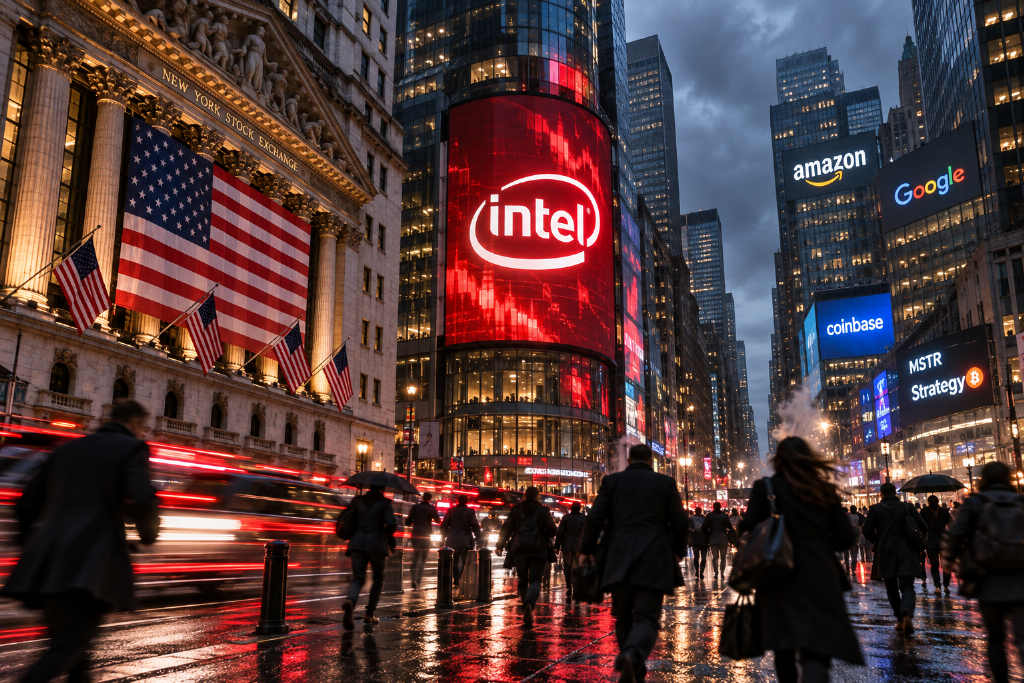
Tech-led selloff dominates Oct. 30 trading
U.S. equities turned sharply lower on Oct. 30, with technology shares taking the brunt of the move. Several catalysts hit at once. Amazon and Alphabet disclosed AI capital spending at levels that pushed investors to question the visibility of returns. Intel beat on third-quarter results but issued a much weaker fourth-quarter outlook, sending shockwaves through the semiconductor supply chain. The Federal Reserve, after its Oct. 27-28 FOMC meeting, left rates unchanged but said it needed an "accumulation of more information" before making adjustments. A Reuters survey cited in the source article said almost all economists still expect another rate hike in December.

Commodities added another layer of pressure. WTI crude settled at $102.95, up 0.93%, staying above the $100 mark. Spot gold fell below $3,900 intraday and closed at $3,884.90, down 3.63% on the day. The source article said elevated oil prices were adding to inflation pressure and narrowing the room for Fed rate cuts.
Indexes and sector rotation
By the 4:00 p.m. ET close on Oct. 30, the market split was clear. The hardest-hit areas were semiconductors and the AI hardware and compute chain. The Philadelphia Semiconductor Index, or SOX, fell 7.20%. Intel dropped 28%, AMD fell 10%, ARM lost 10%, Dell fell 10%, SanDisk dropped 11%, and NVIDIA was down more than 3%.
Defensive groups held up much better and in several cases moved higher. In healthcare, Eli Lilly rose 3.77% and AstraZeneca gained 7.04%. In consumer staples, Walmart added 2.01% and Costco rose 1.94%. Energy names also advanced, with ExxonMobil up 1.18% and Chevron up 1.67%. Among the largest platform companies, losses were more contained: Apple fell less than 1%, Alphabet fell less than 1%, Microsoft lost 1.58%, and Amazon slipped 1.40%.
Fed holds steady, but December hike expectations remain
The Fed left the federal funds rate unchanged at its Oct. 27-28 meeting. Its statement kept a hawkish tone, saying policymakers wanted an "accumulation of more information" before making any move. The source article also cited a Reuters survey dated Oct. 20 showing that almost all economists expected another rate increase in December.
The transmission mechanism laid out in the article was straightforward: a hawkish pause keeps short-end rates elevated, higher discount rates weigh on growth-stock valuations, and uncertainty around AI CapEx payback then intensifies the selling pressure.

Intel: strong Q3, weak Q4 guidance
Intel was the day’s focal point. The company reported third-quarter revenue of $16.5 billion, up 21% year over year, and non-GAAP EPS of $0.52, above the $0.40 market expectation cited in the article. Its DCAI, or data center and AI segment, generated $7.3 billion in revenue, up 78% year over year, which the article described as the strongest growth rate in 15 years.
The problem was guidance. Intel projected fourth-quarter revenue of $15 billion to $16 billion, below the roughly $17 billion market expectation. It guided non-GAAP EPS to $0.25 versus a $0.43 expectation, and forecast gross margin at 38.0%, well below the 44.1% posted in Q3.
The stock fell more than 28% at the open, erasing nearly $150 billion in market value and leaving Intel at about $342 billion, according to the article. CEO Lip-Bu Tan said execution had improved and process technology was advancing, but investors focused on the deterioration in near-term earnings visibility. The move spread quickly across the supply chain, hitting AMD, ARM, NVIDIA, and TSMC.
Amazon: AI infrastructure spending becomes the story
Amazon reported third-quarter revenue of $201.9 billion, up 12% year over year. Operating income reached $28.1 billion, up 61%, and operating margin hit a record 13.9%. AWS revenue came in at $46.0 billion, up 39.3%, with an annualized run rate of $184 billion.
What shook the market was spending. Amazon posted Q3 cash CapEx of $75.9 billion, far above expectations, and raised its full-year outlook to about $220 billion. The article said more than 65% of that total is going to AI infrastructure. Management said the investment is meant to expand revenue and free cash flow over the long term, while also acknowledging that AI services currently carry lower margins than the core cloud business. Amazon shares fell about 1.4%.
Alphabet: slower search ads and heavy CapEx hit sentiment
Alphabet released its third-quarter results after the close on Oct. 28. Revenue was $127.6 billion, up 25% year over year, but below the $128.2 billion expectation cited in the article. Net income was $26.2 billion, down 25%. Free cash flow was negative $9.1 billion, marking a second straight negative quarter, while CapEx totaled $51.4 billion.
There were bright spots. Google Cloud revenue doubled year over year to $30.7 billion, above the $28.8 billion expectation, and TPU products had started external sales. But search advertising revenue came in at $63.4 billion, up just 12% and below expectations. The article said monetization efficiency for AI-mode queries remained weak.
The market response was severe. Alphabet fell 12.64% on Oct. 29, its biggest one-day decline since listing, wiping out about $500 billion in market value. The article said several brokerages cut price targets, including RBC from $425 to $400 and D.A. Davidson from $350 to $300.
Semiconductors sink while defensive sectors gain
The semiconductor selloff was broad. SOX dropped 7.20%. Beyond Intel, AMD fell 10%, ARM lost 10%, Qualcomm and Dell were down more than 10%, SanDisk fell 11%, and TSMC lost 4%. The article framed the move as a reset in expectations for the semiconductor cycle as the visibility of returns on AI hardware spending deteriorated.
Money rotated into defensive areas instead. Eli Lilly rose 3.77% and AstraZeneca gained 7.04%. Walmart added 2.01% and Costco rose 1.94%. ExxonMobil and Chevron advanced 1.18% and 1.67%, respectively. The source article described the shift as a move out of growth and into defense, reflecting a clear risk-off tone.
Crypto-linked U.S. stocks: Strategy posts record profit, MSTR still falls
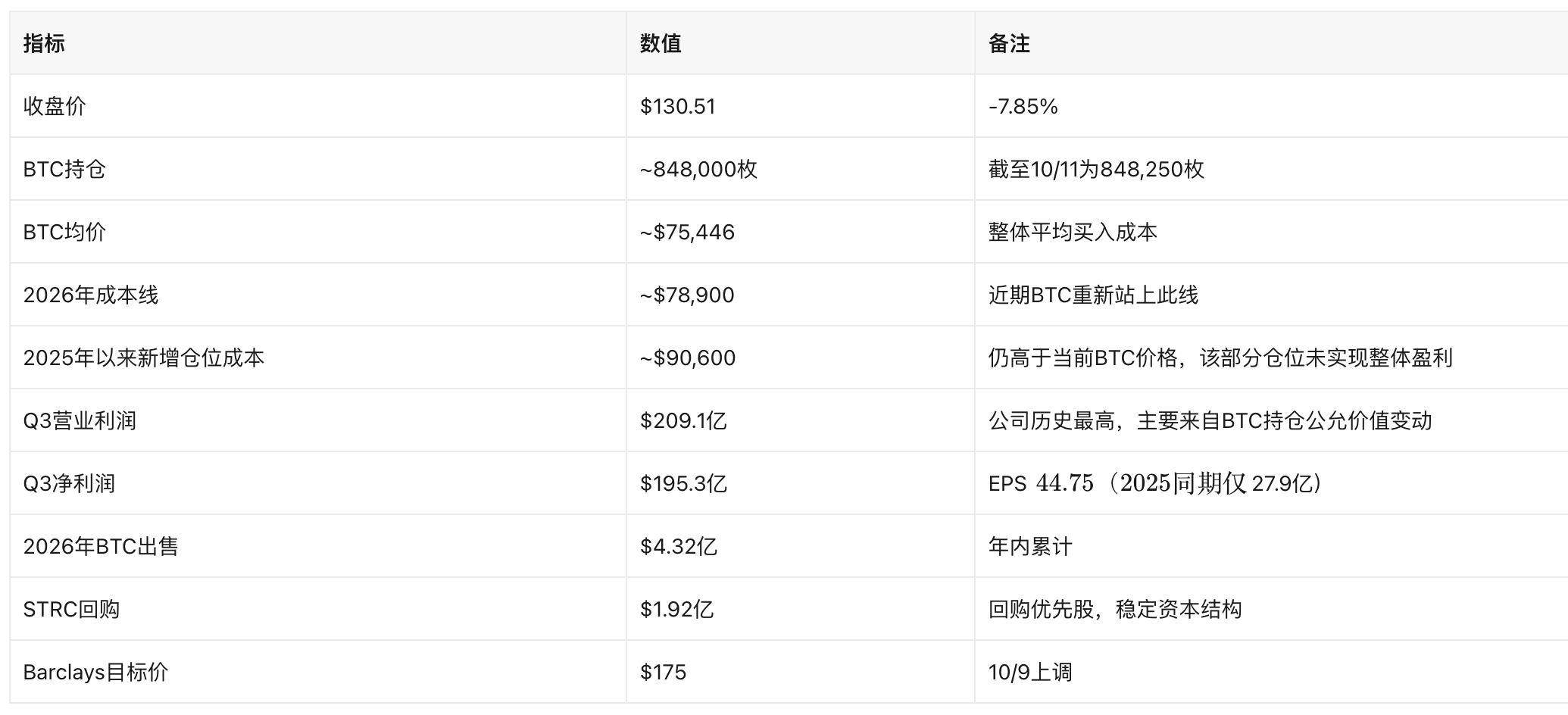
Among crypto-related equities, Strategy reported Q3 2026 operating profit of $20.91 billion and net profit of $19.53 billion, with EPS of 44.75. The article said the record result was driven mainly by fair-value changes in its BTC holdings. The company held about 848,000 BTC at an average price of roughly $75,446 and also repurchased 192 million STRC preferred shares. Barclays had previously raised its price target to $175.
That did not shield the stock from the broader selloff. MSTR closed at $130.51. Using the article’s rough calculation of 848,000 BTC multiplied by $77,206, the company’s holdings were worth about $65.47 billion before debt. On that basis, the article said mNAV was well below 1.0x, reflecting a market discount tied to leverage and funding-chain sustainability concerns for digital asset treasury companies. It also noted that Peter Schiff had previously questioned the sustainability of STRC financing.
The article added two names to its crypto-equity watchlist. First, according to a Coingape report dated Oct. 26, a Vanguard ETF bought 4.5 million shares of Metaplanet for the first time. Second, AZI, or Autozi Internet Technology, announced in February that it would invest 1.1 billion and acquire 1.87 billion in digital assets counter-cyclically, while entering digital asset treasury and compliant payments infrastructure with crypto partners. The article said follow-up developments remain to be tracked.
Coinbase, spot ETF flows, and the Binance security issue
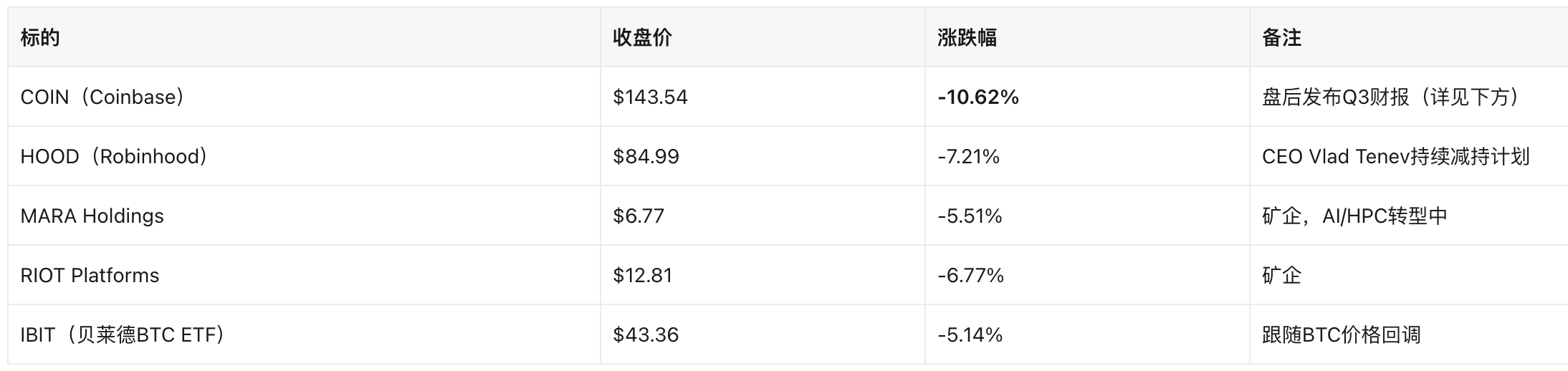
Coinbase released its Q3 2026 earnings after the U.S. market close on Oct. 30. The article said detailed figures were still pending, but the stock had already fallen 10.62% during the session, reflecting concern about slower revenue growth at crypto trading platforms.
For spot Bitcoin ETFs, the article’s read was that October saw a small net outflow overall, but flows turned positive for three straight days from Oct. 26 to Oct. 28, led by IBIT, suggesting a marginal improvement in institutional demand. Compared with the weak period in June, when net outflows reached $4.52 billion, current fund flows were described as relatively stable.
On stablecoins and payments, the article said Circle had no major news on the day, and there were no major crypto-related announcements from Visa, Mastercard, or PayPal. Reuters also reported on Oct. 30 that Binance had disclosed a security issue, briefly pressuring BTC and broader crypto prices. Specific details had not yet been released.

Accounting rules remain a key driver for digital asset treasury firms
The article said fair-value accounting under FASB ASC 350 is now in effect, allowing digital asset treasury companies to record fair-value changes in BTC holdings through the income statement. Strategy’s $20.9 billion in Q3 operating profit was cited as a direct example. The article said the rule continues to encourage more companies to consider adding BTC to their balance sheets.
There was no major new SEC development on the day, though the market remains focused on whether disclosure requirements for digital asset treasury companies will be refined further.
Cross-market signals: MSTR and COIN underperform BTC
BTC was quoted at $77,206, down 0.74%, while MSTR fell 7.85%. The article said that gap showed digital asset treasury stocks were being dragged lower by the broader tech selloff, with mNAV discounts widening further.
Coinbase fell 10.62%, more than 14 times BTC’s decline by the article’s calculation, highlighting the high-beta nature of crypto trading platforms in a risk-off market. Mining names such as MARA and RIOT posted declines close to the SOX index, which the article linked to a broader repricing across AI and compute-related chains.
Middle East tensions, oil, tariffs, and the U.S. midterm election
On geopolitics, the article said the U.S.-Iran standoff remained unresolved. The Trump administration was maintaining a maritime blockade on Iran and rejected Tehran’s proposal to lift the blockade before advancing talks. Iran responded with a hard line, and its military warned of countermeasures.
That kept a risk premium in energy markets. WTI stood at $102.95, up 0.93%, while Brent crude remained in a $105 to $110 range. The article laid out the chain clearly: higher oil prices lift U.S. gasoline prices, add to inflation pressure, reduce the Fed’s room to cut rates, and weigh on growth-stock valuations. For crypto, the article said geopolitical stress would normally support the "digital gold" narrative around BTC, but this time inflation concerns tied to oil prices and the Fed’s hawkish stance were the dominant forces, so BTC moved lower with other risk assets.
On trade, the effective U.S. tariff rate on global trading partners remained around 13.7%, based on data through February 2026 cited in the article. It also said trade friction remains relevant for semiconductor supply chains and that part of Intel’s weak Q4 guidance reflected uncertainty in global demand.
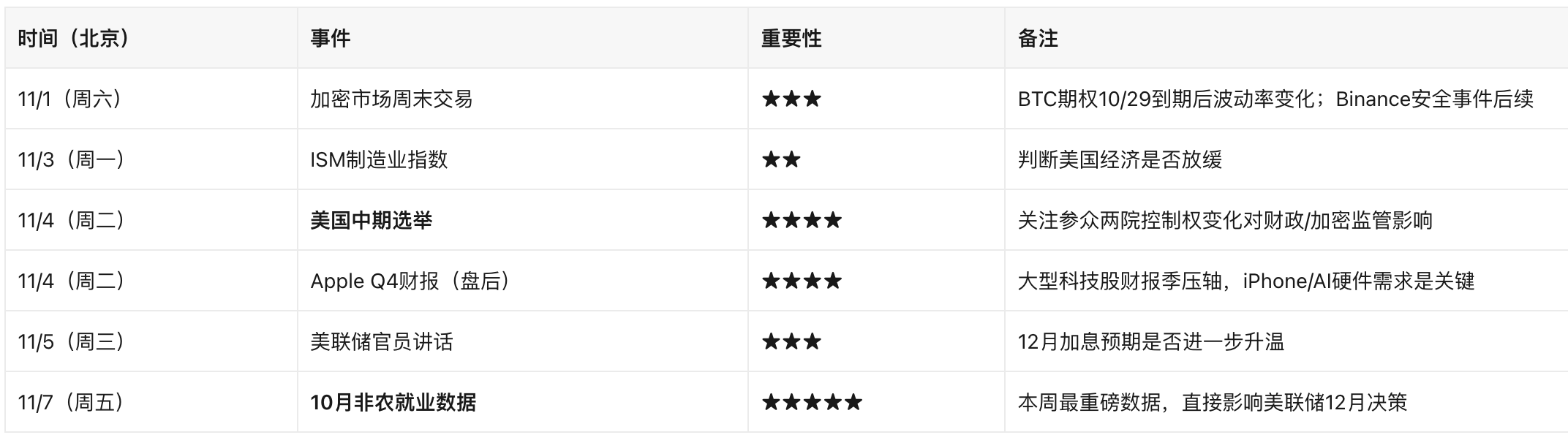
Politically, Nov. 5 is the date of the U.S. midterm election. The article said the race remained tight and markets were watching policy uncertainty closely, including fiscal policy, crypto regulation, and trade direction.
What the market is watching over the next 24 to 48 hours
The source article listed several near-term focal points. One is the market’s digestion of Coinbase’s Q3 report, especially trading volume, subscription revenue, and compliance progress. Another is the follow-through from Strategy’s earnings, with investors reassessing MSTR’s mNAV and funding sustainability around BTC near $77,000, while also watching for any new BTC purchase announcement. Spot Bitcoin ETF flows at the start of November are another signal to watch after the late-October rebound. The Binance security issue is also on the list, as a more serious disclosure could draw both market and regulatory attention.
The article also flagged several risks. If Apple’s earnings show AI spending pressuring margins, the tech selloff could deepen. If Middle East tensions push oil above $110, inflation pressure and hawkish Fed expectations could intensify. If BTC falls below $75,000 and Strategy’s 2026 cost line of $78,900 is decisively broken, mNAV discounts and forced selling pressure across digital asset treasury names could widen. An unexpected U.S. midterm election outcome could also hit risk appetite in the short term.



