
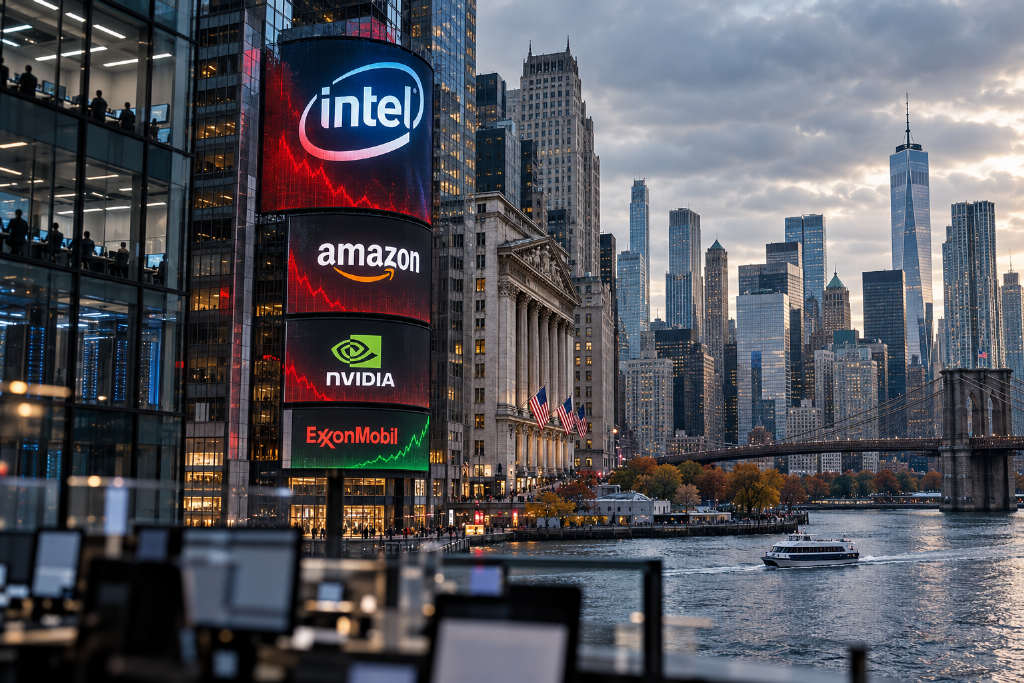
U.S. stocks opened lower on Oct. 30, and the sell-off in technology shares continued. The Dow Jones Industrial Average was down about 0.2%, the S&P 500 fell about 1.1%, and the Nasdaq dropped about 2.2%. CNBC said investor concern rose after earnings from Amazon and Intel sharpened questions over whether heavy AI spending by large tech companies can pay off.
Tech shares stayed under pressure at the open
Among individual names, Intel (INTC) fell about 25.7%, Amazon (AMZN) lost about 5.3%, and Nvidia (NVDA) was down about 2.5%. Cloud startup Nebius (NBIS) also fell about 7.3%. Gold and silver shares weakened as well, while some oil stocks moved the other way. Exxon Mobil (XOM) rose about 1.5%.
The Nasdaq remained the weakest major index, extending the pressure on technology shares seen earlier in the week. The report said this was not a one-day shock. During the same week, Alphabet had already seen a sharp pullback after free cash flow moved deeper into negative territory, while Microsoft held on to positive cash flow, pushing the market to draw a clearer line between companies still able to spend aggressively on AI and those losing cash flow support.
Nasdaq futures had already been down about 2% before the opening bell, and the cash index largely followed that path once trading began. With index weight concentrated in semiconductor and cloud giants, any disappointing guidance from a major company is being read as a repricing signal for the broader AI infrastructure chain.
Names tied to new cloud and AI infrastructure themes also came under pressure. Nebius fell about 7.3%, showing that investors were not only cutting exposure to the traditional Magnificent Seven group, but also cooling on later-stage high-growth narratives.
Intel guidance and Amazon cash flow drew the market’s focus
Intel’s sharp drop followed fourth-quarter revenue guidance of about $15 billion to $16 billion, below prior market expectations of about $17.1 billion. Its finance chief warned that weak PC demand would likely continue through the first half of 2027. A soft PC market, combined with capacity and expansion spending, made pressure on free cash flow harder for investors to ignore.
Amazon, meanwhile, kept capital spending at a high level and posted a second consecutive quarter of negative free cash flow. Its fourth-quarter outlook also came in below expectations. The report said the company’s cloud and retail businesses still have underlying support, but investors are now asking a different question: after the money goes out, when does cash flow turn positive again?
Nvidia fell about 2.5%. The decline was smaller than the moves in Intel and Amazon, but the stock was still pulled lower by the broader technology sell-off. Market attention has shifted from AI compute shortages to a more direct set of questions: who is spending heavily, for how long, and whether there is enough cash flow to absorb it.
Money rotated toward parts of the energy sector
While technology stocks faced valuation pressure, some oil names traded with a different tone. Exxon Mobil gained about 1.5% at the open. Gold and silver shares fell sharply, suggesting that capital was being repositioned across defensive and commodity trades as well, rather than reflecting a simple, market-wide shutdown in risk appetite.
The report also pointed to higher financing costs and rising credit risk as another line running through the sell-off. Expansion in AI data centers and chip capacity depends heavily on capital markets and bond financing. When negative free cash flow appears alongside lower guidance, investors become more sensitive to leverage and refinancing conditions.
The market is repricing the AI spending cycle
This opening move was not framed as a reaction to one earnings miss alone. Instead, it brought the question of how long AI infrastructure spending can continue directly into index and stock pricing. Intel challenged the recovery narrative with weaker PC demand and lower guidance, while Amazon’s back-to-back quarters of negative free cash flow reminded investors that even cloud giants are being judged on cash generation.
Short-term flows moving toward some energy stocks and away from richly valued technology heavyweights reflect a shift in risk pricing, not the disappearance of the AI theme. For Taiwan supply chains and other risk assets tied to cloud and semiconductor orders, the report said the market is now writing one issue directly into share prices: whether high spending can be converted into cash flow, with valuation and financing conditions tightening alongside that reassessment.


