
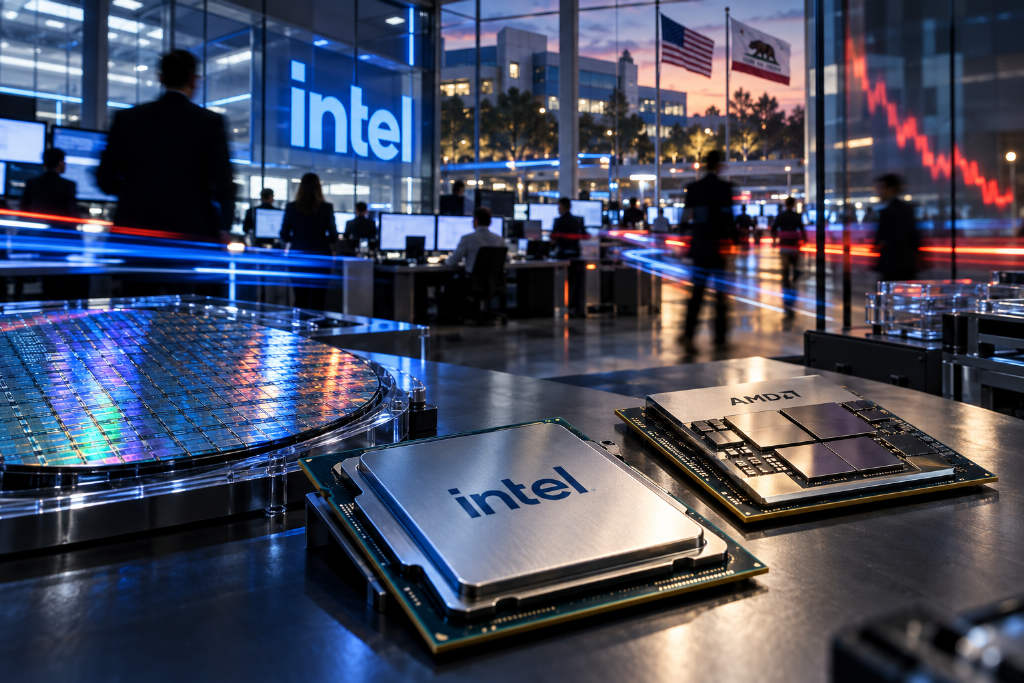
Intel reported third-quarter 2026 results and issued fourth-quarter guidance that came in below market expectations, as weak PC processor demand and supply-chain constraints weighed on the outlook. After the release, Citrini researcher Zephyr said in a post that Intel remains too dependent on the consumer PC market, while AMD’s chiplet design gives it an edge in the current correction.
Q4 guidance missed expectations and the stock fell 16% after hours
Intel said third-quarter revenue rose 21% year over year to $16.5 billion. Its data center and AI unit climbed 78% to $7.3 billion. The client computing group, which houses the company’s PC chip business, fell 5% to $8.1 billion.
For the fourth quarter, Intel projected revenue of $15 billion to $16 billion, below the analyst average of $17 billion. Adjusted earnings per share were guided to $0.25, also below the expected $0.43. The stock dropped 16% in after-hours trading following the announcement.
The company also said fourth-quarter gross margin is expected to decline to 38% from 43% in the third quarter, citing persistently high wafer manufacturing costs and a shift in product mix.
Memory price increases and shortages hit PC shipments
Intel said the decline in client computing revenue was tied to shortages of memory chips from suppliers including Samsung Electronics, SK Hynix, and Micron. Higher component prices then weighed on end shipments of laptops and desktops.
Chief Executive Officer Lip-Bu Tan said rising memory costs are a challenge across the industry. He expects the global PC market to decline 12% in 2026 and contract another 10% in 2027, with weak conditions lasting at least through the first half of 2027.
Researchers said Intel underestimated the speed of the inventory correction
Citrini researcher Jukan said Intel badly underestimated how rising memory prices would hit PC demand and how quickly the inventory correction would unfold. He said those risks had already surfaced during the second-quarter earnings call, and management had acknowledged them, yet still expected client revenue in the third quarter to stay roughly flat and counted on CPU restocking to provide support.
That assumption now looks too optimistic, Jukan said, and Intel should have set a more conservative expectation for the client business.
Client computing still accounts for nearly half of revenue
Intel’s filing showed that the client computing group generated $8.1 billion in the third quarter, close to half of the company’s $16.5 billion in consolidated revenue. That leaves the company highly exposed when PC demand cools quickly.
Independent semiconductor analyst Alex, who is also described as bullish on Intel, said the issue is not only demand but execution. He had expected substrate supply to be the limiting factor and to constrain growth in the third and fourth quarters. In his view, Intel did not cut Intel 7 client capacity aggressively enough to redirect output toward data center products, and it may still be holding hundreds of millions of dollars in 18A client chip inventory, which he framed as a management problem.
On Intel’s view that total addressable market, measured by shipments, will decline 10% next year and may not improve until 2028, with no recovery in 2027, Zephyr said that outlook still looks too optimistic. He expects PC shipments next year could fall 20%.
Zephyr pointed to AMD’s chiplet model as a better fit for the cycle
With PC demand weakening and server demand staying firm, Zephyr said AMD’s fungible chiplet architecture may be in a stronger position. The report summarized the case in two main parts:
- Higher data center exposure and expanding supply: Compared with Intel, AMD gets a smaller share of revenue from client products, which reduces the hit from a weaker PC market. The company is also increasing supply for data center products and extending its planning horizon to three to five years.
- Cost and yield flexibility from chiplets: Smaller dies tend to have better yields. When advanced-node manufacturing is expensive and capacity is tight, that can be more economical than a large monolithic design. Some components can also be mixed across consumer, server, and AI product lines, while different functions can use different process nodes.
Server CPU demand remains strong as investors watch 14A and 18AP
Even with the weak near-term guidance, Tan’s comments on the earnings call were still constructive. In Jukan’s summary, Tan expects industry supply to remain tight through all of 2027 and into 2028, and said industry server CPU shipments should grow more than 30% in both 2026 and 2027. He added that growth would be even higher if more supply were available.
Alex approached the issue from a capacity angle. He said Intel’s answer to a monthly shortfall of 20,000 to 25,000 Intel 3 wafers is to restart Intel 3 in Oregon and convert Fab 38 to 14A. Combined with full utilization in Ireland, at about 65,000 to 70,000 wafers, and roughly 20,000 wafers of added Oregon capacity, he said most models have not yet reflected that step-up. In his view, the 2027 growth story has not changed much, though the next two quarters of earnings will be affected by the gap.
He estimated that out of roughly $20 to $30 in profit over the next four years, only about $1 of EPS would disappear because of this issue, which in his view does not justify a 22% drop. Still, he said the misread revived memories of 2022 to 2024, prompting investors to sell.
Alex also said Tan had hinted that more developments are coming soon, including the Ohio plant tied to SK Hynix and 18AP and 14A customers expected to be announced in the first quarter of 2027.



