
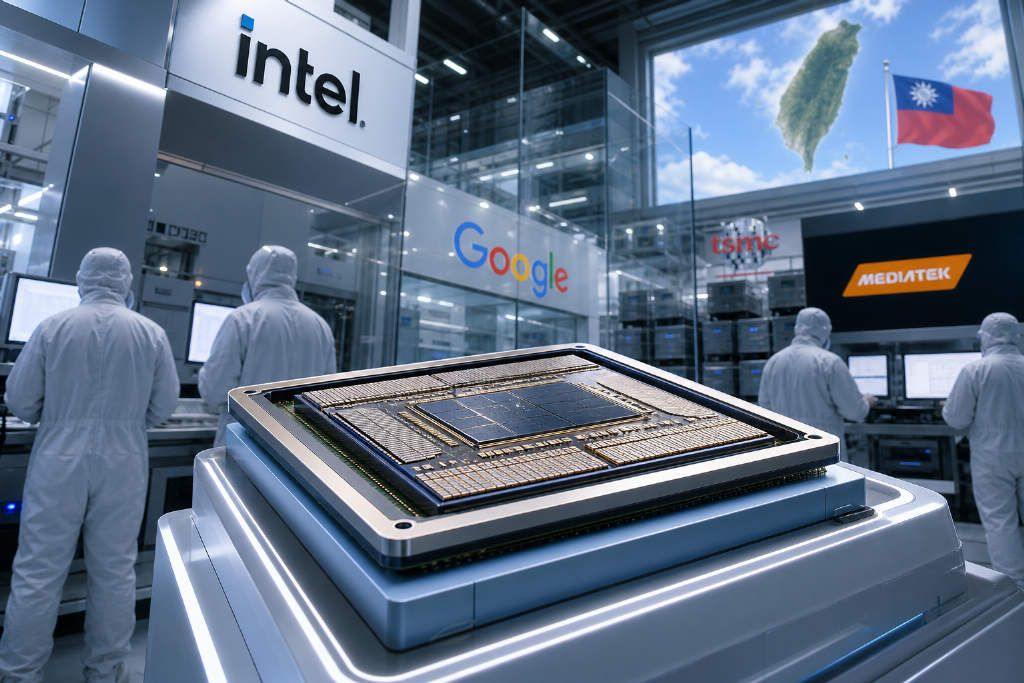
Intel’s EMIB advanced packaging technology has passed yield and performance validation in a Google Tensor Processing Unit, or TPU, project, DigiTimes reported, citing supply-chain sources. The report said the result has not only strengthened Google’s willingness to continue using EMIB, but has also prompted MediaTek, Google’s ASIC partner, to speed up its move toward a more diversified packaging strategy. With Taiwan Semiconductor Manufacturing Co.’s CoWoS capacity staying tight, Intel EMIB is emerging as a serious alternative in the advanced packaging market.
Google TPU project gives EMIB a key validation point
The shift began after Google confirmed that its AI accelerator TPU would use Intel’s EMIB packaging technology, the report said. Supply-chain sources told DigiTimes that the first Google TPU product built with EMIB reached its preset yield target and met Google’s requirements across technical specifications, production cost and manufacturing capacity.
That matters beyond a single production milestone. According to the report, once yield reached target levels, the case for keeping EMIB in later TPU generations became much stronger. With CoWoS capacity still constrained, Google has little reason to return to earlier sourcing plans if Intel can keep yield and technical performance at the same level. Under those conditions, the current cooperation path could continue.
MediaTek acts as the link between Google and Intel
MediaTek played a central role in connecting Google and Intel in the project, the report said. As Google’s main ASIC design partner for the TPU program, MediaTek’s ability to integrate the technology stack directly affected whether the EMIB solution could be implemented smoothly.
People familiar with MediaTek’s internal operations told DigiTimes that several senior executives in the company’s U.S. ASIC team have Intel backgrounds. That reduced the friction of an initial cross-company partnership. The report said first-time cooperation is usually the hardest stage; once that hurdle is cleared and experience is built, later collaboration tends to become easier. Seeing that process work, Google would be more confident in keeping the same supplier combination.
Even though MediaTek has consistently treated TSMC as its priority partner and has kept relations with other suppliers relatively low-profile, the successful work with Intel EMIB has already given the company a more diversified advanced packaging setup, according to the report.
MediaTek sees value beyond one Google order
For MediaTek, the strategic value goes well beyond winning business tied to Google, the report said. If the company can work with both TSMC CoWoS and Intel EMIB, it can offer a broader range of technical options when competing for ASIC programs from other cloud service providers, or CSPs. That could improve its bargaining position in future deals.
Demand for AI infrastructure is growing rapidly, and cloud groups including Amazon, Microsoft and Meta are all pushing ahead with in-house AI chip programs. As their requirements for ASIC design partners become stricter, suppliers able to coordinate with multiple advanced packaging vendors may hold an edge over rivals that depend on a single packaging source. The report framed the Google TPU case as an important capability check for MediaTek as it strengthens its standing in the CSP ASIC market.
TSMC capacity limits are pushing the supply chain outward
From TSMC’s side, the report noted that the company had previously said on an earnings call that it hoped more suppliers would enter advanced packaging to help ease supply pressure. That signaled capacity limits on its own side and indirectly accelerated the broader diversification trend now taking shape.
The report also said Intel’s supply chain had historically been relatively closed, making entry difficult for Taiwanese companies. If the Google TPU project continues successfully, it could open a new path for Taiwan’s supply chain. Looking ahead, the advanced packaging opportunities tied to Intel’s own CPU products were also described as significant. For Taiwanese companies involved in test equipment and high-speed interface components, the report said this could become a new area worth targeting.