
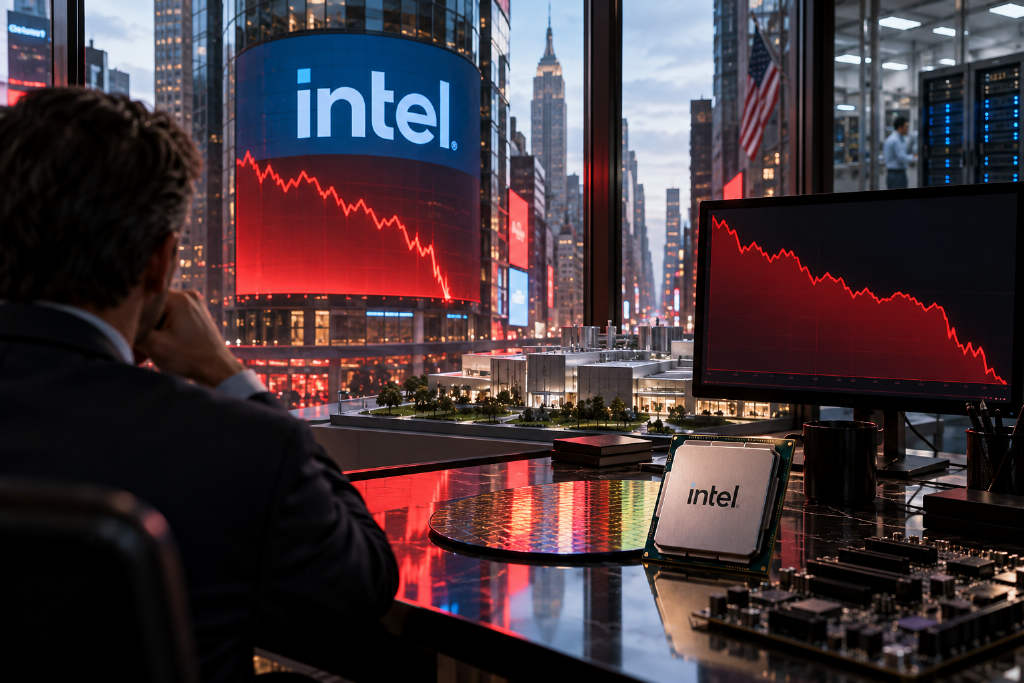
Intel shares sank nearly 30% to $65.76 on Friday after the chipmaker gave a fourth-quarter forecast that missed Wall Street expectations by a wide margin, overshadowing what had otherwise been a strong earnings report.
The selloff wiped out more than $146 billion in market value and marked Intel's worst one-day decline in more than 50 years.
Strong third-quarter results failed to calm investors
Intel is in an unusual spot. Demand for its processors is rising as AI infrastructure spending expands, yet the company does not have enough manufacturing capacity to fully capture that demand. At the same time, its legacy PC business is under pressure, while the factories tied to its long-term recovery are consuming large amounts of capital.
Its third-quarter numbers were solid. Revenue rose 21% year over year to $16.5 billion, and adjusted earnings per share came in at $0.52. That was above Intel's own guidance of $0.38 and ahead of Wall Street's $0.40 estimate. According to CFO Dave Zinsner, it was the eighth straight quarter in which the company exceeded its own financial expectations.
Data Center and AI led the quarter
The company's strongest segment was Data Center and AI. The division generated $7.3 billion in revenue, up 78% from a year earlier and nearly 80% versus the same period last year. Operating profit for the unit reached $3 billion, equal to 42% of revenue.
Still, the market was looking past the quarter that had just ended. Intel said it expects fourth-quarter revenue of $15 billion to $16 billion. The midpoint of that range, $15.5 billion, is about $1.6 billion below the $17.07 billion analysts had expected. Adjusted earnings per share are projected to fall to $0.25, versus Wall Street's $0.43 estimate.
Margins are expected to weaken
Gross margin is also set to deteriorate. Intel forecast a non-GAAP gross margin of 38% for the fourth quarter, down from 44.1% in the third quarter.
The company pointed to three main pressures behind that decline: weaker PC demand, manufacturing constraints affecting server processors, and an accident at one of its factories in Israel.
Zinsner calls 2027 an investment year
During the earnings call, CFO Dave Zinsner described 2027 as an investment year and told investors not to expect positive free cash flow. Free cash flow refers to the cash left after a company covers operating expenses and spending on equipment and infrastructure. Intel said it is prepared to give up near-term cash generation in order to finance its manufacturing buildout.
"Probably not a dynamic where we are going to have positive free cash flow next year," Zinsner said on the call. He added that Intel expects at least a 20% return on invested capital from its manufacturing node investments, while also acknowledging that several major projects will require heavy spending at the same time.
Foundry push and strategic partnerships remain central
That spending is part of Intel's broader effort to rebuild its manufacturing business and compete more directly with Taiwan Semiconductor Manufacturing Company, or TSMC, the world's leading contract chipmaker. Intel wants to make chips not only for its own products but also for outside customers through a foundry model.
The turnaround effort has already drawn major partners. In September 2025, Nvidia invested $5 billion in Intel and agreed to work with the company on custom processors for PCs and data centers. The deal gave Intel a financial lift and linked its processors more closely to Nvidia's AI ecosystem.
Intel's next-generation 18A process is also central to the plan to regain a technological edge. The manufacturing technology is expected to underpin chips including Panther Lake.
More recently, a preliminary agreement with Apple to manufacture some of its chips helped push Intel shares above $130 in May. If completed, the arrangement could give Intel an important new customer as Apple looks to diversify its manufacturing supply chain.
Demand is there, but execution remains the issue
Those developments had helped fuel optimism around Intel's recovery. Friday's selloff showed how much still has to go right. The company has strong demand in data center products, but it still needs to raise manufacturing output, deal with a shrinking PC market, and keep funding an expensive expansion before investors are likely to see steady cash generation.


