From Experiment to Industry: Regulatory Intervention Meets Industrial Formation
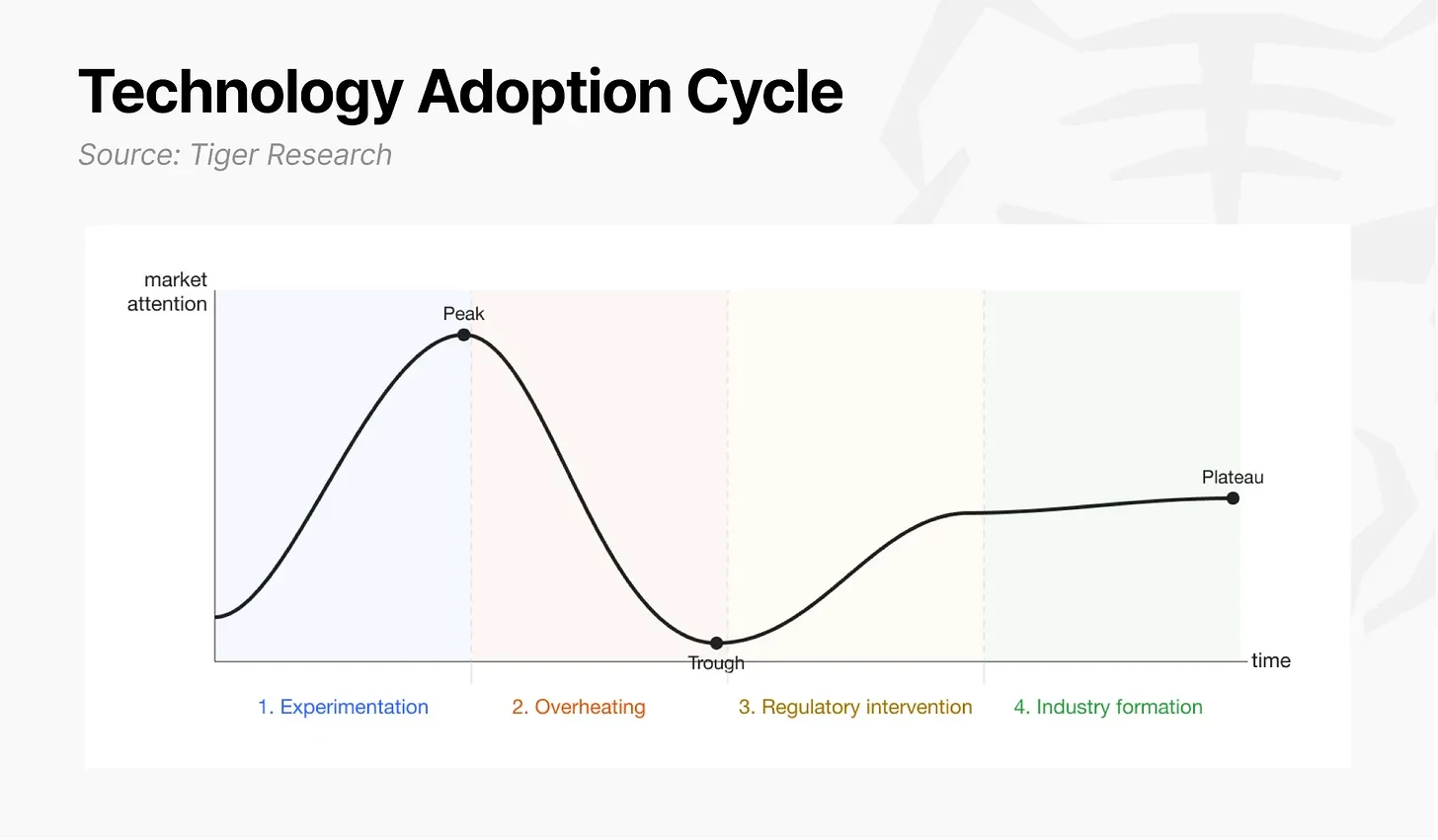
New technologies typically undergo four stages: experimentation, overheating, regulatory intervention, and industrial formation. The crypto industry is currently in the transition zone between stage three and four. After Bitcoin's birth, the ICO boom and DeFi surge marked the overheating phase, with the FTX collapse in 2022 serving as both the peak and inflection point. Since then, speculative demand has been filtered out, real-world use cases have been validated, and U.S. regulators have shifted toward formalization rather than laissez-faire or suppression. Because crypto aims to directly replace core financial functions like settlement, payments, and issuance, it faces greater friction with traditional financial institutions and takes longer to be absorbed. Now the industry has finally reached the convergence of regulatory intervention and industrial formation.
Defining Internet Capital Markets: Redefining Asset Issuance, Trading, and Settlement
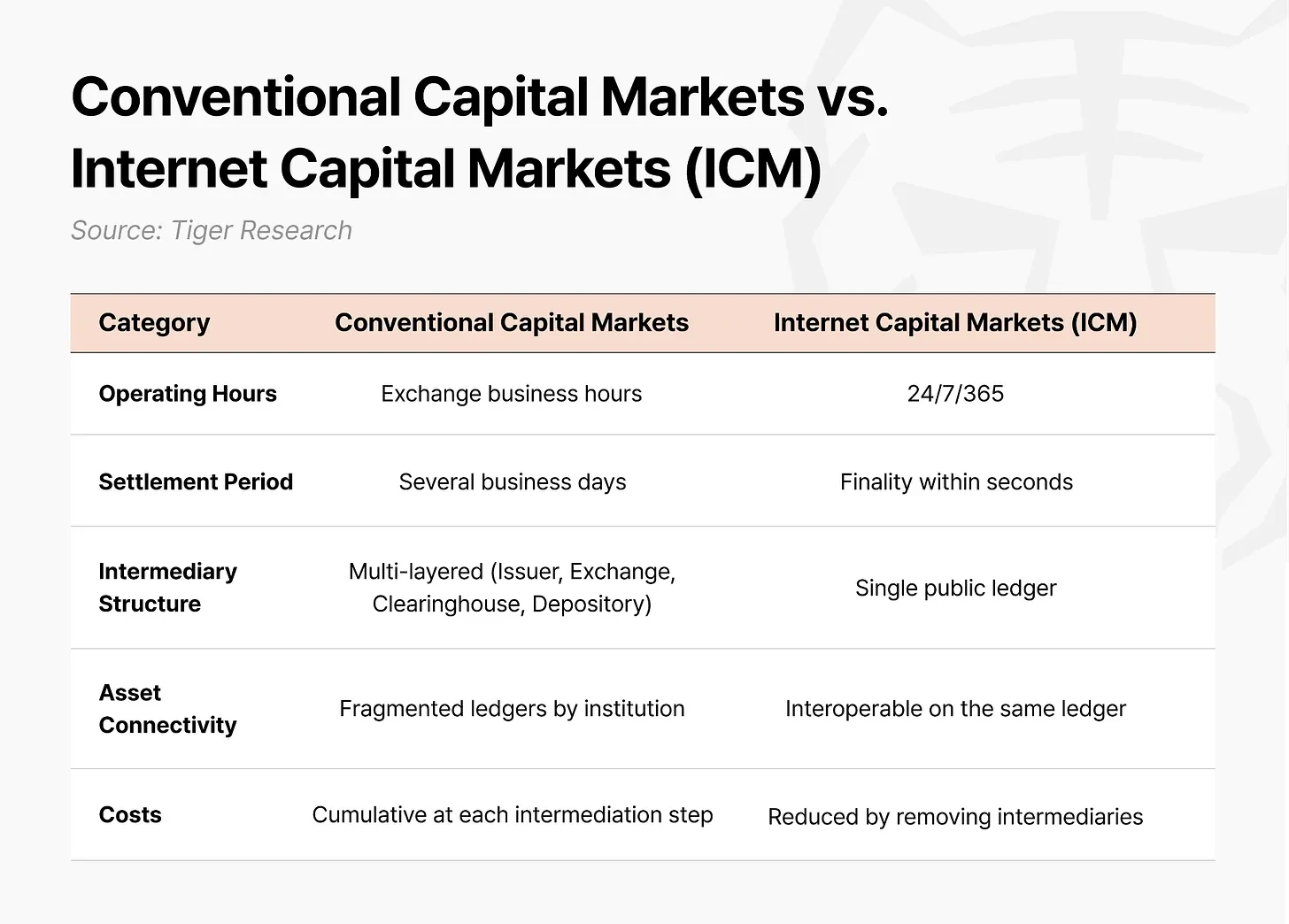
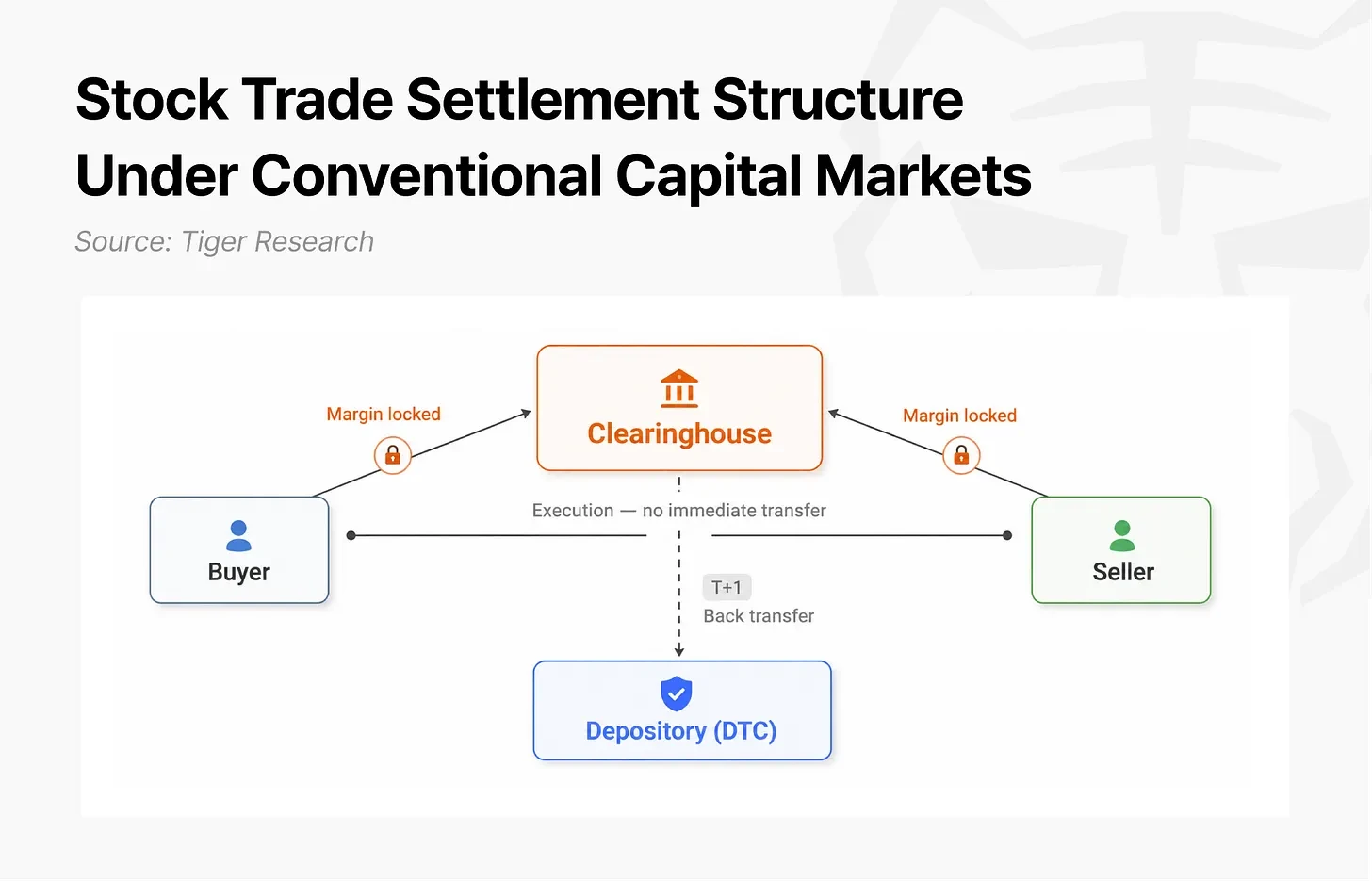
What the crypto industry points to as it enters the industrial phase is a reconstruction of the capital market itself. This future can be defined as Internet Capital Markets (ICM): a capital market where asset issuance, trading, and settlement all occur on a single public blockchain. Today's capital markets run on infrastructure designed before the internet existed. Buying a stock requires intermediaries such as clearinghouses, custodians, and depositories; settlement takes T+1 or even T+3. In ICM, code replaces the role of the clearinghouse. Smart contracts simultaneously transfer assets and payments, executing and settling in seconds without the need for reconciliation or margin. The entities driving this transformation are expanding from crypto startups to traditional financial institutions. Institutions that once earned revenue from multi-layered intermediary structures are now themselves participating in this shift.
Major Breakthroughs in the U.S. Regulatory Framework
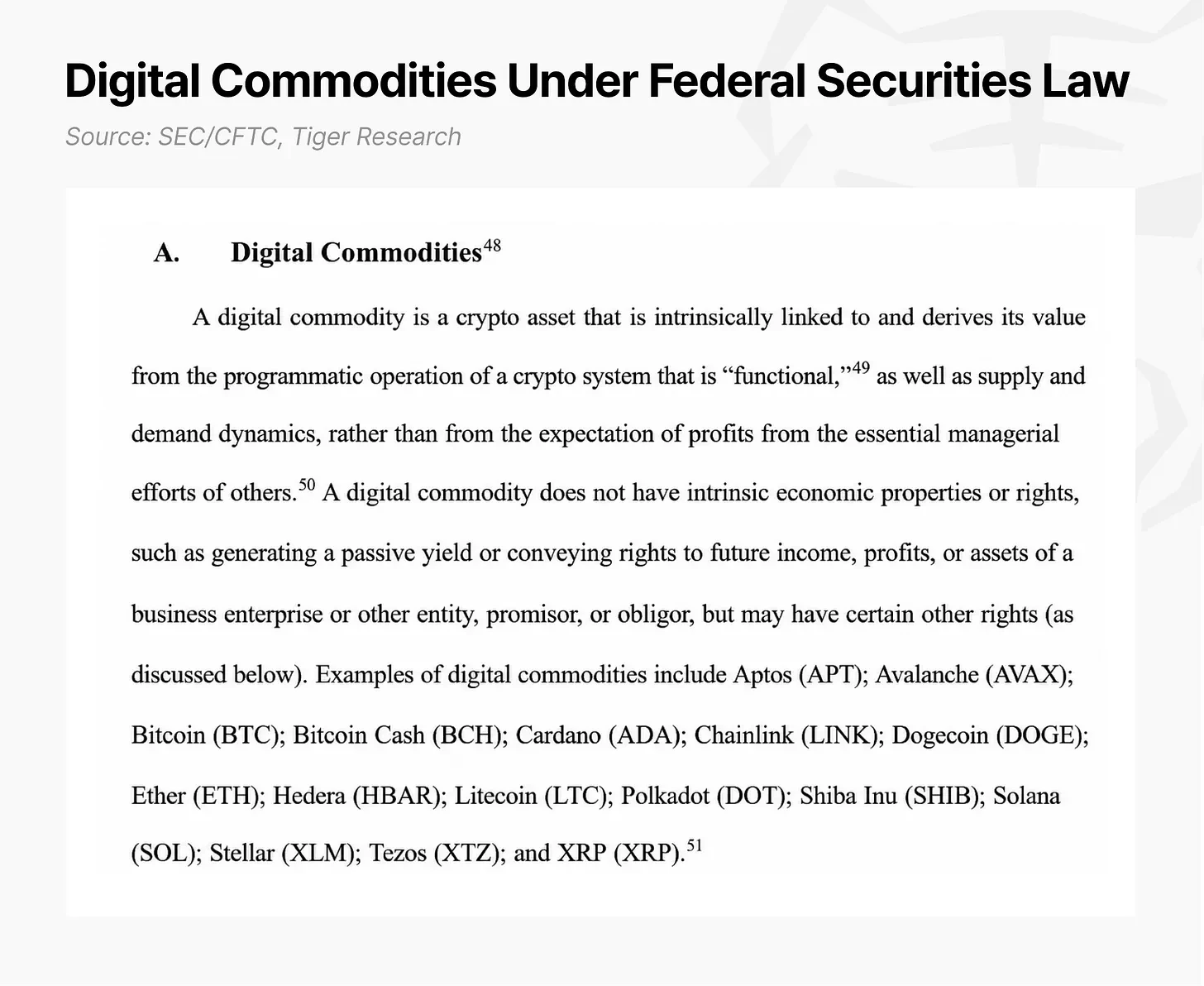
Significant regulatory progress has been made. The U.S. Congress passed the GENIUS Act, clarifying the legal status of stablecoins. In March 2026, the SEC and CFTC issued joint interpretive guidance classifying 16 assets including Solana (SOL) as digital commodities, moving away from the binary "security/non-security" framework. They also formally excluded protocol staking from securities laws. This provides institutional investors with legal assurance to buy, hold, and stake assets. Additionally, the SEC approved Nasdaq to trade certain securities in tokenized form, and the DTCC confirmed a limited pilot in July with a full rollout in October. The CFTC approved Kalshi's Bitcoin perpetual futures contract for the first time, taking the first step to bring offshore perpetual futures liquidity (approximately $61.7 trillion in 2025) into the U.S. regulated system.
Solana: The Leading Public Blockchain for Institutional Practice
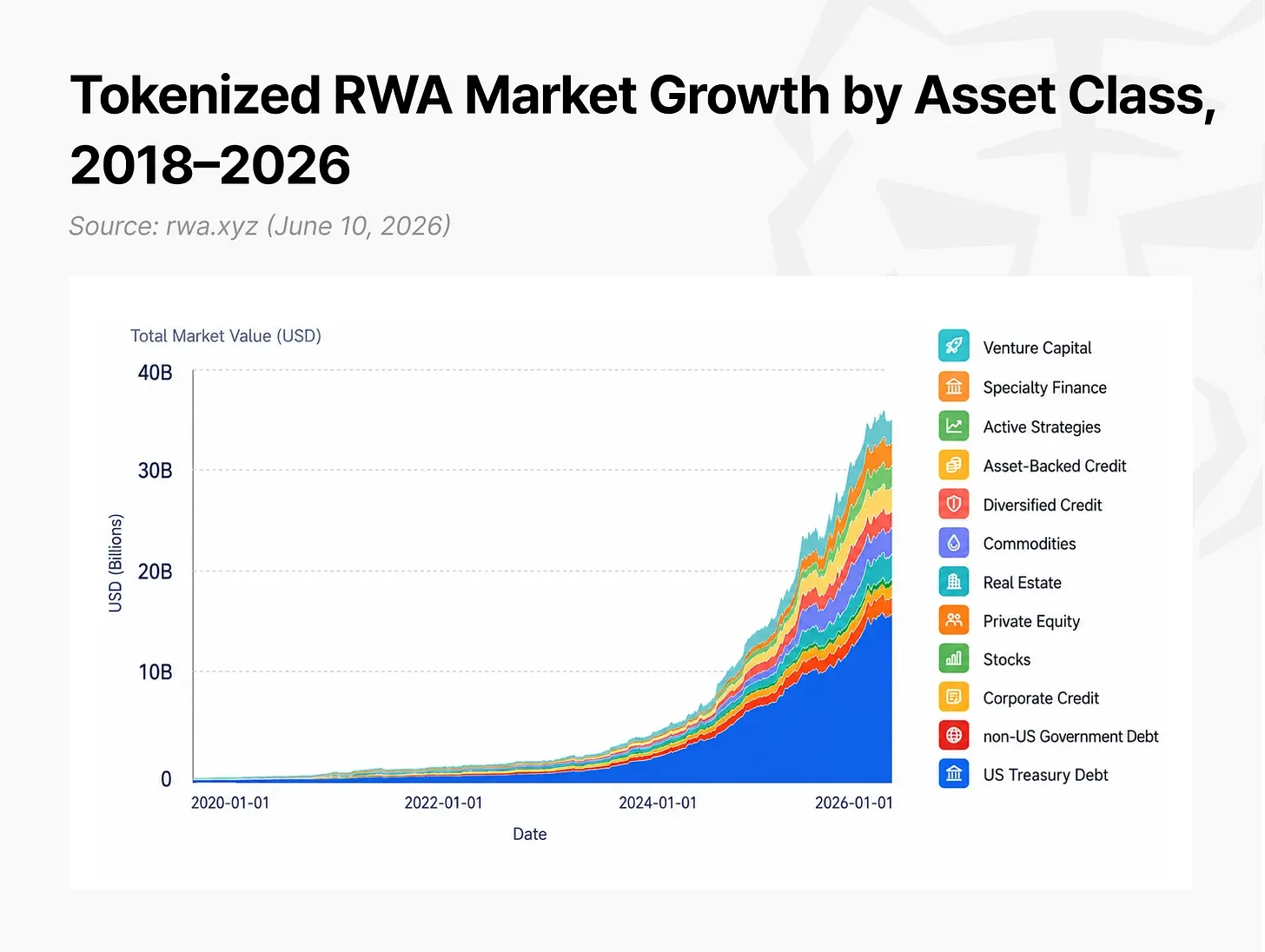
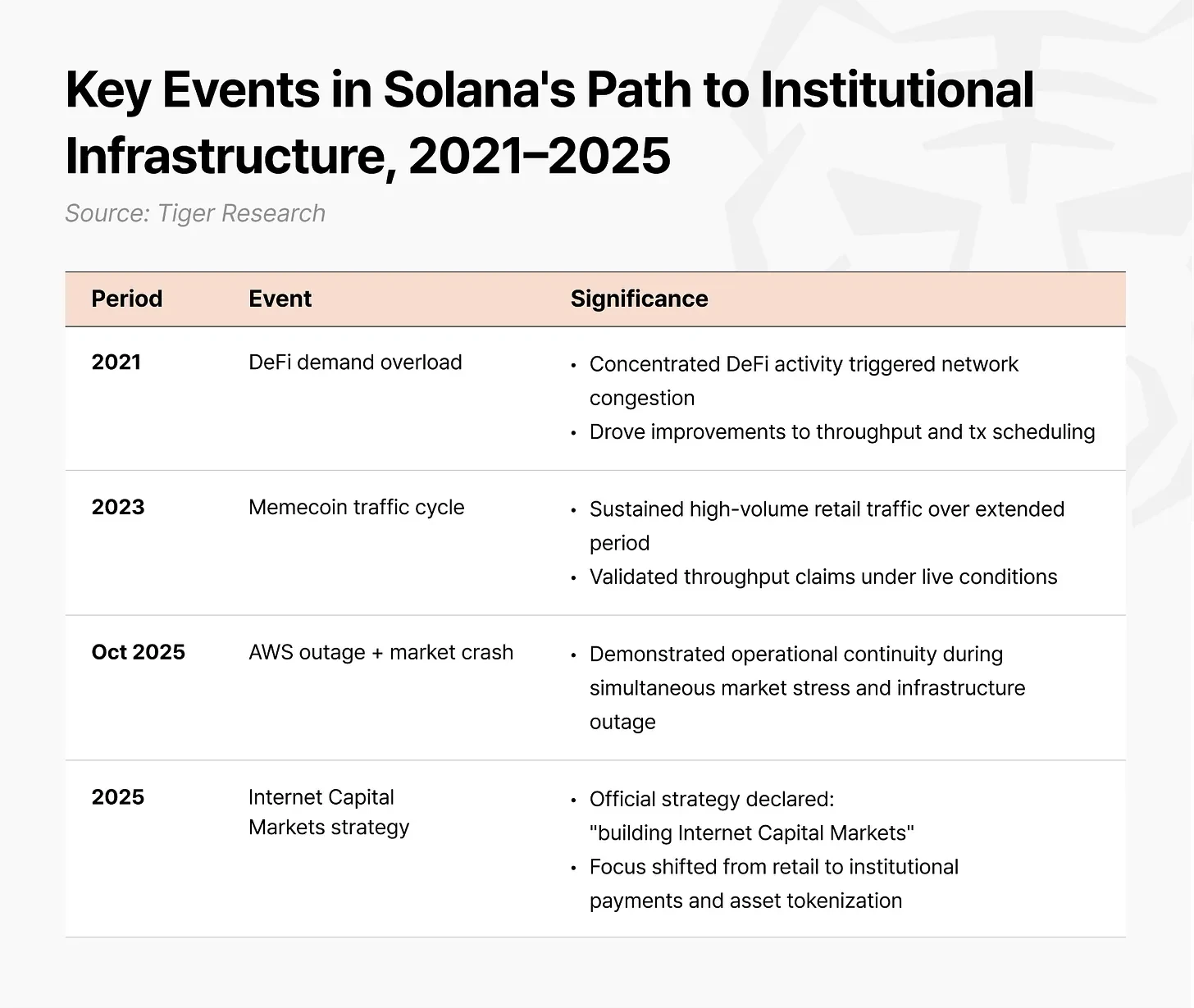
In the U.S. Internet Capital Markets landscape, Solana is a public blockchain that combines technology, institutional practice, and regulatory design. Its Token-2022 standard embeds freeze, clawback, whitelist, and confidential balance functions directly into the token itself, addressing financial requirements for asset holding and transaction eligibility. Multiple major financial institutions have conducted proof-of-concepts or real transactions on Solana: J.P. Morgan arranged a $50 million commercial paper issuance (USCP); State Street and Galaxy launched an on-chain treasury management fund (SWEEP); Citi and PwC completed a tokenized trade finance proof-of-concept; Western Union issued the USDPT dollar payment token for cross-border remittances. Fiserv announced a white-label stablecoin platform FIUSD, and Apollo issued a tokenized credit fund ACRED via Securitize with leveraged strategies. Figure Technology bridged its home equity line of credit (HELOC) to Solana for liquidity. These cases demonstrate that Solana is the convergence point for institutional capital due to its settlement economics (0.5-second finality, $0.0013 average fee), programmable compliance, and institutional-grade stability.
Strategic Window for Asian Institutions: Fast Followers' Opportunity
For Asian financial institutions, the stage of building infrastructure from scratch has passed. The pragmatic path is to be a fast follower, adopting proven U.S. frameworks to reduce trial costs. The criterion for entry is not whether policy exists but whether it is executable: clear laws, guidelines, licensing regimes, and synchronized market infrastructure. Currently, Singapore's MAS, Hong Kong's SFC/HKMA, Japan's FSA, and the UAE's ADGM/VARA are in the executable phase; Korea's FSC/FSS, Thailand's SEC, and others are in a transitional phase requiring architectural preparation; emerging markets like Indonesia, Vietnam, and the Philippines are in the exploration phase where small-scale experimentation is appropriate. For institutions in jurisdictions with slow regulatory progress, an offshore path is effective: establish entities in Singapore or the UAE to build compliance systems and counterparty networks, then transfer capabilities back home when domestic regulations are ready.
Remaining Frontier Challenges and Key Legislation
Although the regulatory framework covers custody, digital commodities, stablecoins, and tokenized securities, frontier issues remain unresolved. Free trading of stocks on public blockchains is currently limited to non-U.S. residents or accredited investors. DEXes face gaps in AML obligations and order processing responsibilities. The GENIUS Act strictly prohibits stablecoin interest payments. The CLARITY Act, which would define the overall market structure for digital assets, has roughly a 50% or lower chance of passing in 2026 due to partisan disagreement over ethics clauses. The legislative window from mid-July to early August is essentially the year's final deadline. Missing it would push the timeline into the 2026 midterm election phase, making consensus even harder.
Internet Capital Markets are no longer a concept; they are a running reality. Verification is evident in the real deployments by J.P. Morgan, State Street, and others on Solana. The variable for Asian institutions is no longer "whether to enter" but the order and entry point. Reference cases are validated; standards are not yet frozen. This interval — validation done, standards not fixed — is precisely the window available for fast followers. How long it remains open is uncertain.