



Apple has entered the foldable phone market with the iPhone Duo, unveiled at its 2026 fall product event by new CEO Ternus. The device starts at RMB 15,999 and reaches RMB 26,499 in its top configuration, making it the most expensive iPhone to date.
Its arrival comes after years of speculation around when Apple would finally move into foldables. Since Samsung launched the Galaxy Fold in 2019, the category has cycled through inward-folding, outward-folding, triple-folding and wide-folding designs. Chinese brands pushed the segment at a punishing pace, trying to turn foldables from a niche product for early adopters into a serious business. Xiaomi cut prices to RMB 9,999, while OPPO went down to RMB 7,999. By 2025, foldable phone shipments in China had passed 10 million units, with Huawei alone taking 71.8% of that market.
According to the source article, Tim Cook had been interested in foldables for years. In China, he saw more consumers using foldable phones from Huawei and Samsung, and after wrapping up a trip to Asia in 2020, he pushed the project forward once he returned to the US. Apple, though, set unusually strict engineering targets for the team: crease depth below 0.15 mm, crease angle below 2.5 degrees, and a liquid-metal hinge yield above the 85% mass-production threshold. Actual supply-chain yields stayed stuck at 60% to 70%, and the effort was paused.
Seven years into the category, foldables still had not moved beyond a niche, the article said. Penetration remained around 2%, while global shipments fell 21.6% year over year in the first half of 2026. Clamshell foldables dropped 47%.
Apple’s entry may change the market, but not from a position of perfection
Counterpoint expects global foldable smartphone panel shipments to rise 23% in 2026, with second-half shipments 53% above the first half. Apple is expected to account for 27% of full-year shipments, all of them concentrated in the second half, and the article describes that as a likely turning point in moving foldables toward the mainstream.
At the same time, the piece argues Apple is not arriving as the obvious late-stage winner in this category. Folded up, the iPhone Duo measures 11.3 mm thick and weighs 254 grams. Samsung’s Z Fold8, by comparison, is 9.7 mm thick and weighs 201 grams. The iPhone Duo also drops the telephoto lens and removes Face ID. The crease can still be felt, and from some angles it can still be seen.
The article’s point is blunt: the iPhone Duo was not launched because Apple had solved every hardware problem. It was launched because Apple needed to secure a place in a premium category before Huawei and Samsung fully captured the high-end foldable mindshare.
To offset hardware compromises, Apple redesigned split-screen and sidebar functions in iOS 27 for the foldable form factor. iPad apps can also run on the Duo without extra developer adaptation and still deliver a workable experience. Even so, the article says it remains unclear how much software and ecosystem advantages are really worth in foldables.
Why foldables have not delivered classic economies of scale
The article identifies memory as the biggest cost variable for the smartphone industry in 2026. Rising memory chip prices have squeezed DRAM and NAND supply for handsets, pushing costs higher across the board. Foldables, it says, have seen increases above the industry average.
That cuts against the usual consumer-electronics pattern, where larger production drives costs down and lowers prices over time. Foldables have not followed that path.
Behind the RMB 15,999 price tag on an iPhone Duo sits a bill of materials covering the display, hinge, chip, memory and structural components. Several of those cost items do not exist in a conventional slab phone.
The article contrasts foldables with mid-range phones priced around RMB 4,000. If storage costs rise by RMB 1,500, a mid-range vendor is usually left choosing between a price increase and lower specs, either of which directly hurts demand. Foldables already sell above RMB 10,000, so the same RMB 1,500 increase accounts for a much smaller share of the retail price.
That creates what the article calls a profit safe-haven effect. It does not mean foldables are cheaper to build. It means their higher pricing gives brands more room to absorb rising costs.
Image source: Huawei Terminal
The article says higher storage prices have also opened a window for phone makers to reset pricing across the market. When all brands face the same cost curve and Huawei, Xiaomi and Honor move prices higher first, the incentive for others to keep defending low-price positions weakens. In that view, an industry-wide cost shock has ended up doing something vendors struggled to do on their own: push back against destructive price competition.
Two layers of profit: hardware and ecosystem
The article breaks the value of foldables for phone makers into hardware profit and ecosystem profit.
On hardware, a higher BOM combined with a higher selling price means a larger absolute gross profit per unit. IDC expects global foldable smartphone shipments to grow 30% year over year in 2026, with Apple taking about 22% of shipments in its first year.
On ecosystem profit, the article notes that Apple’s services business carries margins above hardware. A foldable matters to Apple because a larger screen can help keep users inside iOS and raise long-term value per user. As mobile AI shifts from answering questions to completing tasks, users need more display space to review information, handle content and switch between apps. Foldables, the article says, are especially suited to parallel AI multitasking.

Still, room to absorb costs is not the same thing as pricing power. Having a buffer and being able to pass that cost on to buyers are two different things.
Apple, Huawei and Xiaomi are pricing foldables for different reasons
The article uses Apple, Huawei and Xiaomi to show three distinct pricing strategies.
- Apple: The iPhone Duo starts at RMB 15,999 and is meant to defend high-end users. QuestMobile data cited in the article shows 15.3% of Huawei users move to Apple, while 19.1% of Apple users move to Huawei, making the two each other’s biggest destination for premium-user outflows. Some premium iPhone users have already switched to Chinese foldables to try the form factor.
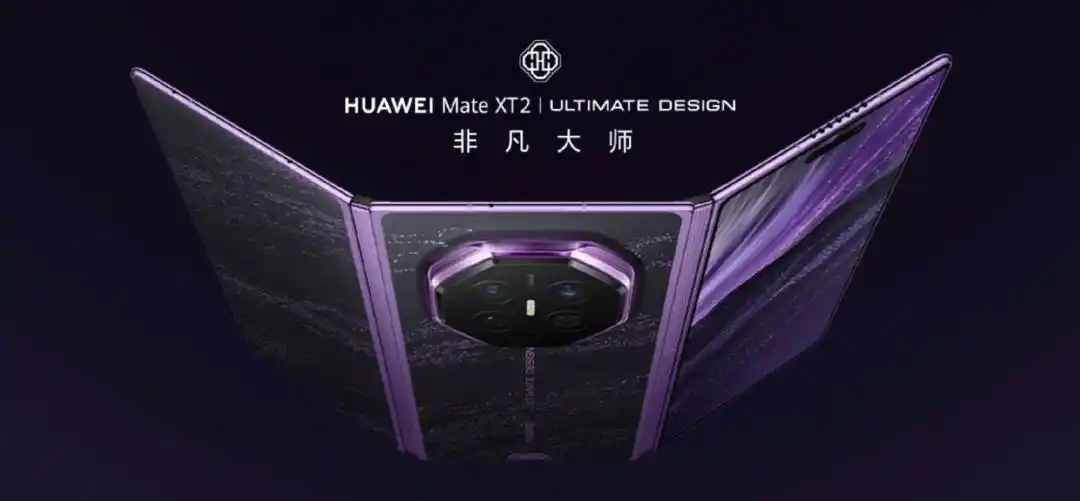
- Huawei: The triple-folding Mate XT2 starts at RMB 19,999 and serves as a price anchor in the ultra-premium market. The article says the scarcity of the triple-folding design and Huawei’s brand strength create the premium, and the company’s first goal may be to defend pricing power in China’s ultra-high-end market rather than expand foldable volumes.
- Xiaomi: The 18 Fold starts at RMB 10,999 and is Xiaomi’s first RMB 10,000-plus phone. According to the article, it accounts for only 0.8% of total shipments but lifts overall ASP by RMB 32. Its strategic role is to establish a price anchor while supporting both premium branding and volume ambitions. The article also says it gives Xiaomi a vehicle for its in-house chip effort and broader premium narrative.
The shared logic, in the article’s framing, is that foldables remain one of the few smartphone categories where vendors can still charge a high premium and where the competitive structure has not been fully settled.
Hinges have become one of the most powerful choke points in the foldable chain
A foldable phone is not simply two slab phones joined together. Compared with a standard handset, the category adds three core elements: a hinge, precision structural parts and UTG, or ultra-thin glass.
The hinge is the clearest new addition. It is the biggest piece of industrial value that foldables created from scratch.
A single hinge assembly contains 50 to 100 tiny functional components, with metal injection molding, or MIM, parts making up roughly 60% to 70% of the total. Key dimension tolerances range from ±0.01 mm to ±0.03 mm. The iPhone Duo hinge, the article says, contains more than 100 components. Its hinge cover uses 3D-printed titanium, while titanium plates and ceramic fiber inserts inside the structure improve rigidity.
That is why the article describes the hinge as the largest incremental industry created by foldables. Slab phones do not have this mechanical system at all. In 2025, the global foldable hinge market in consumer electronics was worth about $500 million, and the article says it is expected to reach $1.3 billion by 2032, a compound annual growth rate of about 15%.
The competitive structure is highly concentrated. Unlike traditional phone components that often have multiple suppliers, the first-tier hinge assembly market for Apple is described as being almost monopolized by Amphenol and Shin Zu Shing. With few near-term alternatives, hinges have become one of the strongest pricing-power nodes in the foldable supply chain.
The iPhone Duo hinge chain reflects that hierarchy. First-tier assemblies are led by Amphenol and Shin Zu Shing, while Chinese companies mainly participate as second-tier component suppliers. The article characterizes it as a standard top-down model: the assembly supplier wins the order, sets the standard and allocates part numbers, while lower-tier vendors manufacture to drawing. Chinese suppliers are deeply embedded, but mostly in the most process-intensive segment rather than the most valuable one.
The companies named in the article include Lingyi iTech for stamped precision parts and carbon-fiber reinforcement brackets around the hinge, Jingyan Technology for MIM precision parts, Eontec for the liquid-metal hinge spindle, and Shanghai Fu Chi, a Dongmu subsidiary, which is also important in that segment and widely uses its MIM technology in internal phone structures.
The article adds that Amphenol, originally the lead supplier, lost ground because of lower yields, allowing Shin Zu Shing to move into the lead production role. Even then, Shin Zu Shing is currently supplying only hinge “golden samples” that meet Apple’s standards for the iPhone Duo, and production remains unstable.
That leaves the key bottleneck not just in capacity, but in yield. In the article’s framing, hinge yield is what now holds back the whole chain.
Yield economics decides where profit lands
The article treats yield economics as the clearest way to understand profit distribution in the hinge business, with Apple’s liquid-metal hinge as the sharpest example.
Image source: Apple
Apple’s liquid-metal hinge posted yields of 30% to 65% during mass-production validation, later improving to 60% to 70%, still below Apple’s 85% target. The article gives a simple example. To secure 8.5 million qualified components, a 65% yield would require production of about 13.08 million units. At an 85% yield, only 10 million would be needed. The gap is about 3.08 million units.
The material itself explains why that is hard. Zirconium-based liquid metal has about 2.5 times the strength of titanium alloy, the article says, with tensile strength reaching 1,500 to 2,000 MPa and opening-and-closing life exceeding 300,000 cycles in testing. But it is also extremely difficult to machine. During trial production, yields in some batches fell below 50%. Even after several rounds of optimization, yields rose only to 60% to 70%, still below Apple’s 85% mass-production bar.
The article’s point is that yield is not a lab-side optimization metric. It directly decides where profit accumulates in the industrial chain. A 3.08 million-unit gap means more raw materials, more processing hours, more testing and more scrap. Those losses ultimately come out of supplier margins.
The deeper battleground is in display material stacking
The article then shifts from hinges to what it sees as the real long-term battlefield: stacked materials inside the display.
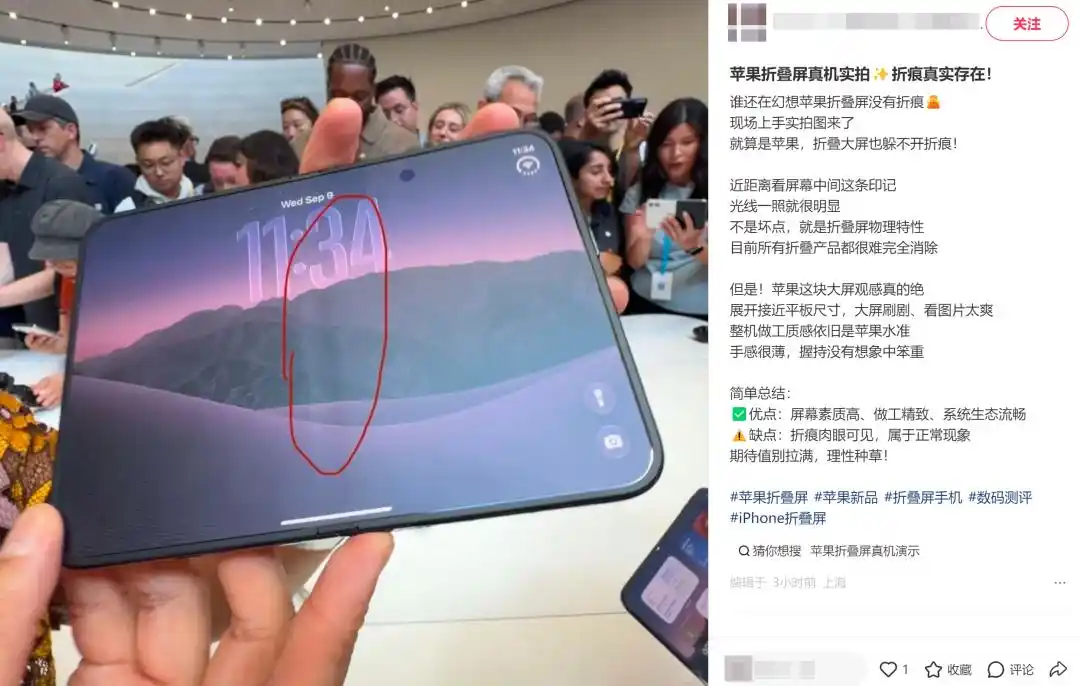
Apple’s launch event pulled attention toward the idea of a “crease-free” screen. For many consumers, a foldable phone succeeds once the crease disappears. The article argues that the issue runs deeper than hinge quality.
What appears to be a bendable plastic layer is actually a stack of more than ten materials, including the surface protection layer, flexible glass, the OLED display layer, adhesive layers, the support plate and a titanium base plate. When the phone folds, each layer bends to a different extent. One layer, called the neutral layer, is stretched neither in tension nor in compression. It is the safe line in the bending process.
Image source: Xiaohongshu
If that neutral layer shifts away from the critical structural position, one of the surrounding layers takes too much strain. Over time that creates microcracks or even permanent deformation, which is where the crease comes from. The article’s conclusion is direct: the essence of the crease problem is not a weak hinge, but a misaligned neutral layer in the stacked display materials.
Apple’s solution in the iPhone Duo is a ten-layer ultra-thin-material OLED stack combined with nano-texture surface treatment to reduce the visual visibility of the crease as much as possible. The physical crease still exists, the article says, but is harder to spot. It calls that an engineering compromise.
The display is also the most expensive component in a foldable phone.
For now, Samsung is Apple’s exclusive supplier for foldable OLED panels under a three-year exclusive supply agreement. The 7.8-inch foldable OLED panel customized by Samsung for Apple is set for shipments of 8 million units in 2026, and the 2027 supply target has been lifted to 15 million units, up 87.5% year over year.
Do BOE and other Chinese panel makers still have a shot?
The article then turns to Chinese display manufacturers.
BOE is mainland China’s largest semiconductor display maker and the world’s No. 2 supplier of AMOLED smartphone panels behind Samsung Display. In LCD, BOE has long ranked first globally by shipments. It is a core display supplier for Chinese brands including Huawei and also one of the main OLED suppliers for Apple’s iPhone 18 series.
Foldable panels are different. The article says BOE’s second-quarter foldable panel shipments fell 41% year over year, while its share dropped about 9 percentage points to 22%. Samsung Display’s share, by contrast, rose 13.5 percentage points to 66%.
It argues that the decline should not be read simply as weaker competitiveness. Apple’s entry expanded the total market quickly, and much of that incremental demand flowed to Samsung.
BOE was kept out of Apple’s foldable supply chain mainly because its panel yields have not yet cleared Apple’s certification threshold. Apple set a minimum panel yield standard of 70%. Samsung eventually pushed mass-production yields above 80%, while BOE’s yield and quality-control consistency still fell short of Apple’s admission bar.
Outside Apple’s chain, BOE remains strong. In the first quarter of 2026, BOE led global foldable smartphone panel shipments with about 45% market share, supported mainly by Huawei demand. The article argues that while Chinese panel makers have seen their growth rates diluted by the incremental effect of Apple’s entry, their footing in the Android camp remains deeper than many assume.
Foldables are also changing the competitive logic of the panel industry in three ways.
- Product mix is shifting. Counterpoint data cited by the article shows large book-style foldable panel shipments growing 107% year over year in 2026, while clamshell panel shipments are expected to fall 59%. That points to book-style foldables becoming the dominant format, forcing panel makers to focus production capacity and engineering resources there.
- Value per panel is rising. Foldable OLED panel ASP is significantly higher than slab-phone OLED ASP. In 2026, the price gap between foldable panels and standard slab-phone panels widened from 2.55x to 2.78x. For panel makers, foldables are a higher-value product line that can improve product mix and gross margin.
- The competitive structure may open again later. Once Samsung’s three-year exclusive agreement with Apple expires, the door could open to Chinese panel makers — but only if they can match Samsung in high-end yield and consistency. The article notes that BOE has already made substantial progress in yields on UTG production lines below 18 microns.
The next phase will be decided by who controls unavoidable supply-chain nodes
The article ends with a broader conclusion about where competition goes from here. The next phase in foldables will not be defined only by thinner bodies, lighter weights or smaller creases. It will be decided by who controls the supply-chain nodes that cannot be bypassed, especially in hinges, panels and UTG.
What Apple waited for, in this telling, was not just capacity. It was the point at which capacity across multiple supply-chain links could become qualified and deliverable capacity at the same time. That standard is now becoming the new passing line for the industry.
The original article was published by the WeChat public account Zhixiedao and written by Meng Zhaoye.