
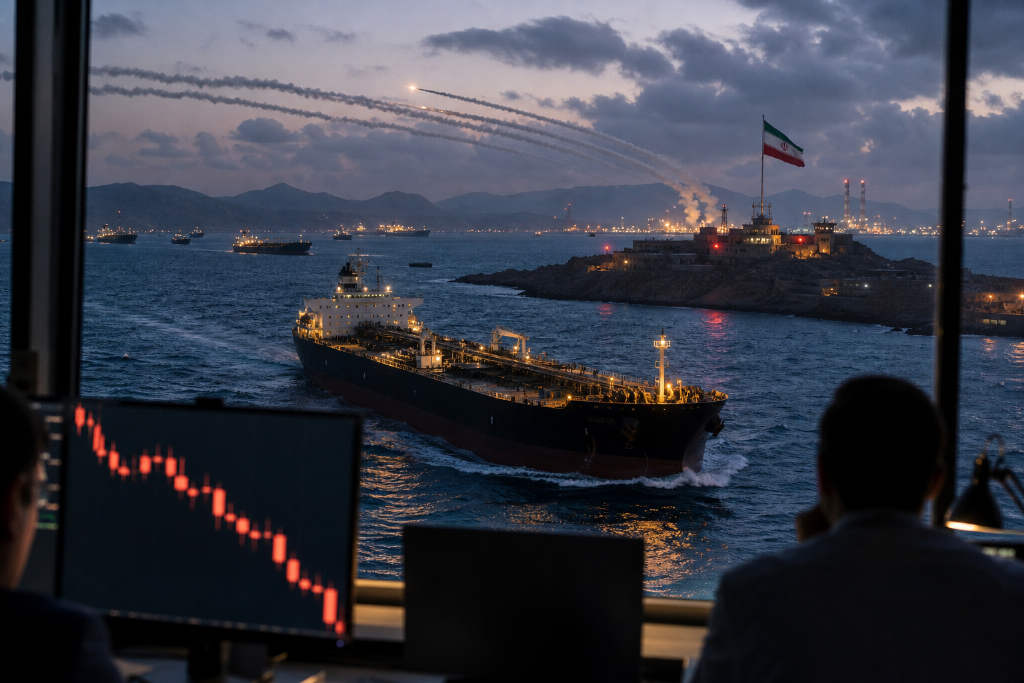
A U.S. airstrike on Aug. 30 against Iranian rocket and mine deployment positions on Larak Island in the Strait of Hormuz, followed by Iran’s ballistic missile retaliation against two U.S. bases in Jordan, rapidly escalated tensions around one of the world’s most important energy chokepoints. The Strait of Hormuz, which carries roughly one-fifth of global seaborne crude, was pushed back to the edge of open conflict.
The market reaction was immediate. Brent crude broke above $90.5 a barrel and U.S. WTI crude climbed past $85.5. Reuters-tracked interest-rate derivatives pricing, as cited in the report, showed the implied probability of the Federal Reserve resuming rate hikes in September, or taking an extremely hawkish stance, rising to about 57%. With oil surging, inflation expectations firming, and risk-free rates moving higher, futures tied to the three major U.S. stock indexes opened lower, while Asia-Pacific technology shares also weakened.
The article was written by the MEXC Crypto Pulse research team and focuses on how higher oil prices feed through to inflation, interest rates, and equity valuations.
Key points
- U.S. forces struck Iranian military targets on Larak Island, and Iran then launched ballistic missiles at U.S. bases in Jordan, marking a clear escalation in direct confrontation.
- The Strait of Hormuz handles about one-fifth of global seaborne crude shipments. As shipping risk rose, Brent moved above $90.5 a barrel and WTI climbed above $85.5.
- Interest-rate derivatives pricing tracked by Reuters put the implied probability of a September Fed hike, or an extremely hawkish outcome, at about 57%.
- Higher Treasury yields squeezed valuations, leaving U.S. stock futures and Asia-Pacific technology shares under pressure.
- The report also says commodity volatility is spilling into foreign exchange and crypto markets, with a stronger U.S. dollar draining offshore dollar liquidity.
Larak strike brings shipping risk in Hormuz back into focus
The report says the Middle East crossed a sensitive line over the weekend after months of contained confrontation.
U.S. strike on Larak Island and Iran’s response in Jordan
According to public statements from U.S. Central Command, the Pentagon, and the U.S. military, Washington carried out an airstrike on two targets on Larak Island after monitoring what it described as efforts by Iran’s Islamic Revolutionary Guard Corps to place naval mines in the Strait of Hormuz and deploy anti-ship rocket launchers. The strike marked another publicly acknowledged U.S. attack on military facilities inside Iran after several weeks of relative calm.
Iranian state media later confirmed damage to the facilities and pledged a harsh response. Hours later, Iran launched multiple ballistic missiles at a U.S. air base in Jordan. The report says most of the missiles were intercepted, but the fact of direct military exchange itself changed the market’s earlier expectation that diplomacy might contain the situation.
Traffic through the strait falls and risk premium jumps
The Strait of Hormuz is one of the world’s most critical energy transit routes. Citing data from the United Kingdom Maritime Trade Operations, or UKMTO, and international shipping-monitoring agencies, the article says the route typically handles 6 million to 8 million barrels of crude a day as well as large volumes of liquefied natural gas. After the strikes, the number of visible bulk commodity vessels transiting the strait over the weekend fell sharply to only about five per day.
Shipping companies and multinational energy traders began suspending or reassessing Gulf routes because of concerns over precision strikes and mine risks. Higher marine insurance costs, rerouting, and delays added to the geopolitical premium built into commodity prices.
How crude above $90 feeds into inflation and rates
The article frames the market move as a chain reaction: higher energy prices first lift inflation fears, then alter interest-rate expectations, and finally hit bond and equity valuations.
Brent and WTI both clear key levels
Based on real-time data from the U.S. Energy Information Administration, or EIA, and global futures exchanges, Brent crude quickly moved through $88 and then $90, reaching an intraday high of $90.61. WTI also pushed through the key $84 level and held above $85.5.
The article says technical traders see the breakout above the upper end of the prior trading range as opening the door for a test of $93 and possibly higher if the Middle East situation does not cool in the near term.
Hawkish September pricing rises to 57%
Citing Bloomberg rate-model analysis, the report says that when international crude remains above $90, both the U.S. Consumer Price Index, or CPI, and the Personal Consumption Expenditures Price Index, or PCE, face meaningful risk of a second rebound.
Against that backdrop, rate-derivatives traders sharply reduced bets on rate cuts this year and pushed the implied probability of the Fed keeping rates high, or even being forced to hike in September, to about 57%. The Treasury market responded with selling across maturities, lifting benchmark yields and raising borrowing costs across the economy.
The article also notes that on global trading platforms such as MEXC, energy-linked and safe-haven derivatives that track macro moves often attract concentrated liquidity when commodities swing hard. Those contracts use leverage, and their prices can diverge from spot markets because of basis differences.
Valuation pressure hits tech and Asia’s semiconductor chain first
In equity valuation models, a higher discount rate directly reduces the present value of future cash flows. That makes high-multiple growth stocks especially sensitive.
Higher risk-free rates compress technology valuations
The article says growth-oriented technology shares listed on Nasdaq and the New York Stock Exchange are among the most rate-sensitive assets in the market. As Treasury yields rise with oil, the discount rate moves up as well. That compresses the theoretical value of companies whose earnings are weighted further into the future, including AI hardware names, software-as-a-service firms, and major semiconductor companies.
At the same time, higher oil prices raise expectations for corporate operating costs and electricity bills for data centers, weakening confidence in margin expansion for large technology firms.
Asia’s semiconductor supply chain and currencies move together
Asia-Pacific markets priced in imported inflation pressure as trading opened on Monday. The article says Japan, South Korea, and Taiwan are highly dependent on Middle Eastern crude imports, so a sharp rise in oil can worsen current-account expectations and leave the yen and won under pressure.
On the Japan Exchange Group and Korea Exchange, major semiconductor equipment makers and foundry leaders broadly faced foreign outflows, while lower openings in heavyweight technology names dragged on benchmark indexes.
Macro stress spills into crypto and foreign exchange
The article argues that the risk-off wave triggered by oil is eroding the liquidity barrier between traditional financial assets and digital assets.
Citing cross-asset observations from the Financial Times, it says the U.S. Dollar Index, or DXY, typically strengthens in the early stage of renewed inflation fears and revived Fed tightening expectations because of its safe-haven appeal and rate advantage. A stronger dollar can siphon offshore dollar liquidity, putting broader risk assets, including cryptocurrencies, under periodic pressure.
Even so, the report adds that if geopolitical tensions turn into a longer-term test of sovereign monetary systems and settlement channels, hard-money assets with non-sovereign features and global settlement utility could go through a second round of value reassessment.
Variables the market is watching next
The report highlights four areas to watch for the next move in global equities and commodities.
- Whether the U.S. and Iran expand direct military strikes geographically, especially around energy terminals, refineries, and naval escort formations along the Gulf coast.
- Whether daily tanker tonnage through the Strait of Hormuz recovers, which would indicate whether the shipping industry can restore normal crude logistics through escorted transit.
- Upcoming U.S. inflation and employment data, and whether Fed officials’ public comments before the September meeting align with the current hawkish pricing near 57%.
- Any production-policy adjustment by the Organization of the Petroleum Exporting Countries, or OPEC, and its allies after crude moved above $90, particularly whether Saudi Arabia and the United Arab Emirates release spare capacity to calm the rally.
James Mitchell’s view
James Mitchell says in the article that, viewed through market microstructure and cross-asset quantitative fund flows, the global equity sell-off triggered by geopolitical conflict and crude breaking key levels is essentially a sharp repricing of stagflation risk premium.
He argues that stock traders in bull markets often treat geopolitics as short-term noise and underestimate the nonlinear effect of energy moving above $90 on the macro liquidity backdrop. Once Brent reached $90.5 and daily traffic through the Strait of Hormuz fell to single digits, the move was no longer a routine safe-haven pulse. In his view, it became a direct threat to the cost structure of global supply chains. Interest-rate swaps pricing a 57% chance of a September Fed hike reflected institutional concern that the tightening cycle could be extended.
Mitchell also says professional derivatives traders and multi-asset allocators face substantial left-tail risk if they try to catch the falling knife while discount rates are repricing quickly. He points instead to the slope of backwardation in the oil term structure and stabilization signals in the 10-year Treasury yield as indicators worth tracking. Until volatility clearly mean-reverts, he favors a defensive posture toward expensive equities.
Questions raised in the article
Why did global equity markets fall broadly?
The report says the trigger was the U.S. strike on Iranian military targets on Larak Island and Iran’s missile retaliation, which sharply increased perceived risk to the energy supply chain running through the Strait of Hormuz. Brent moving above $90.5 intensified fears of a second inflation wave, lifting the implied probability of a September Fed hike to 57%. Higher Treasury yields then pushed up discount rates across the market, hitting technology shares and other richly valued assets.
Why is the Strait of Hormuz so important?
The article describes the strait as the key maritime route connecting Gulf oil producers with open international waters. It handles roughly one-fifth of global seaborne crude trade and large LNG volumes. If shipping is blocked or disrupted, the market could face a physical supply gap of several million barrels a day.
Why does oil above $90 alter Fed expectations?
The report says crude is a core cost input for transport, industry, and agriculture. Once oil breaks above $90, gasoline, electricity, and logistics costs rise, making it harder for inflation to return to the central bank’s 2% target. To prevent inflation expectations from becoming unanchored, the Fed may have to pause cuts or even consider additional tightening.
Why were technology stocks hit harder than other sectors?
According to the article, technology names, especially in AI and semiconductors, often trade at high valuation multiples and rely heavily on discounted future cash flows. When oil pushes risk-free rates and Treasury yields higher, the higher discount rate directly reduces their theoretical value, encouraging a shift toward more defensive assets.
Why did Asian technology shares and semiconductor names drop together?
The report says economies such as Japan and South Korea depend heavily on imported Middle Eastern energy. A surge in oil prices can worsen trade balances, pressure local currencies, and raise operating costs for energy-intensive semiconductor manufacturing and foundry operations. Combined with concern that inflation could weigh on end demand, that created broad selling pressure.
What indicators should investors watch next?
The article points to several markers: whether Brent can hold above $90, daily tanker traffic through the Strait of Hormuz, the path of the benchmark 10-year U.S. Treasury yield, and policy signals from Fed officials ahead of the September meeting.
The report closes with a caution that oil prices, implied rate probabilities, shipping-flow data, and stock-market readings were all snapshots at the time of writing and could change quickly during trading hours. It also says the discussion of the Fed’s September path reflects derivatives-implied market pricing rather than a formal central bank decision. Leveraged contracts tied to oil or equity indexes can amplify losses proportionally.