
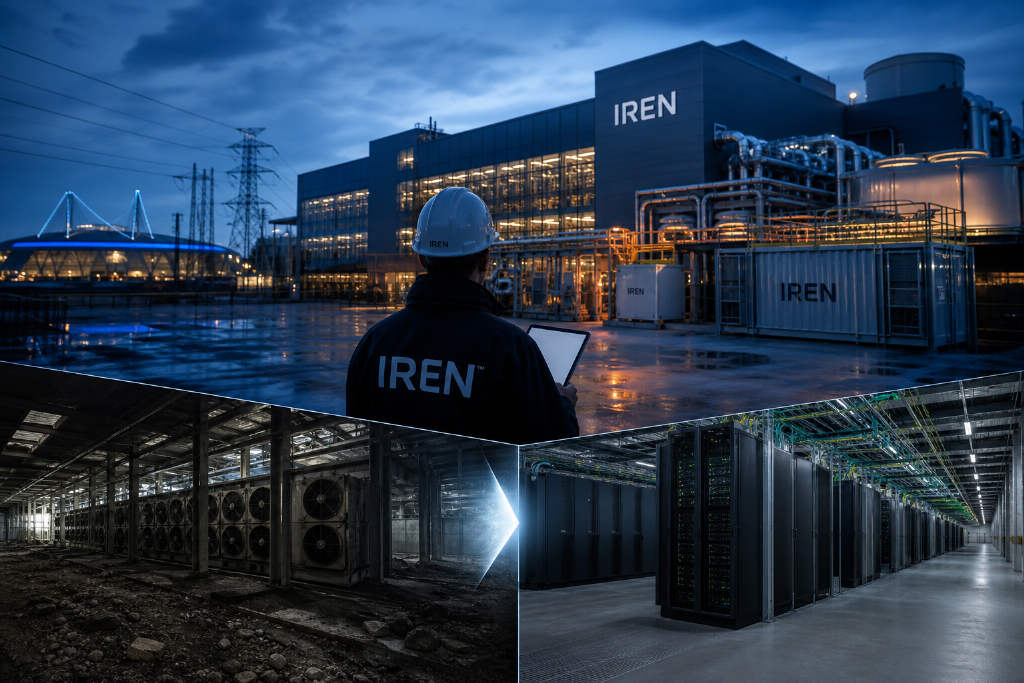
IREN reported $707 million in revenue for fiscal 2026, but the bigger figure was on the spending side. Net cash used in investing activities reached $4.723 billion, more than triple the prior fiscal year, while capital commitments stood at $13.81 billion as of June 30, largely tied to AI hardware and data center construction. A year earlier, that commitment figure was $369 million.
The company, which has been reshaping itself from a bitcoin miner into an AI cloud operator, has not taken a gradual route. Alongside heavy GPU spending, IREN bought data center developer Nostrum for about $148 million and acquired cloud software company Mirantis in a deal worth about $544 million. In June, it also signed a multi-year global partnership with the Golden State Warriors. Sportico reported the deal is worth more than $50 million a year on average.
The pattern is clear: IREN is spending aggressively to shorten the time it needs to complete its shift into AI infrastructure.
GPU procurement is scaling fast, and the next generation is already in the budget
The first major sink for capital in IREN’s AI buildout has been GPUs.
In November 2025, to support a five-year AI cloud contract with Microsoft worth $9.7 billion, IREN signed a procurement agreement with Dell valued at roughly $5.8 billion. The package covered NVIDIA GB300 NVL72 systems along with servers, storage, networking, and related equipment. The capacity is set to be deployed across Horizon 1 through 4 at the company’s Childress campus in Texas, with total IT load reaching 200MW. Under the contract structure, Microsoft is scheduled to pay 20% upfront for each batch.
Before that procurement was fully completed, IREN moved on to another round. In March 2026, the company ordered more than 50,000 NVIDIA B300 GPUs for deployment in Mackenzie, Canada, and Childress in the US. The two Dell orders were worth about $2.3 billion and $1.2 billion, for a combined $3.5 billion.
Then in May, NVIDIA became a customer as well. The two companies signed a five-year AI cloud contract worth $3.4 billion and agreed to work together on up to 5GW of AI infrastructure. To fulfill that deal, IREN later placed another Dell order worth about $1.6 billion for Blackwell systems. NVIDIA also received the right, over the next five years, to buy as many as 30 million IREN shares at $70 each, implying a potential investment of up to $2.1 billion. Those rights are tied to the scale of GPU deployment completed by IREN.
Across those three publicly disclosed Dell procurement agreements alone, the nominal value comes to about $10.9 billion. IREN has noted that the purchases are not one-time cash payments and that a large share is already embedded in the capital commitments it has disclosed.
By the end of June 2026, products installed or ordered by IREN spanned NVIDIA H100, H200, B200, B300, GB300 and AMD MI350X. The latest procurement plans already extend to VR200 under NVIDIA’s next-generation Vera Rubin architecture. Hopper is still in service. Blackwell is being deployed at scale. Blackwell Ultra has not been fully rolled out, yet IREN is already carving out budget and infrastructure for Rubin.
That leaves the company in a tight cycle: one batch of GPUs has not fully depreciated, and in some cases has not fully begun producing revenue, while the next wave of capital spending is already underway.
IREN has listed rapid technology change as a clear risk factor. In AI cloud, the core assets are computing systems that evolve quickly. Newer GPUs typically bring more compute, larger memory capacity, and better energy efficiency, and that shifts the cost per unit of compute. If rivals deploy newer hardware first, older GPUs can lose pricing power and become less attractive to customers. IREN is therefore trying to do two things at once—get cash flow out of existing equipment as quickly as possible, and keep raising money for the next generation.
After GPUs came software, engineering, and delivery capability
Land, power, data halls, and GPUs are not enough on their own to make a fully competitive AI cloud business. IREN’s next step was to fill in the missing layers.
In June, the company acquired Spain-based data center developer Nostrum for about $148 million, including roughly $94.8 million in cash. Nostrum did not mainly bring a ready-made AI customer base. What it added was data center development, engineering, and construction talent, plus local development capability that IREN can use as it enters Europe.
In August, IREN completed its acquisition of Mirantis in a transaction valued at about $544 million. Most of the consideration was paid in IREN shares, with another roughly $40 million in cash, restricted stock, and other consideration. Mirantis has long operated in Kubernetes, cloud infrastructure, and enterprise cloud services. For IREN, the acquisition means more than a software product. It brings the ability to manage GPU clusters, deploy customer environments, orchestrate AI workloads, monitor resource utilization, and provide enterprise support.
In its latest 10-K, IREN divided its AI cloud business into three layers: Data Centers, Compute, and Software. Mirantis fills in that last layer.
The company started with power, land, and bitcoin mining sites. It has since been stacking on data centers, GPUs, networks, storage, cloud software, and enterprise services. Step by step, it is rebuilding itself as a vertically integrated AI cloud company.
The Warriors sponsorship became the most disputed line item
If GPU purchases and strategic acquisitions fit the broad outline of an AI buildout, the spending that has drawn the most confusion from outside observers and shareholders is IREN’s deal with the Golden State Warriors.
On June 25, IREN signed a multi-year global partnership with the NBA team. Starting in the 2026-27 season, IREN will become the team’s official AI cloud partner and replace Rakuten as the jersey sponsor, with its logo appearing on the left chest of Stephen Curry’s jersey. The partnership also covers the WNBA’s Golden State Valkyries, the G League’s Santa Cruz Warriors, and Chase Center.
Sportico reported that the contract is worth more than $50 million annually on average, setting a new sponsorship record for a North American pro sports team. That stands in sharp contrast with IREN’s own numbers: total marketing expense for fiscal 2026 was $20.27 million, and just $2.88 million in the prior year. On that comparison alone, one year of the Warriors agreement could exceed more than twice what IREN had been spending on marketing across an entire year.
Some investors have linked the sponsorship to the company’s use of at-the-market equity issuance and convertible debt financing, questioning why a business still in a heavy capital expansion phase would take on such an expensive sports marketing commitment. Team sponsorship is more common among consumer-facing sectors like apparel, autos, beverages, consumer electronics, and financial services, where broad exposure can feed directly into brand awareness and purchasing decisions. IREN is not a mass-market consumer brand. Its customer base is much narrower, made up of AI labs, tech companies, and senior decision-makers. On that basis, a sponsorship bill of more than $50 million a year looks unusually aggressive.
IREN’s view appears to be different. The company may be less interested in reaching tens of millions of NBA viewers than in buying attention in the San Francisco Bay Area. It sees the region as home to AI startups, technical talent, and potential customers, and believes the Warriors can accelerate awareness among that audience. In its latest 10-K, IREN formally listed “building a global brand” as part of its strategy, including sponsorships, industry events, and marketing aimed at customer acquisition and stronger relationships with technology partners.
The shift ties back to a practical reality in IREN’s changing business model. A bitcoin miner does not need much of a sales function. An AI cloud company does. Beyond Microsoft and NVIDIA, IREN now has to pitch AI labs, startups, and enterprises, convince decision-makers that its clusters are reliable, get procurement teams comfortable with pricing and service terms, and prove itself in a market where AWS, Azure, Google Cloud, CoreWeave, and a group of newer cloud operators are already active.
PANews described the situation as one where IREN is spending heavily on a basic question of identity: what kind of company it is trying to become.
Why the company can spend this much while posting a net loss
After looking through IREN’s spending, the obvious question is how it is funding the buildout. The company posted a net loss of $703 million in fiscal 2026.
The answer lies in a more aggressive capital structure. IREN’s model is to lock in future revenue first, then turn that future revenue into money that can be used today to buy GPUs.
The Microsoft arrangement is the clearest example. Under the $9.7 billion contract, Microsoft is required to prepay 20% of each compute batch. The cash arrives at IREN before the GPUs are fully delivered and before service begins. Until then, it cannot be recognized as current revenue and instead sits on the balance sheet as deferred revenue.
That helps explain why IREN posted a $703 million net loss but still generated $2.1 billion in net cash from operating activities in fiscal 2026. Customer prepayments for AI cloud services increased deferred revenue by about $1.842 billion. The company also recorded about $639 million in asset impairments and $418 million in depreciation and amortization, both non-cash charges. Those items reduced profit without creating matching cash outflows in the same period.
Operating cash was only part of the story. A larger portion came from finance providers. IREN said in its latest results that the Microsoft project had secured $3.6 billion in investment-grade GPU financing at a weighted cost of about 6%. Combined with customer prepayments, that funding can cover roughly 96% of the related GPU capital expenditure.
For other AI customers, the company obtained another $2.8 billion in GPU financing. Of that amount, $2.4 billion was led by investors affiliated with Blue Owl and PIMCO, carrying a fixed rate of 9% and covering about 90% of GPU capex tied to the Mackenzie project. IREN also said recent customer prepayments have typically amounted to 45% to 55% of the corresponding GPU capital expenditure.
The key point is that GPUs and the long-term compute contracts attached to them are beginning to function as financeable assets. Lenders are looking at specific NVIDIA hardware, specific data centers, and contract cash flows from customers such as Microsoft over the next three to five years. That allows IREN to build financing structures around individual equipment pools instead of relying only on retained earnings or cash already on hand.
A capital flywheel emerges from that structure:
- Customers sign long-term contracts and provide prepayments.
- IREN uses those commitments to purchase GPUs.
- Financial institutions lend against the GPUs and contract cash flows.
- Once online, the hardware generates lease and cloud revenue.
- New contracts support another procurement cycle.
Over the past year, IREN has also made extensive use of common stock, convertible notes, and other financing tools. By the end of June, debt principal had climbed to about $7.71 billion from $990 million in the prior fiscal year. Its 10-K says future expansion may continue to rely on customer prepayments, GPU asset financing, equipment financing, convertible debt, and equity.
As of the end of August, the company said cash, committed GPU financing, and customer prepayments together totaled about $14 billion. At the same time, it said 2026 capacity was essentially sold out, with signed contracts tied to about $4 billion in contracted annualized run-rate revenue, or Contracted ARR. Of that, capacity already online accounted for about $1 billion of ARR. That $4 billion is not booked accounting revenue, but it does indicate that IREN holds a base of long-duration contracts that can continue to support financing.
In practical terms, the company is using customer revenue commitments from the coming years to pull forward billions of dollars from lenders and capital markets today.
The real wager is on a narrowing infrastructure window
Once the financing logic is clear, the final question is why IREN believes it has to move this fast.
GPU supply is not the only scarce resource in AI infrastructure. Large blocks of connected power, data center campuses that can be developed quickly, and the ability to deliver modern compute soon after customers ask for it all shape who wins new business. From its bitcoin mining years, IREN inherited two assets that are difficult to replicate quickly: power and data center land.
That advantage has a shelf life. Microsoft, Meta, Google, as well as CoreWeave, Nebius, and Crusoe, are all moving ahead with new AI data centers. More power resources are being developed. GPU supply is also expanding, while the pace of hardware change forces every player to move faster. As one company’s installed fleet keeps depreciating, a rival may already be bringing a more powerful and more efficient next-generation platform into service. The scarcity premium once enjoyed by former miners may not last.
This is why IREN has repeatedly emphasized time-to-compute. When a customer needs capacity, the company that can most quickly combine power, data centers, and GPUs into a working training or inference cluster has a better chance of locking in multi-year contracts ahead of others. The company is, in effect, buying time with capital.
The transition is still incomplete, and the revenue mix shows that clearly. In fiscal 2026, IREN generated $578 million from bitcoin mining and $129 million from AI cloud. Mining remained the primary source of cash over the full year. But in the fourth quarter, the lines crossed for the first time: AI cloud revenue reached $70.5 million for the quarter, while bitcoin mining fell to $66.7 million.
At the same time, IREN is actively retiring mining-related assets that still carry book value. In fiscal 2026, the company recorded about $639 million in asset impairments, a meaningful share of which came from bitcoin mining machines and data center equipment taken out early to make way for AI conversion. IREN has even proposed that it will substantially complete the conversion of its existing data centers from bitcoin mining to AI cloud by Dec. 31, 2026.
The gamble comes down to three separate speeds:
- whether demand for AI compute grows fast enough to absorb rising supply;
- whether GPUs begin generating cash fast enough to outrun depreciation and financing costs;
- whether IREN can complete its business transition before the power advantage once held by miners is matched by other AI infrastructure companies.
That leaves speed as both the biggest risk and the biggest source of upside. If the transition moves quickly, today’s enormous capex may turn into future revenue. If it does not, GPU depreciation, funding costs, and new competitors will close in just as fast.
PANews concluded that IREN management appears to have made a hard choice: the table for AI infrastructure is filling up quickly, and waiting may mean losing not just an opportunity to spend, but the chance to compete at all.