

The Internal Revenue Service is working on a revised voluntary disclosure program for unpaid taxes, with a launch planned before December, according to Forbes, which cited remarks from IRS Criminal Investigation chief Jarod Koopman at a UCLA Extension tax controversy conference. Koopman said taxpayers who come forward voluntarily would face penalties that are lower than those imposed under the current framework.

In a report published by Odaily, the policy discussion is framed through the case of Roger Ver, the early bitcoin advocate known as “Bitcoin Jesus.” The article examines Ver’s tax settlement, the structure of U.S. expatriation tax rules, and the reporting obligations that still apply to on-chain assets even when third-party forms do not capture the activity.
Roger Ver’s 2014 expatriation remains at the center of the case
Odaily said Ver began buying bitcoin in 2011 and later became widely known for promoting the asset. In March 2014, after obtaining citizenship in Saint Kitts and Nevis through an investment migration program, he gave up his U.S. citizenship.
Under a U.S. Department of Justice announcement cited in the article, Ver’s net worth placed him in a category that required expatriation-related tax filings and payment of capital gains tax on worldwide assets, including bitcoin.
An indictment filed in April 2024 alleged that Ver and two U.S. companies he controlled held about 131,000 BTC in February 2014, when bitcoin was valued at about $871 per coin. Of that total, roughly 73,000 BTC were held by MemoryDealers and Agilestar. Prosecutors alleged that Ver provided false information to a law firm and an appraisal firm, causing the companies and their bitcoin holdings to be significantly undervalued, while also claiming that he personally held no bitcoin. The indictment estimated the tax loss at at least $48 million, and Ver was later arrested in Spain.
According to the article, Ver admitted in an agreement that when he filed his expatriation return in May 2016, he did not report all of his bitcoin and did not pay capital gains tax on the deemed sale of those holdings. That omission caused a tax loss of $16,864,105. He also admitted that the underreporting was willful, which triggered the maximum civil fraud penalty of more than $12 million, plus interest.
Odaily said Ver has now paid the full amount owed, including tax, penalties, and interest, totaling about $49.9 million. Prosecutors then moved to dismiss the case.
IRS says revised voluntary disclosure rules are in the works
Forbes reported that Koopman told conference attendees the IRS is revising its voluntary disclosure program and wants cases resolved within 120 days after taxpayers submit the required materials.
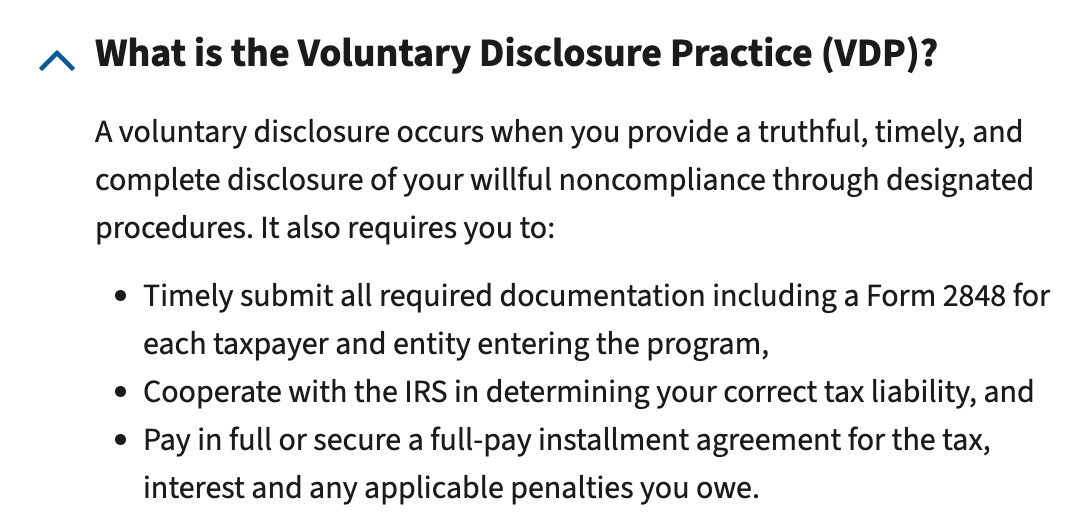
In this context, “resolved” means the IRS has reviewed the submission, calculated the additional tax, penalties, and interest, and agreed on a final amount with the taxpayer. Odaily added that some reports indicate taxpayers may need to arrive with all amended returns already prepared, covering prior years in which income or gains were underreported or omitted.
For crypto holders, that can mean reconstructing years of transaction history, identifying the acquisition price of each coin for tax basis purposes, and then calculating the amount due. The article noted that this preparation period is not included in the 120-day resolution window.
Koopman did not provide a numerical estimate for how much penalties might fall. He said only that penalties under the revised voluntary disclosure process would be “substantially lower” than current levels. The IRS has not published penalty rates, eligibility requirements, or an effective date.
Odaily pointed to the current benchmark: a 75% civil fraud penalty applied to the year with the highest tax liability, usually across a six-year lookback period. The IRS also allows installment payments.
Why expatriation tax can still be assessed years later
The article said Ver’s case remained actionable a decade later because it involved fraud. In that situation, the IRS is not bound by the normal assessment time limit.
Under U.S. expatriation tax rules, a person who meets the definition of a covered expatriate is treated as if all worldwide property had been sold on the day before expatriation, with capital gains tax due on the resulting gain. Odaily listed three triggers: net assets above $2 million, average income tax liability over the prior five years above the annual threshold, or failure to certify tax compliance for the previous five years. The article gave $206,000 as the threshold for 2025. Covered expatriates must also submit a global balance sheet and a compliance certification.
The IRS has long treated convertible virtual currency as property. In the article’s reading, that means bitcoin is subject to the same deemed-sale treatment as other assets, with no carveout.
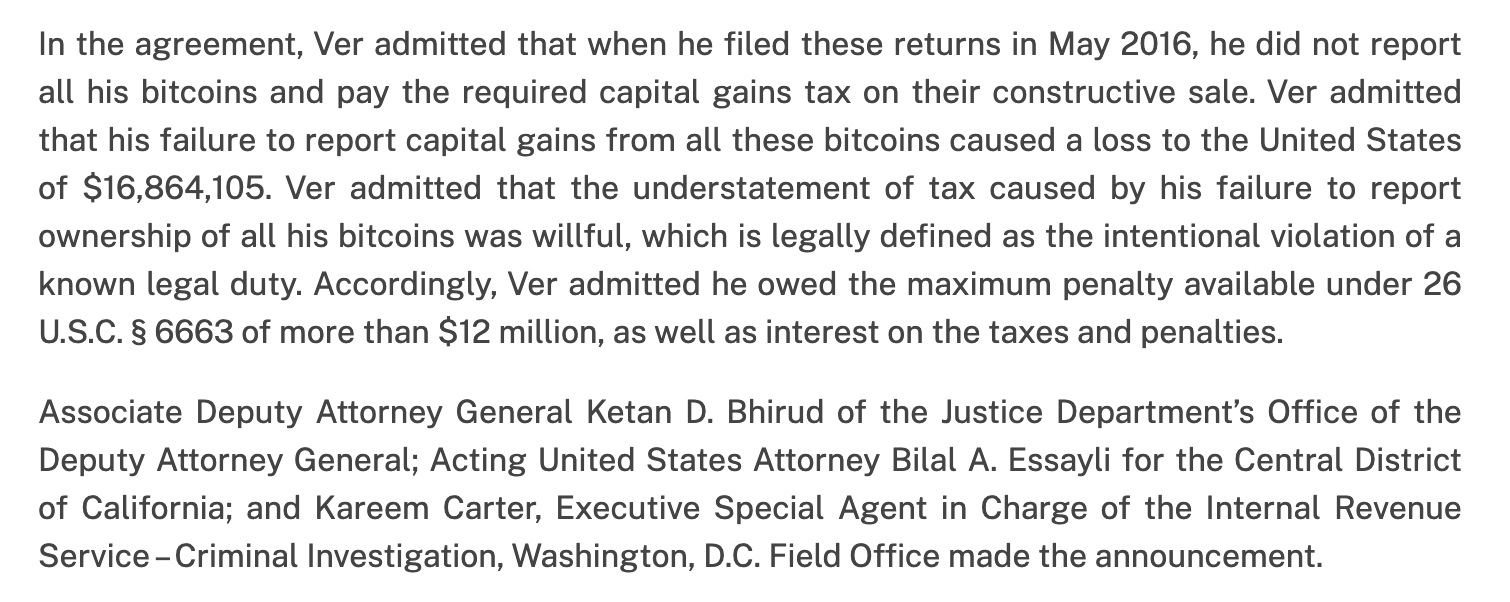
As for timing, the normal IRS assessment period is three years, extending to six years if omitted gross income exceeds 25%. But if a return is false or fraudulent and intended to evade tax, there is no time limit for assessment. Odaily said the IRS must prove fraudulent intent with “clear and convincing evidence,” and Ver’s admission placed his case within that rule.
On-chain reporting still depends heavily on taxpayer records
Odaily said U.S. tax law treats digital assets as property rather than currency. That means each sale, exchange, or payment is a taxable disposition and must be reported on Form 8949 and Schedule D.
U.S. exchanges will issue Form 1099-DA for sales after Dec. 31, 2024. Still, the 2025 form will report only gross proceeds, while cost basis reporting will not begin until transactions in 2026, according to the article.
Congress has repealed the broker rule aimed at DeFi, so Form 1099-DA applies only to centralized custodial platforms. DeFi swaps, most NFT trades, and wallet-to-wallet transfers will not appear on the form, but that does not make them non-taxable. Taxpayers still need to report those dispositions on their own. Staking rewards, mining income, airdrops, and DeFi yield are treated as ordinary income at fair market value when received, not as capital gains.
The article also stressed the recordkeeping burden around cost basis. If a transaction generated profit, taxpayers should retain the transaction hash, timestamp, fair market value in U.S. dollars at the time of the transaction, and the basis allocated to each lot. Transfers between wallets owned by the same person are not taxable, but they still need documentation. Without that trail, inbound assets may be treated as having zero basis when matched against broker data, which could leave the full amount exposed to tax.
Odaily ended the report by reminding readers with relevant U.S. tax obligations to file in line with the applicable rules.


