
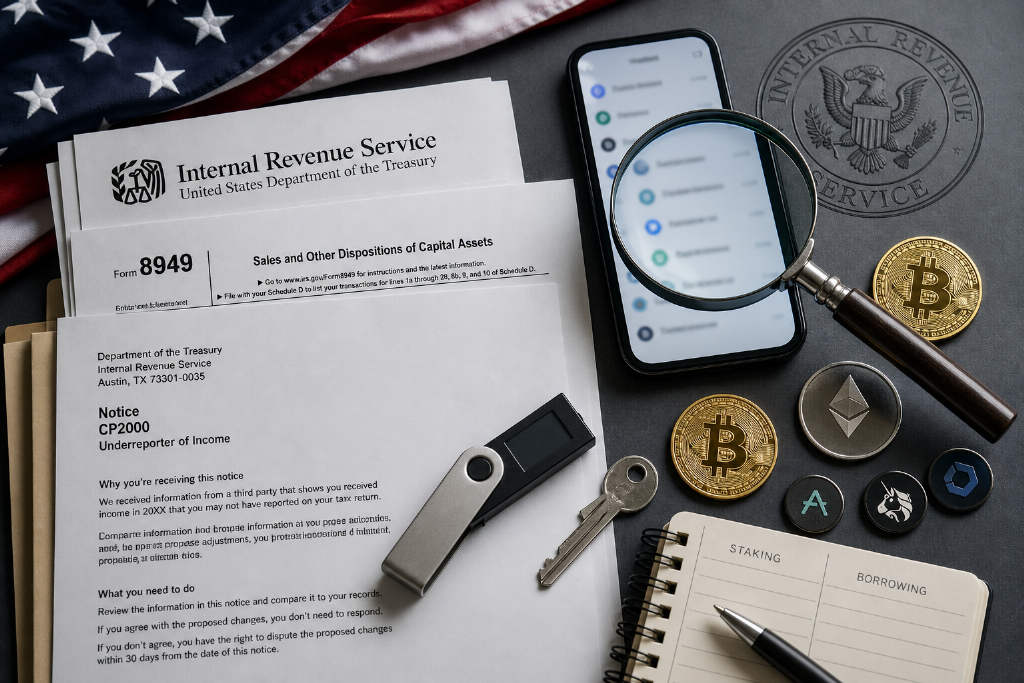
The Internal Revenue Service is moving from form-focused crypto enforcement toward wallet-focused scrutiny, according to a Forbes column by CoinTracker head of tax strategy Shehan Chandrasekera. He cited a Chainalysis estimate that global taxable onchain activity will total at least $457 billion in 2025, with 86% of that activity falling outside the view of reporting forms such as Form 1099-DA.
Most taxable activity sits in areas where no broker files a form
The 86% figure covers self-custody wallets, decentralized exchanges, DeFi protocols, staking and lending income, and peer-to-peer payments. In those settings, there is no broker responsible for preparing and filing an IRS reporting form.
The column did not say the IRS has announced any new policy formally called “wallet enforcement.” That label reflects the author’s reading of several rules that are already in force.
Form 1099-DA will first reach taxpayers in the 2026 filing season
Form 1099-DA applies to transactions that take place after Jan. 1, 2025, and taxpayers will receive it for the first time during the 2026 tax filing season. Brokers must send the form to customers by Feb. 16 and submit it to the IRS by March 31.
The main issue is cost basis. For tax year 2025, the cost basis field on 1099-DA, including Box 1g, will in most cases be left blank, while brokers report only gross proceeds. Cost basis reporting alongside proceeds will not begin until transactions after Jan. 1, 2026.
Coinbase Vice President of Tax Lawrence Zlatkin said, “This year could be very confusing for many investors because 1099-DA reports gross proceeds from transactions, while cost basis information will not be provided to the IRS until tax year 2026.”
As described in the column, the IRS may see that a trader sold $50,000 but not see that the trader originally paid $48,000. If the taxpayer does not add the cost basis back on Form 8949, the system may treat the full $50,000 as profit. If the numbers do not match, an automated CP2000 notice can be issued.
Cost basis must now be tracked wallet by wallet
The “wallet” framing also comes from Rev. Proc. 2024-28. Starting Jan. 1, 2025, cost basis must be tracked separately for each wallet. Taxpayers can no longer pool all holdings together for a single calculation.
The definition of wallet is broad. Exchange accounts count, including Coinbase and Kraken. Self-custody wallets also count, including MetaMask and Ledger. If the same token moves from one wallet to another, the cost basis record must move with it.
Chandrasekera argued that manual reconciliation becomes nearly impossible for anyone using multiple wallets and interacting with DeFi. The report noted that this view comes from a tax software executive, but also said the rule itself is written that way.
Outside the form does not mean outside the IRS view
For activity that does not appear on tax forms, the IRS uses other tools. The report said the agency has been contracting with blockchain analytics firms such as Chainalysis and TRM Labs since 2015 to connect wallet clusters with known identities.
A dedicated enforcement effort, Operation Hidden Treasure, is aimed at identifying unreported crypto income, including wallets that have never used a U.S. exchange.
Combined with mandatory exchange reporting and John Doe summonses, the room to stay outside the reporting net is much smaller than it was a few years ago.
Processing may be slow, but automated notices can move faster
How quickly the IRS can work through the 2025 data is a separate question. Miles Fuller, who spent 15 years at the IRS and is now at Taxbit, said the agency will likely be slow in digesting that data set.
Zlatkin, though, warned that a mismatch between 1099-DA and a tax return can trigger an automated notice without any human review.
A study released in April found that only 6.5% of U.S. crypto users actually report to tax authorities.
What taxpayers may need to watch in 2026
Based on the column’s breakdown, the 2026 filing season brings two immediate issues. First, Form 1099-DA will start covering digital asset transactions that occurred after Jan. 1, 2025. Second, for tax year 2025, the form will usually show gross proceeds without automatically supplying cost basis. Taxpayers who do not restore that information on Form 8949 risk having the IRS system treat the entire sale amount as taxable gain.
In the Chainalysis framework, roughly 86% of at least $457 billion in global taxable onchain activity in 2025 will occur in self-custody wallets, DEXs, DeFi, and peer-to-peer transfers that do not generate 1099-DA forms. The reporting gap does not mean the activity is invisible to the IRS.