
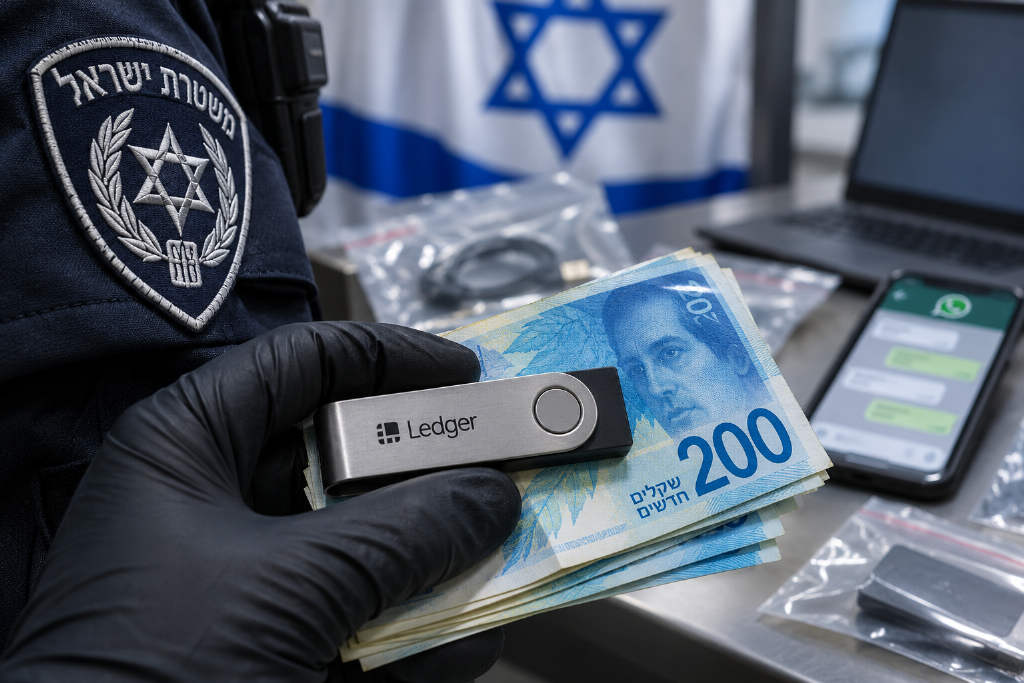
Israeli police arrested five suspects on November 10 over roughly 16 million shekels, or about $5 million, in cryptocurrency transactions arranged through a WhatsApp group. The suspects are being investigated for alleged money laundering, fraud and the unlicensed provision of financial asset services.
The search was carried out by the National Economic Crime unit under Lahav 433. Officers seized crypto wallets, computer equipment and tens of thousands of shekels in cash from the suspects’ homes before questioning the five over the three allegations.
Alleged loan agreements used to disguise proceeds
Police allege that the suspects presented proceeds from crypto transactions as borrowed funds. Investigators found that the group used forged loan agreements to make crypto income deposited directly into bank accounts appear to be private loans, avoiding financial institutions’ checks on the source of the money. The transactions were also not reported to tax authorities as required.
The Jerusalem Post reported that the National Economic Crime unit was leading the investigation and that the five faced allegations of money laundering, fraud and the unlicensed provision of financial asset services.
Israel’s tax authority announced two other arrests on October 6. One case involved transaction volume worth tens of millions of dollars. In the other, an Ashdod resident was accused of failing to report about $13 million in crypto trading income between 2019 and 2021. All three cases concerned individuals rather than exchanges.
Audit puts annual reporting at about 500 people
A November 2024 report by Israel’s state comptroller found that an average of only about 500 people a year reported crypto activity from 2018 through 2022. The report estimated at least 200,000 potential filers, putting the reporting coverage rate at approximately 0.25%.
That works out to roughly one person reporting for every 400 potential filers. BlockTempo argued that, with defense spending and deficit pressure rising, crypto assets had become a clear target for tax collection and that group-based over-the-counter trades were particularly liable to go unreported.
Bank trading plans and individual transactions
Israel’s crypto oversight in recent years has focused in part on regulated institutions. Discount Bank announced in November that it would open Bitcoin and Ether trading through its app on November 26, although customers would not be able to transfer the coins out.
Earlier, Leumi, Israel’s largest bank, partnered with Galaxy on plans to open Bitcoin, Ether and Solana trading in early 2027. BlockTempo said banks are required to keep records of individual transactions and restrict outgoing funds, placing compliance costs on regulated institutions.
BlockTempo said WhatsApp-based over-the-counter transactions operate without know-your-customer (KYC) checks or exchange wallet whitelists, with payments going directly to individual bank accounts. The outlet argued that investigators trace funds through unusual bank deposits and reporting records. It linked the three allegations in the case to unlicensed services, forged agreements and questions about the source of funds.
Taiwan’s approach to exchanges and personal filings
BlockTempo contrasted the Israeli cases with Taiwan’s approach, which it described as regulating service providers first and then addressing individual reporting. Taiwan’s financial regulator brings exchanges under oversight through anti-money laundering registration and KYC and anti-money laundering (AML) requirements; individuals are subject to income tax reporting. A dispute has also arisen over whether gains must be reported even when funds have not been withdrawn.
The outlet argued that the Israeli case shows authorities turning their scrutiny toward individuals when reporting coverage is low, using criminal enforcement.



