

China added 67 new unicorns in the first half of 2026, and more than half of them were AI or embodied intelligence companies, according to a recent report from IT Juzi. The firm then pulled together the angel-stage cap tables of all 107 unicorns currently on its list in China’s AI and robotics/embodied intelligence sectors to answer a narrower question: which investors have been most successful at backing future unicorns at the seed, angel and angel-plus stages.
As of July 2026, the data showed that nearly 300 institutions had landed at least one unicorn through angel-round investing. IT Juzi said that figure was well above market expectations. Part of the reason, it wrote, is that star projects are now drawing attention from the day they are formed, pushing up the number of institutions that show up in angel rounds.
In the sample, 21 unicorns attracted between five and nine institutions at the angel stage. Another seven drew more than 10 investors: Qingtianzu, Wujie Dynamics, Lingchu Intelligence, Tashi Zhihang, Galbot, Baichuan Intelligence and Dreame. Most of those companies were founded after 2024, the report said, after the current wave had already started to build.
Sequoia China, GL Ventures and ZhenFund led by total angel-round unicorn count
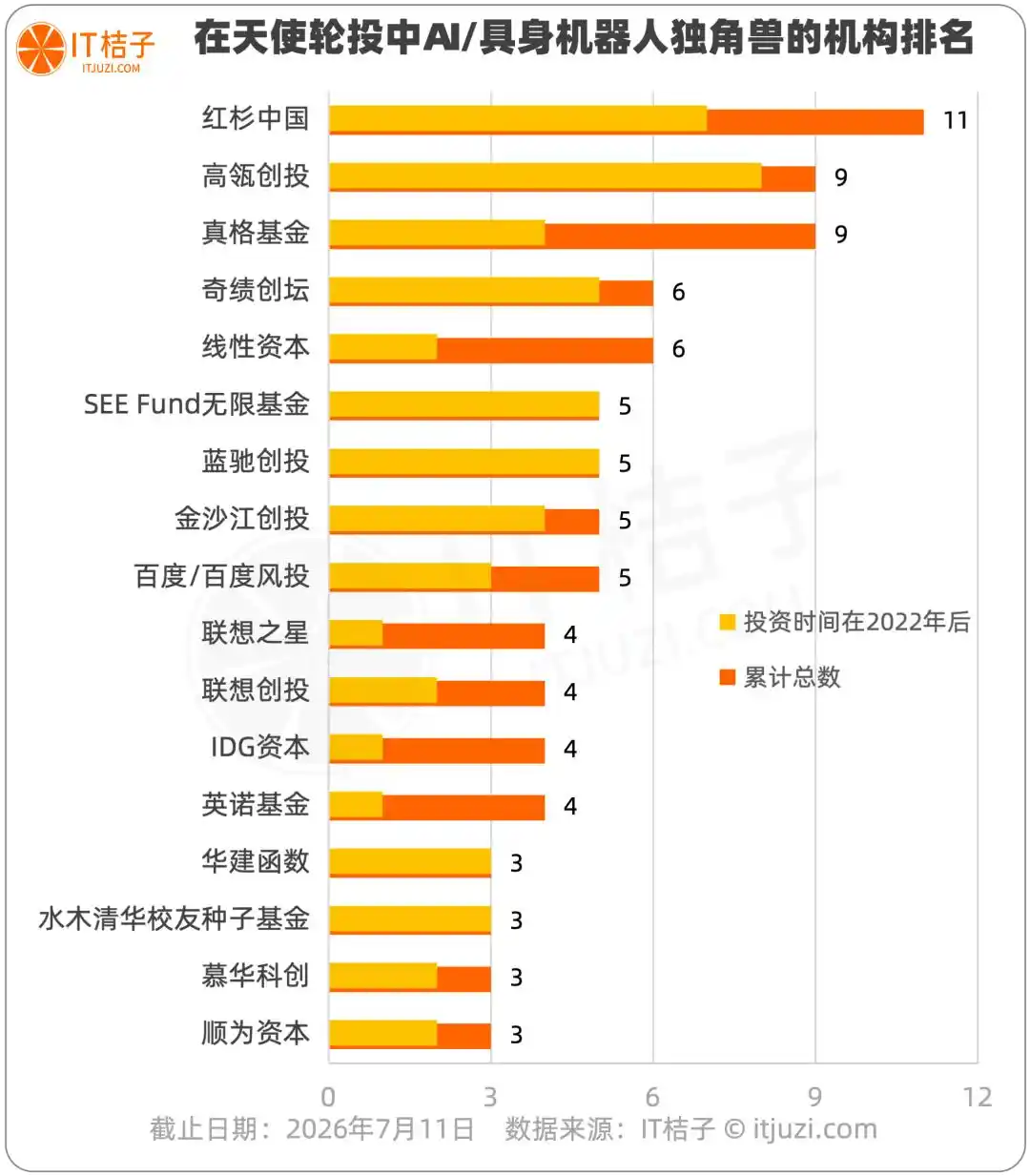
IT Juzi used 2022 as the dividing line between the generation before GPT and the companies formed after the large-model era began. On a simple count of unicorns backed at the angel stage, Sequoia China ranked first with 11, while GL Ventures and ZhenFund followed with nine each.
The report said a major reason those firms scored so highly is that they put more capital to work during the past two years, when embodied intelligence investing accelerated and many of the best-known early rounds were being formed.
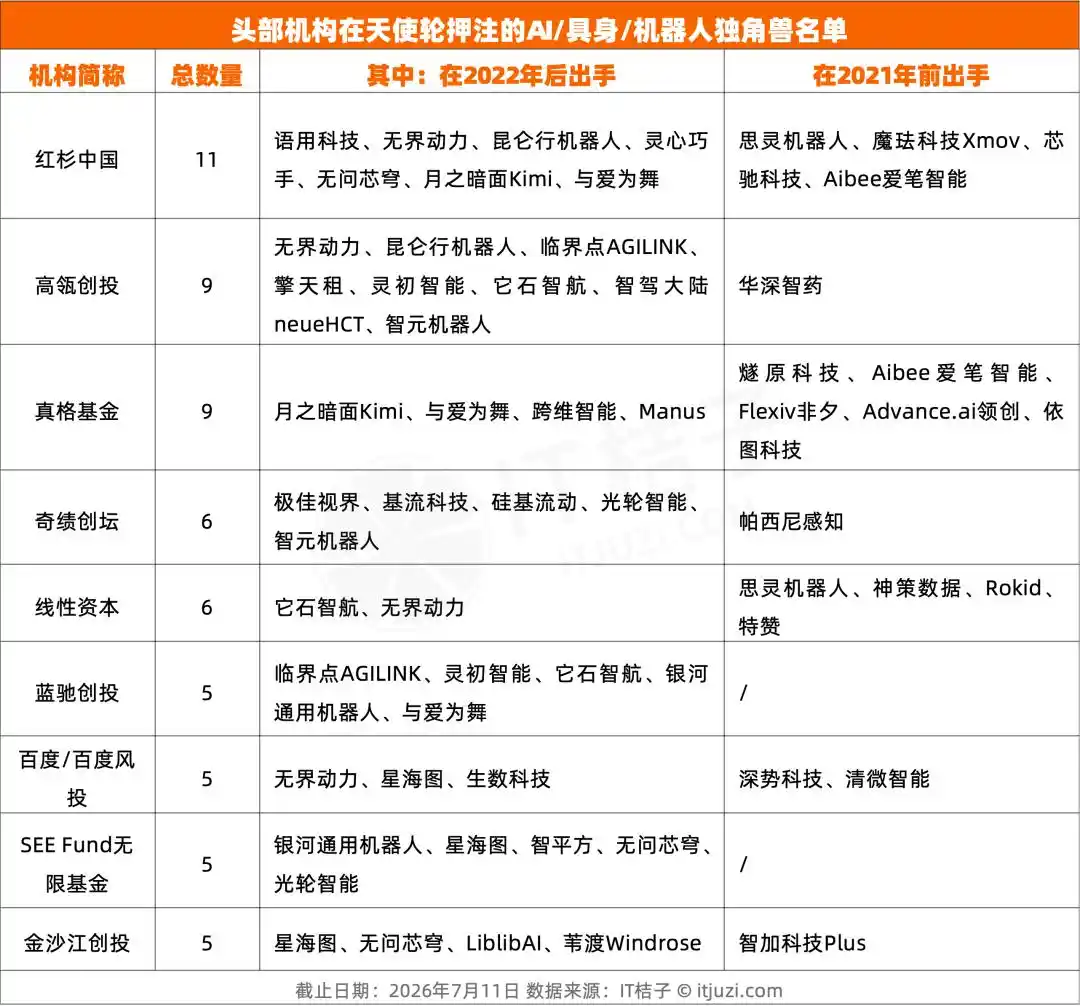
Sequoia China’s angel-stage bets included Wujie Dynamics, Kunlunxing Robot, Lingxin Qiaoshou, Kimi and Infinigence AI. Seven of those investments were made after 2022.
GL Ventures also backed Wujie Dynamics, Kunlunxing Robot, Lingjiedian and Lingchu Intelligence. Of its nine projects, eight were invested in during or after 2022. IT Juzi’s framing was that GL Ventures, with deeper pockets, moved aggressively once the direction started to look more certain.
ZhenFund also had nine angel-round unicorns. Unlike the first two firms, five of ZhenFund’s investments were made in or before 2021, giving it heavier exposure to the earlier generation of AI startups. In the current large-model and embodied intelligence wave, the firm backed Moonshot AI’s Kimi, education large-model company Yu Ai Wei Wu, embodied intelligence company Kuawei Intelligence and Manus at the angel stage. The report said the count may not be the most eye-catching, but Kimi and Manus are enough to stand out as flagship wins.
Beyond the top three, Linear Capital, GSR Ventures, IDG Capital, Lanchi Ventures, Baidu Ventures and Shunwei Capital each backed at least three unicorns at the angel stage.
Looking across the full table, IT Juzi said the same pattern has appeared in both the AI cycle a decade ago and the current large-model and embodied intelligence cycle: the investors that repeatedly find and back unicorn opportunities early are still mostly U.S. dollar funds, many of which had already positioned themselves in 2023. By contrast, many domestic RMB funds preferred pure hard-tech projects and moved more slowly on embodied intelligence, often not entering until after 2025.
If the focus shifts to post-2022 new bets, MiraclePlus, Lanchi Ventures and SEE Fund become the key names
IT Juzi then changed the lens. Instead of looking at the largest cumulative stock of angel-round unicorns, it stripped out older holdings and focused only on new embodied intelligence investments made after 2022. On that basis, the report said MiraclePlus, Lanchi Ventures and SEE Fund deserve closer attention.
Those three firms held six, five and five unicorns respectively, almost all in embodied intelligence, and all of those investments were made after 2022. In other words, the report argued, they were not leaning on legacy wins from earlier cycles. They built those positions through fresh early-stage bets in the current embodied hard-tech wave.
MiraclePlus: using volume to deal with uncertainty
According to IT Juzi’s data, MiraclePlus got into several unicorns at the angel stage, including Jiajia Vision, SiliconFlow, Jiliu Technology, AgiBot, Guanglun Intelligence and robotic sensor company PacSensing. Those companies later grew into unicorns.
The report described MiraclePlus as a localized version of the YC China model. Traditional VC logic usually calls for deep diligence on each company, making sure the founder is on the right path before writing a larger check. In AI, and especially in embodied intelligence, that approach runs into a problem early on because neither the technical route nor the industry structure is settled.
Most VC investors respond to that kind of uncertainty by waiting, IT Juzi wrote: waiting for technical paths to converge, waiting for consensus to form, waiting for the winners to emerge. By then, the angel round is usually gone.
MiraclePlus took the opposite approach. If it is close to impossible to identify the exact winner in advance, cover more of the field. When technical paths are still splitting quickly and any one of them could open onto a huge market, betting on a single branch is a gamble; covering many branches is a strategy.
Operationally, MiraclePlus does not conduct traditional diligence and does not rely on deals referred by financial advisers. Instead, it runs spring and fall founder camps each year, screens several thousand applications, selects dozens of teams, and offers $300,000 or the RMB equivalent for 7% equity, with a post-money valuation fixed at about $4.28 million.
IT Juzi said Lu Qi’s model can be read as a way to help founders at scale, while also raising capital efficiency. With the same $100 million, MiraclePlus could invest in more than 300 companies, while Sequoia might only be able to invest in 10.
That also means risk is spread systematically. A $300,000 entry ticket that fails does little damage to the overall fund. If one of those companies grows into a $1 billion unicorn, the theoretical return can exceed 100x before dilution, enough to absorb the cost of many failed bets. IT Juzi framed that as a classic early-stage formula: diversification against uncertainty, and low entry cost in exchange for high return multiples.
The report also noted the limits of the model. The entry bar is low, but MiraclePlus has finite post-investment bandwidth for each team. Most of that support is concentrated in the few months of the founder camp, when teams are trying to build and validate products quickly.
Lanchi Ventures: getting to the table before consensus forms
IT Juzi called Lanchi Ventures an outlier. The firm manages nearly RMB 20 billion and sits among China’s top early-stage funds, yet it remains focused on seed to Series A investing, with single checks generally ranging from $1 million to $6 million.
In the VC industry, that is almost a contrarian move. Funds of similar size often shift toward post-Series B deals because, from the LP perspective, the larger the fund and the smaller the ticket, the harder it is to produce meaningful DPI. Lanchi managing partner Chen Weiguang argued otherwise. In 2022, he said, “Excessive pursuit of management scale is the biggest killer of excess returns.”
That view showed up in fundraising too. After Lanchi’s fourth dual-currency fund was oversubscribed at RMB 3.9 billion, or about $560 million, the firm closed it voluntarily instead of continuing to expand.
IT Juzi’s data showed that Lanchi backed embodied intelligence unicorns such as Lingjiedian, Lingchu Intelligence and Tashi Zhihang at the angel stage, and entered Galbot even earlier at the seed stage.
The report cited one market account of how that happened. In early 2023, Chen Weiguang spoke with Galbot founder Wang He for three hours. Galbot was incorporated in May that year, and Lanchi joined the first financing round one month later. According to the report, many domestic robotics companies were still focused mainly on the body of the machine at the time, while Wang was thinking about how to rebuild the robot’s “brain” with large models so it could genuinely understand the physical world. Because real-machine data was extremely scarce, the company used simulation to generate training data. Lanchi later continued to add capital in subsequent rounds as a follow-on investor.
IT Juzi pointed to two sourcing mechanisms behind Lanchi’s early access. The first is the BuMing founder camp. In early 2023, the firm launched the BuMing ecosystem brand to find and meet a new generation of AI founders earlier. Each cohort takes only 20 people. There are no formal classes. The format centers on co-creation workshops, with Lanchi partners participating throughout and younger technologists, repeat founders and investors brought together for in-depth discussions on frontier topics.
BuMing has now run five cohorts. The report said its strategic value lies in letting Lanchi’s investment team observe founders while they are still in what it called the “60 days underground” phase, before they are widely visible, and assess how they think, how their teams work together and how they judge technology. IT Juzi described it as Lanchi’s “underwater project radar.”
The second channel is the AGI Pioneer Club. Also in early 2023, Lanchi issued an “AGI Pioneer Call,” inviting AI founders, technical leaders from major companies and frontier academic researchers to join. The report said the club functions both as an operating community and as a dense information network, giving the firm faster access to technical debate and talent movement.
That combination, IT Juzi argued, lowers the discovery cost of early-stage investing. And because Lanchi has the capital base and the ability to keep following on, it can also lower the cost of missing out once it believes it has identified the right team.
SEE Fund: amplifying an engineering network centered on Tsinghua-linked founders
The article also spent significant space on SEE Fund. The fund was launched in 2021 by Yao Song, founder and former CEO of DeePhi Tech. Its approach was highly vertical from the beginning, centered on early-stage projects tied to Tsinghua’s electronic information fields and focused on semiconductors, broader electronic information technology and the industrial internet. Its investments are concentrated before the Pre-A stage.
SEE Fund’s first vehicle was only RMB 200 million, and its second was about RMB 600 million. Even so, the LP roster included Sequoia China, Hillhouse, ByteDance and Matrix Partners China. The report noted that those LPs could also become potential downstream buyers of companies backed by the fund.
IT Juzi said SEE Fund managing partner Ma Lin had already become convinced about embodied intelligence in early 2023, before the theme turned hot. While many venture firms were competing for allocations in AI large-model startups, SEE Fund chose a differentiated route and increased exposure to embodied intelligence instead.
The fund then built a systematic layout across the embodied intelligence chain, including Guanglun Intelligence in embodied data, Infinigence AI in AI compute, Qiongche Intelligence on the “brain” side, and Galbot, Xinghaitu and Zhifang on the “body” side. The report said many of those companies have already become unicorns.
IT Juzi also stressed the role of the Tsinghua electronics alumni network. One example is Infinigence AI founder Professor Wang Yu, who is dean of the Department of Electronic Engineering at Tsinghua University and had previously co-founded DeePhi Tech with Yao Song. Against that background, SEE Fund’s angel-round investment in Infinigence AI was not surprising, the report said.
Other examples listed in the article included Xinghaitu founder Gao Jiyang, who graduated from Tsinghua’s electronics department, worked at Waymo and later led production at Momenta after returning to China; Galbot founder Wang He, who completed his undergraduate degree in 2014 in Tsinghua’s microelectronics department; and Guanglun Intelligence co-founder Yang Haibo, who had been a director at Meituan, whose founder Wang Xing is also part of the Tsinghua network.
The article also mentioned the Shuimu Tsinghua Alumni Seed Fund, an older institution built around Tsinghua ties. At the angel stage, it backed three AI and embodied intelligence unicorns: SiliconFlow, Jiliu Technology and Accelerating Evolution. IT Juzi said the advantage of this kind of approach is high information density and lower trust costs inside a concentrated network. At the same time, the report added that SEE Fund is no longer investing only in Tsinghua-linked projects and has started to include founders from outside that circle.
Capital is accelerating into the sector, but embodied intelligence remains a long-cycle bet
IT Juzi said embodied intelligence should be viewed on at least a 10-year return cycle, which means the current unicorn roster is still only a midgame snapshot. Its data showed that from January to June 2026, total financing in China’s embodied intelligence sector exceeded RMB 90 billion, more than double the full-year total for 2025. Capital is heating up quickly, but commercialization is still at an early stage.
Over a longer time frame, the report returned to a structural pattern. In both the AI cycle a decade ago and the present large-model and embodied intelligence cycle, established U.S. dollar funds have remained the institutions most willing and most able to identify unicorn opportunities early. Many of them were already deploying in 2023. IT Juzi argued that this is not accidental. U.S. dollar funds generally have longer fund lives, higher tolerance for long periods of uncertainty, and LPs that are more willing to accept a rhythm of heavy early deployment followed by slower validation.
RMB funds, by comparison, face exit pressure and reinvestment constraints. When technical paths are still unsettled and commercialization remains unclear, their decision chains tend to be longer and their investment pace more cautious. IT Juzi used that to explain why firms such as ZhenFund, Linear Capital and GSR Ventures were able to establish an angel-round playbook earlier, while many domestic RMB funds only began to enter embodied intelligence at scale after 2025.
The article also said that balance is starting to shift. As embodied intelligence has been included in China’s strategic emerging industries, more RMB GPs are setting up dedicated early-stage vehicles, and local government guidance funds are entering faster. IT Juzi’s conclusion was that competition in early-stage investing could move over the next two to three years from a show dominated by U.S. dollar institutions to a market where dual-currency players compete head-on.
The original article was published by the WeChat public account IT Juzi (ID: itjuzi521) and written by Wu Meimei.