
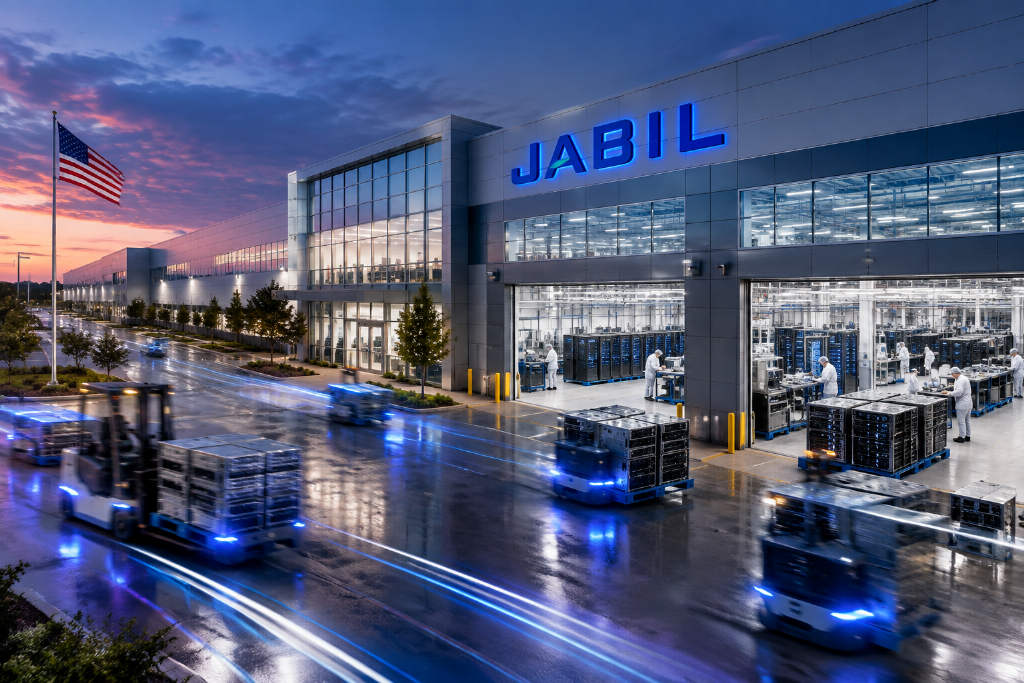
Jabil Inc. (NYSE: JBL) will report fiscal 2026 fourth-quarter and full-year results before the U.S. market opens on Sept. 30, 2026, then hold a call that the company has described on its investor relations page as an annual investor briefing. That distinction has shaped expectations. The market is less focused on quarter-end numbers that are already largely bracketed and more focused on management’s strategic and financial priorities for fiscal 2027.
The setup is straightforward. Jabil is no longer being watched only as a traditional electronics manufacturing services company. It is now being valued, at least in part, as a supplier tied to AI data center infrastructure. On the company’s June third-quarter call, management said fiscal 2026 AI-related revenue should come in at about $13.6 billion, up roughly 50% from $9.0 billion in fiscal 2025. Yet the stock has not tracked that growth line higher. As of Sept. 24, JBL was at $310.13, well below its June high, with a 52-week range of $189.60 to $428.93. The gap between operating momentum and share-price performance is the issue this guidance needs to address.
Q4 matters, but fiscal 2027 matters more
Management’s fourth-quarter guide leaves room, though not much mystery. Jabil previously guided for revenue of $9.2 billion to $10.0 billion and core EPS of $3.80 to $4.20. Consensus estimates compiled by Bloomberg and Yahoo Finance point to about $4.05 in EPS and roughly $9.61 billion in revenue, near the upper half of that range.
That is why the real variable is the full-year fiscal 2027 framework. Investors want to know what management expects for revenue, margins, AI-related sales, capital spending, and free cash flow once the company moves into a larger AI infrastructure base.
Third-quarter results reset the growth curve
According to Jabil’s third-quarter earnings release filed with the U.S. Securities and Exchange Commission, net revenue for the quarter ended May 31, 2026 was $8.751 billion, up about 12% from $7.828 billion a year earlier. GAAP operating income was $445 million and diluted EPS was $2.59. Core operating income reached $504 million, while core diluted EPS was $3.16, up about 24% year over year.
The spread between 12% revenue growth and 24% core EPS growth says more than the top line alone. It points to operating leverage, though not only operating leverage.
The same filing raised the company’s fiscal 2026 full-year outlook to about $35 billion in revenue, a 5.8% core operating margin, core EPS of $12.70, and more than $1.4 billion in adjusted free cash flow. For comparison, fiscal 2025 revenue was about $29.8 billion. The first nine months support that trajectory: revenue rose from $21.55 billion to $25.338 billion, and adjusted free cash flow increased from $813 million to $991 million.
AI-related revenue is now large enough to drive the model
On the third-quarter call, Chief Executive Officer Mike Dastoor said AI-related revenue for fiscal 2026 was expected to be about $13.6 billion. Notes compiled by investment firms from the earnings presentation showed that figure was raised by $500 million from the $13.1 billion discussed in March, and it implies roughly 50% growth from the $9.0 billion recorded in fiscal 2025. Dastoor also said fiscal 2027 AI-related revenue should grow at a percentage rate similar to fiscal 2026, but from a much larger base.
That metric needs context. AI-related revenue is not a standard accounting line item. It is a company-defined category that covers several businesses tied to AI infrastructure, including high-density racks, liquid cooling systems, power management, networking equipment, and related integration services. The advantage is that it captures the shift in business mix. The tradeoff is weaker comparability across the industry.
For Sept. 30, the more important question is whether management gives a specific fiscal 2027 range for AI-related revenue and how that figure sits against total company revenue guidance.
New customers and new capacity shape the 2027-2028 setup
The third-quarter call included two disclosures that matter directly for fiscal 2027 and fiscal 2028.
- First, Jabil said it had added a third hyperscale customer in data center infrastructure. Management expects that relationship to generate revenue in the hundreds of millions of dollars in early fiscal 2027, with the potential to scale to more than $1 billion in fiscal 2028.
- Second, the company outlined its capacity buildout. A new North Carolina facility is expected to be completed in the fourth quarter, with full ramp targeted for January 2027. Capacity in Memphis, India, and Mexico is also moving forward.
The longer-dated piece is India. In a joint announcement released on June 15, Jabil and Adani Enterprises said they planned to form a strategic alliance to build a vertically integrated AI and data center infrastructure manufacturing platform in India, targeting gigawatt-scale capacity for high-density AI racks. That plan lines up with the Adani Group’s broader goal of investing $100 billion by 2035 to build 5 gigawatts of green-powered data center capacity.
Management said on the call that this is a fiscal 2028 event. Capacity construction is the main constraint, so it will not be included in the revenue framework for the coming guidance cycle. It still matters for how investors think about the company’s medium-term ceiling.
Why valuation has compressed even as earnings moved higher
Jabil shares jumped more than 10% after the June earnings release, then gave back ground. Market reports cited in the source material said the stock fell to as low as $300.67 in mid-September. It was still up about 25% for the year, but clearly below the June peak. One direct trigger came on Sept. 8, when Goldman Sachs analyst Mark Delaney kept a Buy rating but cut his price target to $375 from $482. The stock fell as much as 5.1% that day.
Sell-side views are not aligned. According to a Benzinga roundup of analyst actions, UBS upgraded the stock to Buy from Neutral on Aug. 11 and set a $430 target. JPMorgan on June 18 maintained an Overweight rating and raised its target to $450 from $395. Barclays, also on June 18, lifted its target to $426 from $304.
That leaves the debate centered less on whether Jabil can deliver the numbers and more on what multiple investors are willing to pay for those numbers.
The whole AI supply chain is being repriced
This is not unique to Jabil. Among peers, Celestica reported second-quarter revenue of $4.70 billion, up 62% year over year, with adjusted EPS of $2.54, and it raised its full-year outlook. Flex posted a much milder growth profile. Across the electronics manufacturing services group, valuation gaps are increasingly tied to how deeply each company participates in AI racks and networking equipment rather than to total revenue alone.
The macro backdrop still looks strong. CNBC data cited in the source material showed combined 2026 capital expenditures by the four largest hyperscalers were close to $700 billion. An updated figure put that number at about $725 billion, up roughly 77% from $410 billion in 2025. Mainstream market forecasts for 2027 sit near $1 trillion.
But the funding mix is changing. More of that spending is being supported by debt financing and customer prepayments rather than pure operating cash flow. On Sept. 24, Akamai disclosed that its $11.6 billion agreement with Anthropic corresponded to about $5.5 billion in capital expenditures, with roughly $1.7 billion pulled forward into 2026 for advance purchases of key supply-chain components, including memory. For upstream manufacturers, that kind of pre-buying improves order visibility. It also means some demand may be brought forward.
Three sets of numbers investors will watch
The first is fiscal 2027 revenue and EPS guidance. Management said in June that core operating margin should rise above 6% in fiscal 2027. If the final guide lands below that level, the market may read it as evidence that AI rack integration is diluting margins more than expected.
The second is the absolute size of AI-related revenue. UBS had previously suggested Jabil’s fiscal 2027 AI-related revenue could rise by about 50% to more than $20 billion. If management’s framing comes in well below that level, the valuation center may need to move lower. If it lands near or above it, the recent pullback is more likely to be treated as a sentiment reset.
The third is capital spending and free cash flow. Jabil has previously kept capital expenditures at 1.5% to 2% of revenue and has emphasized an asset-light model. Whether that ratio can hold during a period of rapid capacity expansion will say a lot about the cash quality of this growth cycle.
Buybacks are still part of the EPS story
On July 15, the company said its board had authorized a new share repurchase program of up to $1.5 billion. Earlier 10-Q disclosures showed that as of May 31, Jabil had already used $891 million under its fiscal 2026 repurchase plan to buy back 3.7 million shares, leaving $109 million available.
Since 2016, the company has returned about $8.0 billion to shareholders and repurchased roughly 114 million shares at an average price of $65.66. With the share count continuing to shrink, part of EPS growth comes from the denominator, not just the numerator. That distinction matters when investors assess the quality of earnings growth.
The source material also noted that platforms such as MEXC offer tokenized stock tools for investors who want to track moves in U.S. equities and related assets outside regular trading hours. It added that such instruments differ from spot equities in liquidity and settlement mechanics, and that users should understand the rules before using them.
Risks are concentrated in supply chains, customer mix, and timing
Supply chain pressure is the most direct risk. Third-quarter inventory days rose to 84, above the normal target range of 55 to 60 days. Management attributed that to tightness in high-bandwidth memory, high-density circuit boards, and some legacy-node memory products. Rising memory prices can increase working-capital needs and pressure margins at the same time.
Customer concentration is the second risk. Three hyperscale customers create growth leverage, but they also mean any change in order timing by one customer can have a visible effect on revenue. Contract structures in electronics manufacturing services often allow customers to adjust demand within certain limits, which makes short-cycle revenue volatility hard to eliminate.
The third risk is a mismatch between capacity additions and demand timing. North Carolina capacity is set for a full ramp in January 2027, while the India platform is not expected to contribute revenue until fiscal 2028. If industry capital spending enters a digestion phase in between, utilization on new capacity could come under pressure.
Then there is valuation risk. Once a company is priced as an AI infrastructure name rather than a manufacturing services provider, the multiple becomes much more sensitive to guidance. September’s target-price cuts already showed that dynamic.
Three possible paths and what comes after the report
The source material laid out three broad scenarios.
- In a stronger case, fiscal 2027 AI-related revenue comes in near or above $20 billion, core operating margin is clearly above 6%, and capital spending stays within 2% of revenue.
- In a middle case, AI-related revenue remains strong but grows a bit more slowly than in fiscal 2026, margin guidance is modestly above 6%, and management emphasizes supply constraints and the timing of capacity ramps.
- In a pressured case, management offers a conservative range because of memory costs or customer scheduling, or it adjusts the definition of AI-related revenue.
After the report, investors are likely to focus on four follow-up markers: first-quarter fiscal 2027 revenue and margin guidance, disclosure around the revenue contribution from hyperscale customers, any update on the India platform timeline, and the 2027 capex outlook that the four largest hyperscalers provide during the fourth-quarter 2026 earnings season.
James Mitchell’s view: the key issue is the composition of 2027 AI revenue
In James Mitchell’s view, the real information value in this report is not the Sept. 30 quarterly print but how management describes the composition of fiscal 2027 AI-related revenue. At $13.6 billion, AI-related revenue is already close to 40% of the company’s expected $35 billion in annual revenue. Once a business line reaches that scale, its growth rate stops being incremental and starts driving the whole model.
From a quantitative angle, the combination of 12% revenue growth and 24% core EPS growth shows operating leverage at work, but it also includes the denominator effect from buybacks, with $891 million already deployed in the first nine months. Separating those two effects is necessary to judge how much of the margin improvement comes from business mix and how much comes from financial engineering.
He also pointed to two areas where the market could misread the setup. One is treating a target-price cut as proof of weaker fundamentals. Goldman Sachs cut its target while keeping a Buy rating, which looks more like a reset in valuation multiples than a rejection of the earnings path. UBS, during the same period, moved in the opposite direction and upgraded the stock. The second is treating the Adani partnership as a near-term catalyst. Management has already said it is a fiscal 2028 event constrained mainly by capacity buildout, so pulling it into fiscal 2027 expectations creates a timing mismatch.
Mitchell said the most useful quantitative markers from here are threefold: where core operating margin lands relative to the 6% line and how management describes the mix of higher-value businesses such as power and cooling; whether inventory days can move back from 84 toward the normal 55 to 60 range; and whether capital expenditures as a share of revenue remain within the prior 1.5% to 2% band.
Viewed across assets, Jabil’s position also offers a wider lens on the AI infrastructure cycle. Funding sources are shifting from operating cash flow toward debt and customer prepayments, and the roughly $1.7 billion of component purchases pulled forward under the Akamai-Anthropic arrangement is one concrete example. Upstream manufacturers get longer order visibility as a result, but that visibility rests on downstream financing conditions. For investors, tracking the absolute level of hyperscaler capex still matters. Tracking how that capex is financed may matter just as much, because it shapes how resilient the demand curve is under stress.
Key points from the FAQ section
Jabil said it will release fiscal 2026 fourth-quarter and full-year results before the U.S. market opens on Wednesday, Sept. 30, 2026, and hold a conference call and webcast at 8:30 a.m. Eastern Time. The event is also being framed as an annual investor briefing.
Management’s fourth-quarter guidance calls for revenue of $9.2 billion to $10.0 billion, core diluted EPS of $3.80 to $4.20, and GAAP EPS of $3.24 to $3.64. Consensus stands at about $4.05 in EPS and $9.61 billion in revenue.
The company expects fiscal 2026 AI-related revenue of about $13.6 billion, up roughly 50% from $9.0 billion in fiscal 2025 and $500 million above the $13.1 billion figure discussed in March. Management has said the percentage growth rate in fiscal 2027 could be similar to fiscal 2026.
As for why the stock remains well below its yearly high, the source material said the main pressure has come from valuation repricing rather than weaker operating performance. Goldman Sachs on Sept. 8 kept a Buy rating but cut its target to $375 from $482, and the stock fell as much as 5.1% that day. During the same period, UBS upgraded the stock to Buy with a $430 target, while JPMorgan and Barclays carried targets of $450 and $426, respectively.
On the Adani partnership, the two companies announced on June 15, 2026 that they planned to build a vertically integrated AI and data center infrastructure manufacturing platform in India, targeting gigawatt-scale high-density AI rack capacity. Management said clearly that this is a fiscal 2028 event and should not be included in fiscal 2027 revenue expectations.
The most important items in fiscal 2027 guidance remain the same three lines: whether core operating margin can move above 6%, whether management provides a specific range for AI-related revenue and its share of total revenue, and whether capital expenditures can stay within the prior 1.5% to 2% asset-light framework. Inventory days, now at 84, are also a direct read on supply-chain tightness.