
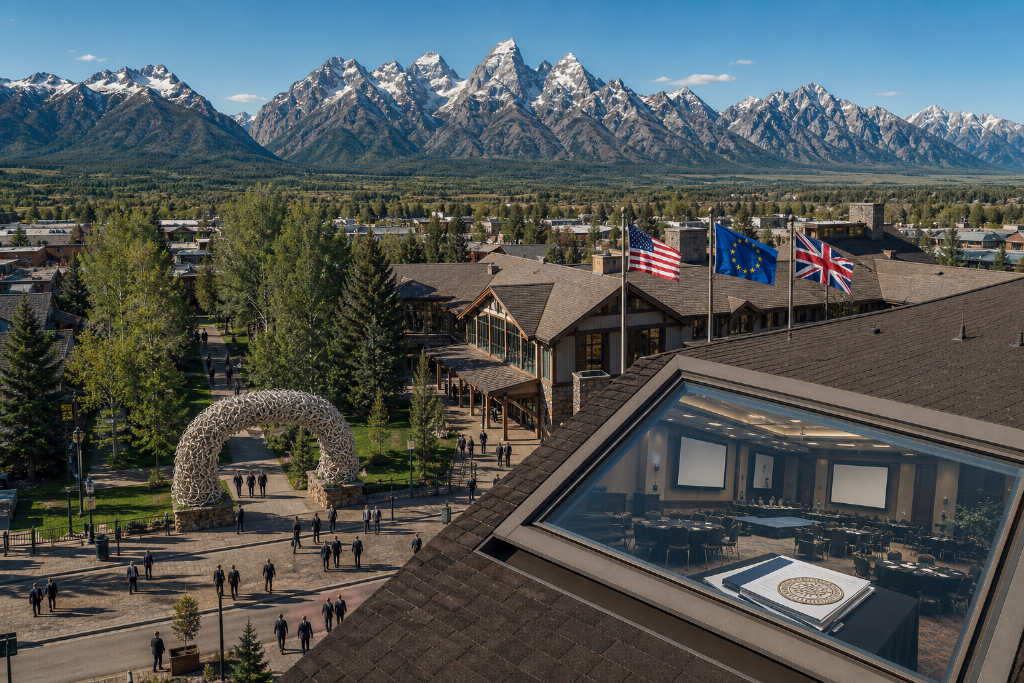
The annual Jackson Hole economic symposium closed with markets focused on Federal Reserve Chair Kevin Warsh and a speech that sharpened expectations around the Fed’s next move. Other central bank officials also sent signals during the gathering, while a political dispute involving Federal Reserve Governor Lisa Cook lingered in the background.
According to a Wallstreetcn report cited in the source article, Warsh used his keynote to make clear that fighting inflation remains the Fed’s first priority. He said inflation has not shown a meaningful slowdown and warned that if officials cannot confirm it is moving toward target quickly enough, the central bank still has "work to do." Markets quickly shifted toward the Sept. 11 consumer inflation report and the Sept. 15-16 Federal Open Market Committee meeting.
Warsh says the 2% inflation target is fixed
Warsh’s keynote was described as his most substantive policy statement since becoming Fed chair.
He said the 2% inflation target, measured by the personal consumption expenditures, or PCE, price index, is a "firm" and "fixed" target. That addressed outside concern that he might consider changing the goal. He also said financial conditions are not currently restraining the economy and called interest rates the Fed’s "primary tool" for carrying out its mission.
Warsh said: "My standard is this: We need to be confident that core inflation is moving clearly, and at a sufficient speed, toward our target. Otherwise, we have more work to do. That is our duty."
He did not explicitly endorse another rate increase. Even so, the wording was enough to trigger repricing in markets. After the speech, expectations for a near-term hike strengthened, putting fresh weight on the Sept. 11 CPI release and the September policy meeting.
The report also noted that Warsh had previously avoided giving markets a clear path for rates. This speech still stopped short of formal forward guidance, but it offered more information than investors had been getting and added uncertainty ahead of the next meeting.
ECB officials warn inflation pressure has not faded
European officials speaking on the sidelines struck a hawkish tone as well.
According to Bloomberg, European Central Bank Governing Council member and Slovenian central bank governor Primoz Dolenc said the euro area’s resilience and the continuing conflict in the Middle East both pointed to the need for a September rate increase, in line with broad market expectations.
He said: "Looking at the new data, the inflation situation has not resolved itself."
Martin Kocher, governor of Austria’s central bank and also an ECB rate setter, said there was "more momentum" in the economy. Analysts estimated euro-zone inflation for August at 3.3%, and Kocher said policymakers remained "vigilant" and were "not complacent."
Bailey signals patience from the Bank of England
The message from Bank of England Governor Andrew Bailey was more restrained than the one coming from euro-zone officials.
Bailey said the U.K. was seeing fairly mild second-round inflation effects and that the labor market had been softening for some time. "I think we can continue to watch this situation for the moment," he said.
This was Bailey’s first public comment on monetary policy since July 30. At that time, he joined the majority in a 6-3 vote to keep rates unchanged.
Tokenization and monetary policy featured in the research agenda
Beyond policy signaling, Jackson Hole also serves as a venue for high-level economic research. This year’s academic agenda centered on financial innovation and its effects on payments systems and monetary policy.
Economists and policymakers at the symposium discussed how tokenization is changing the way financial assets are held and transferred. They also debated the regulatory challenges tied to that shift. Papers presented around the event suggested central banks still face heavy pressure in dealing with the impact of technological change.
Political pressure around Lisa Cook resurfaced before the meeting
A separate political dispute added another layer to the event before it opened.
The report said the White House had recently revived efforts to remove Fed Governor Lisa Cook, citing allegations of mortgage fraud. On Aug. 26, Cook’s lawyer issued a statement calling the allegations "baseless and false." The White House did not immediately respond.
Earlier, Donald Trump narrowly lost his first Supreme Court attempt to oust Cook, partly because of procedural issues.
The source article said the episode served as a reminder that even after Warsh took over the Fed, political pressure from the White House had not fully stopped.
Lagarde, Ueda and Powell were notable absentees
The symposium also stood out for several high-profile absences.
European Central Bank President Christine Lagarde and Bank of Japan Governor Kazuo Ueda did not attend. Both were scheduled to take part in the Group of 20 finance ministers and central bank governors meeting in North Carolina from Monday, Aug. 31, to Tuesday, Sept. 1.
On the U.S. side, the only absent policymaker was former Fed Chair Jerome Powell. The report said Powell broke with precedent by staying on as a member of the Board of Governors after his chair term ended in May this year, but, in line with an earlier pledge, he has largely stepped out of public view.