
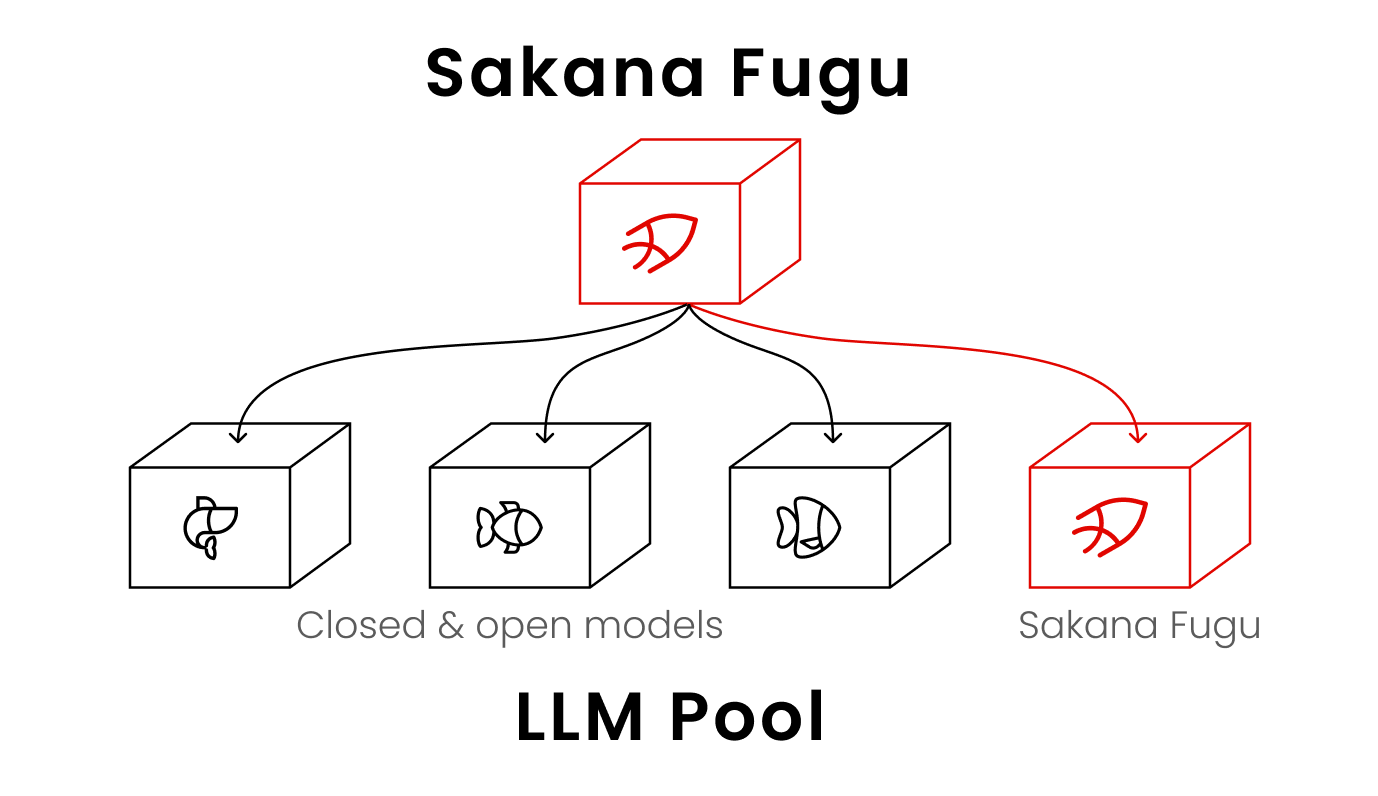
Multiple AI models working together behind a single API — that is the bet of Sakana AI, a Japanese AI lab, which officially launched Sakana Fugu on June 22. The system uses reinforcement learning to train a coordinator model that automatically assigns tasks to specialized agents. Users do not need to know how many models run in the background or manually design collaboration flows; the internal command mechanism handles everything.
TRINITY: A Triangle of Thinker, Worker, Verifier
Fugu's underlying TRINITY architecture splits tasks into three roles: a Thinker that plans solutions, a Worker that executes, and a Verifier that finds flaws. Each role is assigned to a different large language model (LLM), creating a system of checks and balances — essentially, the same model cannot both propose and grade answers.
Conductor: A 7B Coordination Model
The core of the system is Conductor, a 7B-parameter coordination model trained via reinforcement learning. It decides which agents to call for each task, how to facilitate their communication, and how to integrate the final output. Rather than relying on pre-designed workflows, Conductor learns optimal collaboration paths through training, which Sakana describes as a “non-intuitive but efficient collaboration mode.” The agent pool can be flexibly adjusted: the Standard tier allows enterprise users to exclude specific providers or models for data privacy or compliance — a key differentiator for institutions that cannot allow data to leave their premises.
Benchmarks on Par with Top Models
Sakana tested Fugu against frontier models on four benchmarks: SWE Bench Pro (software engineering code repair): Fugu 59.0, Fugu Ultra 73.7; LiveCodeBench (real-time coding competition): 92.9 and 93.2; GPQA Diamond (graduate-level cross-disciplinary Q&A): both 95.5; Humanity’s Last Exam (extremely difficult question bank): 47.2 and 50.0. Sakana claims these scores “match or surpass Mythos Preview and Fable 5 on rigorous benchmarks,” though third-party verification is pending.
Pricing Tiers and Geographic Restrictions
Fugu offers three subscription tiers: Standard at $20/month, Pro at $100/month (10x usage), and Max at $200/month (20x usage), all including access to both Fugu and Fugu Ultra. Enterprise token billing is also available: Fugu Ultra at $5 per million input tokens and $30 per million output tokens; for contexts exceeding 272,000 tokens, rates adjust to $10 input and $45 output.
Sakana emphasizes that calling more agents in a task does not linearly increase costs. The pricing mechanism uses a single blended rate based on the highest-tier model in the active agent pool — adding a second or third agent does not double the bill, giving a clear cost advantage over manually chaining multiple APIs for complex tasks.
A major limitation: Fugu is not available to users in the European Union or European Economic Area, as the company is still working on GDPR compliance (timeline not set). Early adopters who subscribe before July 2026 receive the second month free.