
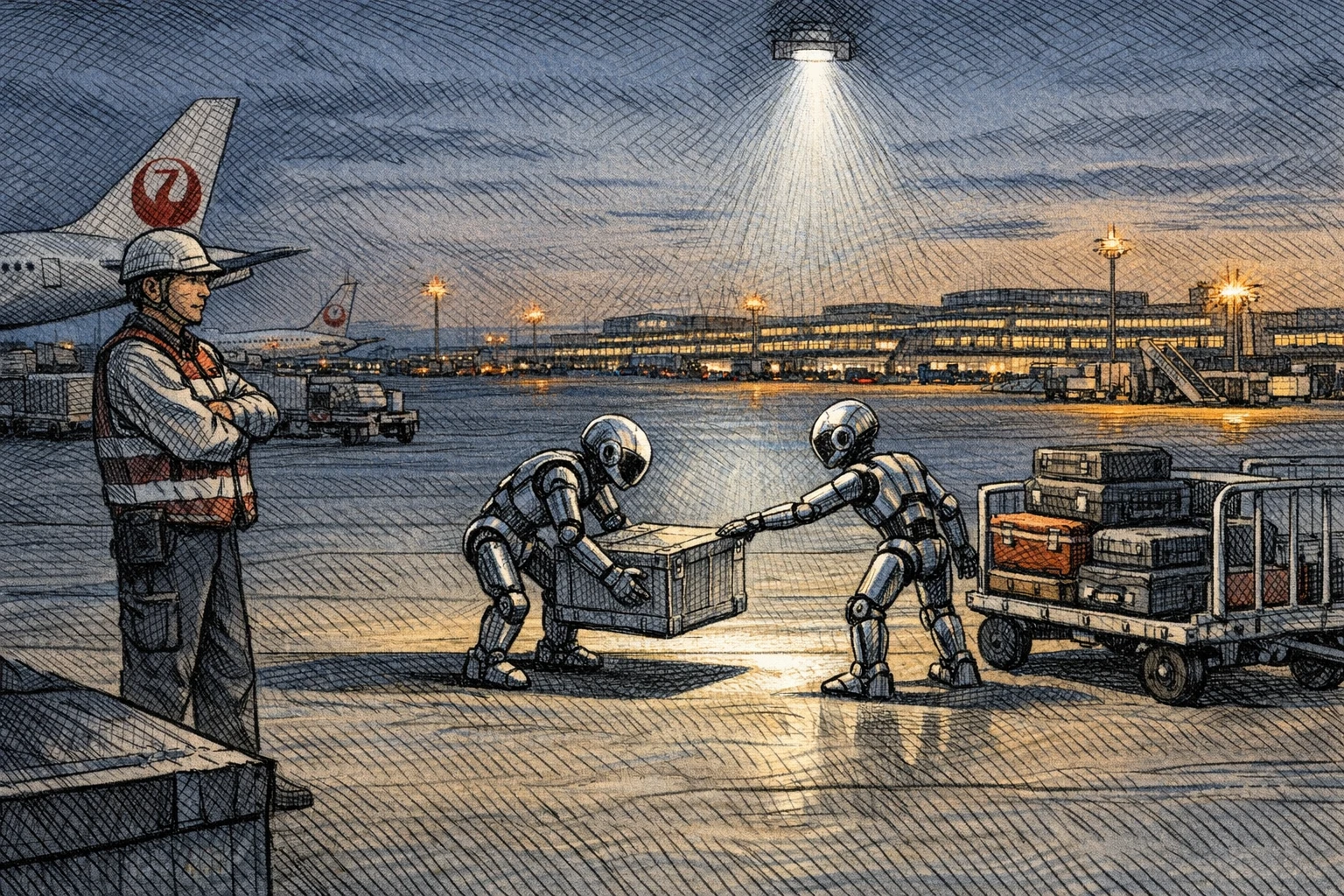
Japan Airlines said it will start a humanoid robot field test at Tokyo Haneda Airport in May 2026, with the trial scheduled to run through 2028. The robots selected for the project are Unitree’s G1 and UBTECH’s Walker E, and their initial assignment will focus on moving cargo containers on the airport apron.
Initial rollout targets cargo rather than passenger baggage
According to JAL’s official release, the trial is being led by JAL Ground Service, a JAL group company, together with GMO AI & Robotics Corporation. The two humanoid robots are about 1.3 meters tall and weigh roughly 35 kilograms, and they will be tested in actual ramp operations at Haneda. JAL said the first phase will not involve direct handling of passenger luggage. Instead, the company is starting with cargo tasks that follow a more fixed structure, a choice aimed at keeping operational risk lower during the test period.
JAL’s plan goes beyond cargo movement. Cabin cleaning and the operation of ground support equipment such as baggage carts are also included in the longer-term roadmap. If the trial delivers usable results, humanoid robots working on the Haneda apron before 2028 would move from pilot stage to a visible part of airport operations.
Why JAL is looking at humanoid robots
The push comes as inbound travel to Japan has risen sharply while airports face a growing shortage of ground staff. Ramp work is not an easy setting for conventional automation. Routes change, cargo differs in shape and weight, and unexpected situations are common. Fixed robotic arms and automated guided vehicles are generally better suited to environments where tasks repeat and conditions remain predictable.
JAL’s stated approach is to have robots fit into spaces already built for human workers, rather than redesigning the workplace around machines. That is where humanoid systems stand out. In theory, they are better suited to moving through human-oriented environments and using tools already designed for people.
Haneda trial will test commercial use in a live environment
Humanoid robots have been discussed for years, but stable performance in real workplaces remains a high bar. Recent projects such as Tesla Optimus, Figure AI, and Boston Dynamics Atlas have drawn attention and entered factory or warehouse trials, yet many public demonstrations still take place in controlled settings.
The Haneda test carries weight because an airport is a live commercial environment with less standardization and less control than a factory floor. If Unitree G1 and UBTECH Walker E can handle their assigned work under those conditions, the results would offer a more practical reference point for humanoid robot deployment. The trial will continue through 2028, and that timeline will determine how far the concept can move into regular ground operations.