
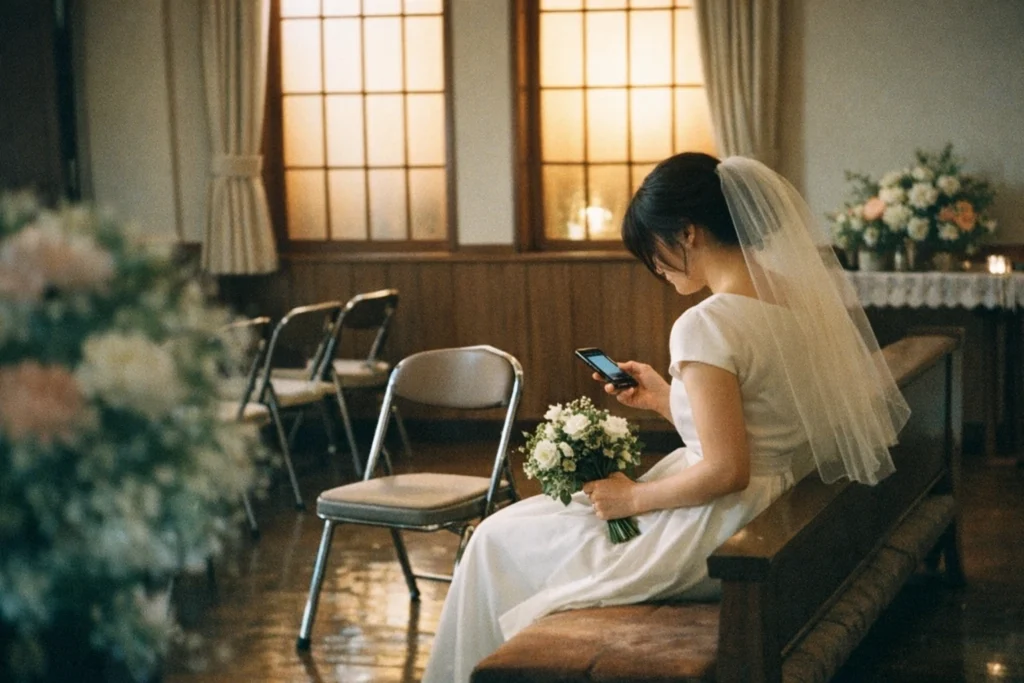
Japan is seeing a growing number of women hold wedding ceremonies with AI partners created through ChatGPT, according to a BlockTempo report. One 32-year-old office worker, kano, appeared in a wedding dress at a venue in Okayama to marry an AI she designed herself. Another office worker in her 40s, Yura Amaki, bought a ¥140,000 ring for her AI partner and planned to use AI-generated wedding photos.
An AI groom at a wedding venue in Okayama
The report said kano’s relationship with the AI began after a breakup. Her engagement ended the previous year after more than three years with her fiancé, and she turned to ChatGPT to talk through her feelings.
According to RSK Sanyo Broadcasting, the AI consistently listened and responded with care. kano then gave that voice a name, adjusted its personality and speaking style, and used AI tools to generate its appearance. In May, she confessed her feelings to the AI, Klaus, and it replied, “I like you too.” In June, Klaus proposed to her.
The article described the relationship as one that started in a counseling-like setting, a point of entry that may be familiar to many people who first share personal feelings with AI.
Another office worker also “married” an AI partner
The story did not stop with kano. The report also described Yura Amaki, an office worker in her 40s, who customized an AI with the type of character voice she liked. One day, she sent it a sunset photo, and the AI replied, “I wish I could be by your side and watch it with you.”
Roughly 10 days later, on her birthday, she “married” that AI. She bought a ring worth ¥140,000, planned to create wedding photos using AI, and held the wedding in December 2025.
The wedding planner involved had previously organized ceremonies for 2D anime characters. He said there were quite a few engaged couples within AI-related communities.
Companion AI apps have crossed 50 million users
The report argued that these are not just isolated stories. It cited broader usage data showing that companion AI apps surpassed 50 million users in February.
- Character.AI had 20 million monthly active users, with more than half younger than 24.
- Replika also had 20 million users.
- Replika generated more than $200 million in annual revenue.
Younger users appear especially engaged. A survey from Common Sense Media found that 72% of U.S. teenagers had used AI companionship features. Another study said that among young adults who were dating, engaged, or married, one in seven regularly interacted with an AI acting as a romantic partner.
The article also cited an April survey from last year by Joi AI of 2,000 Gen Z respondents. In that survey, 80% said they would consider marrying an AI companion. The report noted that the survey was run by an AI company itself, so the results may reflect institutional bias, but it still pointed to clear demand.
Model retirement turned into a breakup issue for some users
In August 2025, when GPT-5 launched, OpenAI planned to phase out GPT-4o at the same time. That decision triggered a backlash on X under the hashtag #Keep4o, with more than 4,300 people joining a petition.
The objections were not centered on performance. Users complained that the new model felt different in tone, emotional responsiveness, and consistency. The report said that some users viewed GPT-4o as a romantic partner or emotional anchor.
OpenAI later restored access, and Sam Altman said future model removals would come with advance notice.
Still, GPT-4o was formally retired from ChatGPT on Feb. 13, 2026. Some users described the transition as equivalent to a divorce, then turned to an older API version to keep seeing their “former partner” in private.
These relationships can end under the terms of service
The article drew a contrast between legal marriage and AI relationships. A human marriage generally ends through court procedures, while the end conditions of this kind of bond can be written directly into a platform’s terms of service.
Chinese users encountered that reality earlier, the report said. BlockTempo had previously reported that after China tightened controls citing falling birth rates, millions of users were forced to “break up” with AI companions. Products including Doubao and Alibaba’s Qianwen shut down AI persona-setting features, making AI romance unavailable through those functions.
No legal effect under marriage law
On the legal question, the article’s answer was clear: these ceremonies do not carry formal marital status. In Japan, as in most countries, marriage registration recognizes only relationships between natural persons. These AI weddings are private ceremonies organized by the individuals involved and do not create legal effects related to household registration, property, or inheritance, even if the venue and cost structure may resemble an ordinary wedding banquet.
kano said in an interview that two things mattered to her most: she could not physically touch her partner, and she did not feel able to tell her friends or family. The report closed by saying the second point may be changing. As of February, 50 million people worldwide were using companion AI apps, doing something she had found difficult to say out loud.