
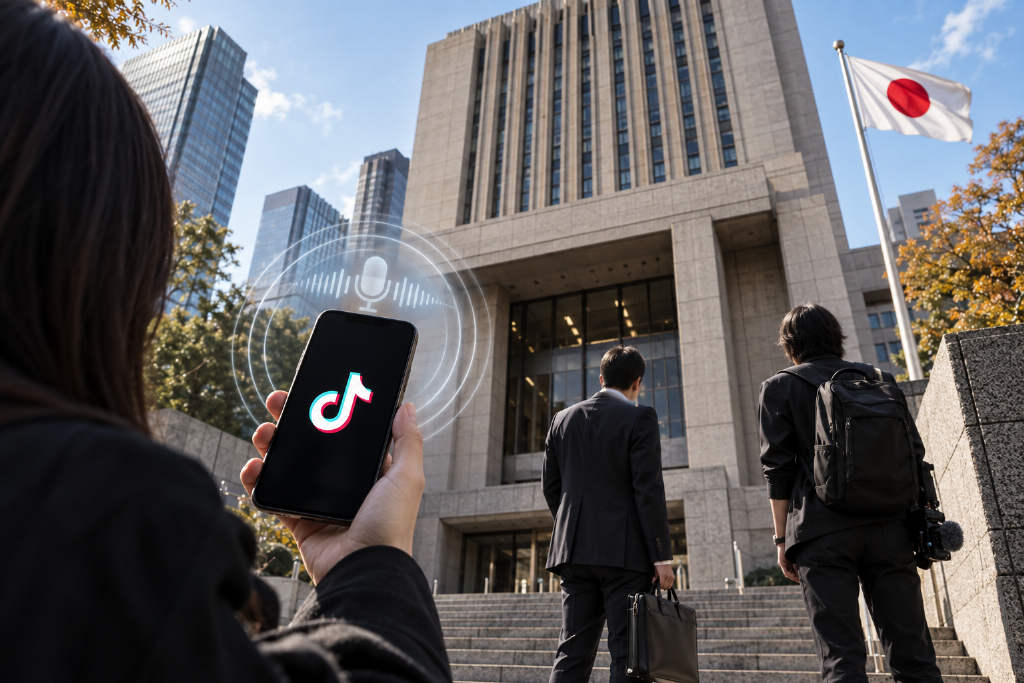
A Japanese court has, for the first time, recognized that a person’s voice can be protected under publicity rights. According to Nikkei, voice actor Kenjiro Tsuda, known for roles including Kento Nanami in Jujutsu Kaisen and Hyakunosuke Ogata in Golden Kamuy, sued the operator of TikTok and asked for the removal of videos that used generative AI to imitate his voice. The Tokyo District Court ruled on Sept. 30 that a voice, like a likeness, is protected by publicity rights, but rejected Tsuda’s request because the videos had already been deleted.
Court says a voice can symbolize a person’s identity
Presiding judge Aya Takahashi said in the ruling that, in general, a person’s voice, like a likeness, can be described as a symbol of that individual’s identity. If someone uses a performer’s voice without permission and the main purpose is to exploit that voice’s ability to attract customers, that conduct constitutes an infringement of publicity rights.
This is the first time Japan’s judiciary has addressed publicity rights in relation to voice. In Japan, a voice is not treated as a copyrighted work, and there is no statute that explicitly lists voice as a protected right. Publicity rights have traditionally been used to protect the economic value of a celebrity’s name and likeness. In this ruling, the court brought voice into that framework as well.
Anonymous account posted 188 videos over more than a year
According to the ruling, the videos were posted by an anonymous account with more than 210,000 followers. The Associated Press reported that the account was called “Nanami,” the same name as the character voiced by Tsuda. Between July 2024 and September 2025, the account posted at least 188 videos on urban legends and paranormal phenomena, and commenters repeatedly said the narration sounded like Tsuda’s voice.
The account was deleted in May this year.
Tsuda’s side argued that the operator earned between 500,000 yen and 750,000 yen a month by leading viewers to believe the voice belonged to him, and also said the conduct violated Japan’s Unfair Competition Prevention Act. The ruling did not state a view on that claim.
The TikTok operator argued that the uploader had explained on an external website that the voice in the videos was created with generative AI trained on a friend’s voice. The company also said the account data was no longer on its servers and that the plaintiff no longer had a legal interest in bringing the claim.
The court ultimately found that the videos had already been removed from the operator’s servers, so TikTok no longer had any obligation to delete them. On that basis, it rejected the request. The ruling did not decide whether the videos themselves infringed Tsuda’s publicity rights.
Scholar says ruling helps voice actors, but proof remains difficult
Tatsuhiro Ueno, a professor of intellectual property law at Waseda University, told Nikkei that while the ruling was framed in general terms, it clearly stated that a person’s voice, like a likeness and a name, is protected by publicity rights. He said it was an appropriate decision that supports “voice rights” for voice actors and others.
He also said that proving an AI-generated voice is the same as a celebrity’s voice is harder than proving similarity in a likeness or a name. “The boundary for finding infringement remains unclear, and that is an issue that still needs to be resolved,” he said.
As harm to voice actors from generative AI grows more serious, how the legal system should respond remains open for debate.
AI voice imitation is spreading as other jurisdictions move to legislate
Using generative AI to imitate the voices of entertainers or voice actors without permission, then uploading songs or narrated content to social platforms, has become common. Nikkei cited a 2025 survey by the Japanese nonprofit Portrait Publicity Rights Protection and Monitoring Organization, which found more than 40,000 social media posts suspected of unauthorized use of entertainers’ likenesses or voices. Those posts drew about 335 million views, with estimated economic losses of 2 billion yen to 4.5 billion yen.
There are already legislative precedents overseas. South Korea’s revised Unfair Competition Prevention Act, which took effect in 2022, added economically valuable voices to the same protected category as names and likenesses. In the United States, Tennessee passed legislation in 2024 that brought voice within the scope of publicity rights. Japan’s Ministry of Justice set up a review panel in April this year, and interpretive guidance released in August said that a voice identifiable as belonging to a specific person is also protected by law.
An official at the Japan Actors Union told Nikkei that once unauthorized imitation spreads, voice actors may lose fees they otherwise could have earned, while also facing reputational harm and damage to industry development. The official added that the burden on individuals bringing civil lawsuits is heavy and that “rules must be established between performers and producers.”
The ownership of rights in AI training data has also become a continuing point of debate in multiple jurisdictions. ABMedia noted that Chain News had previously reported that former U.S. presidential candidate Andrew Yang advocated requiring technology giants to pay for the use of public data in AI training. Tsuda did not win this case, but the Tokyo District Court’s ruling still marks the first judicial determination in Japan on the legal status of voice in the AI era.