

A rumor that Japan’s major photoresist makers had cut off China spread quickly across markets, but the evidence presented for it does not line up cleanly with publicly cited trade data.
The claim named Tokyo Ohka, JSR, Shin-Etsu Chemical, and Fujifilm, describing them as four Japanese companies controlling 90% of the global high-end photoresist market. According to the circulating account, they had stopped taking new China orders for ArF and EUV photoresists, sharply reduced new KrF orders, withdrawn all on-site process engineering teams from China, suspended after-sales support, tuning, and formula adaptation, and stretched delivery times for existing contracts to six to eight months while cutting actual shipment volumes.
That account triggered sharply different reactions. Some framed it as Japan’s harshest blockade yet against China’s semiconductor industry. Others cast it as a turning point for domestic substitution in Chinese photoresists.
The original MarsBit article, sourced from the WeChat account Ke Gong Li Liang and written by Shi Yanhong, argues that once those claims were checked, several key details did not hold together.
Customs figures do not show a collapse in imports
The rumor said China imported 111.3 tons of semiconductor-grade photoresist from Japan in the first quarter of 2026, down 95%. It broke that number into 69.2 tons in January, zero in February, and 42.1 tons in March. A related version said ArF and EUV photoresists had already posted zero imports for five straight months, with high-end KrF arrivals reduced to a trickle and wafer fabs holding only one to two months of inventory.
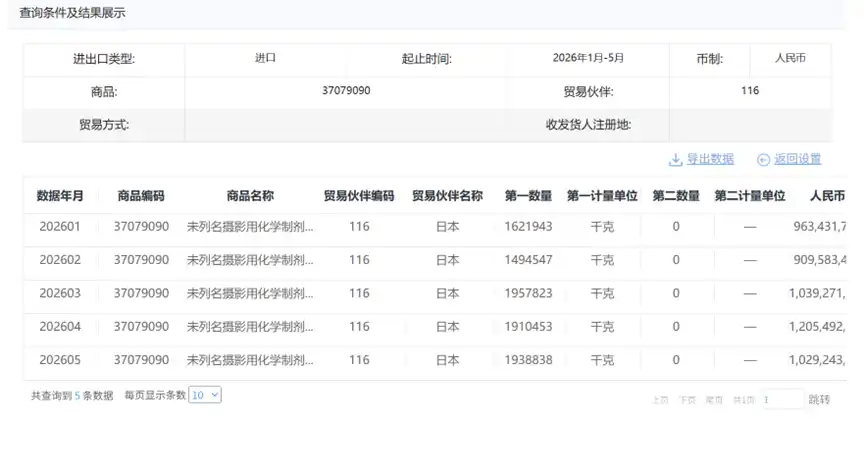
The article says it checked data from China’s General Administration of Customs. For January through May 2026, it reports imports of photoresist from Japan at 1,622 tons, 1,495 tons, 1,958 tons, 1,910 tons, and 1,939 tons, respectively, for a five-month total above 8,900 tons. The data does not break out ArF and EUV photoresists as separate lines, but in aggregate it does not show the kind of cliff-like drop described in the rumor.
The piece adds that a similar story had already circulated in November last year. That earlier wave involved Canon, Nikon, and Mitsubishi. But, as the article notes, those companies do not manufacture photoresists; they are tied instead to lithography systems, components, and upstream raw materials for photoresists. It says some media reports at the time debunked the story and described it as something spread by domestic stock speculators.
The article also says that on Dec. 3, 2025, Japan Chief Cabinet Secretary Minoru Kihara denied reports that Japan had already stopped exporting photoresists to China.
In the current episode, the narrative looks almost the same. The article says no fresh official Japanese denial had appeared by the time it was published, but it also says Japanese trade media, the official websites of the four companies, and domestic specialist media had not reported such a major event either.
Why advanced photoresists matter so much
The article argues that the more important question is not whether the latest rumor is true, but what would happen if supplies of advanced photoresists were ever cut for real.
That starts with what photoresists do. In semiconductor manufacturing, lithography tools project patterns onto wafers, and photoresists record those patterns so they can later be transferred onto the chip surface through etching and other steps. The piece compares the lithography tool to a projector and the photoresist to a photosensitive film.
But the material’s strategic role goes beyond that simple description. In advanced manufacturing, photoresists may not be as expensive as lithography equipment, and they are not sold to end users like chips, yet they can still become a bottleneck. If chipmaking is treated as drawing on a wafer, the machine decides how fine the lines can be, while the resist determines whether those lines stay intact or end up warped, broken, or stuck together.
At mature nodes, these issues are less severe. At 7 nm, 5 nm, and 3 nm, they become central.
The article points to a long-standing “triangle problem” in photoresists: balancing resolution, sensitivity, and line-edge roughness. Higher resolution is needed to print smaller features. Higher sensitivity improves exposure speed and throughput. Lower line-edge roughness supports stable chip performance and yield. Yet the three often pull against each other. Raising sensitivity can make chemical reactions spread too far and roughen the pattern edges. Pushing for extreme resolution can sacrifice stability and productivity. In that sense, resist R&D is a constant effort to strike a workable balance between competing targets.
The challenge becomes harder in the EUV era. ArF lithography mainly uses 193 nm laser exposure, while EUV runs at 13.5 nm. The shorter wavelength improves pattern definition, but the article says the much higher energy also comes with fewer participating photons, which makes random defects more likely.
For advanced chips, those defects can mean scrapping an entire wafer. That, the article says, is why global discussion around EUV technology has increasingly shifted toward photoresists, random defects, and the material system itself, not only the lithography tools.
Another point in the report is that high-end photoresists are not a simple off-the-shelf product. Suppliers and customers usually develop, validate, and optimize them together. The difficulty lies not only in manufacturing the material but in long industrial accumulation. The required performance for advanced nodes typically does not come from one technical breakthrough. It is built through repeated R&D, validation, and mass production over decades.
Japan’s moat is built on formulations and process history
The article says it is misleading to think of photoresist as a single product. It is closer to a large family of formulations.
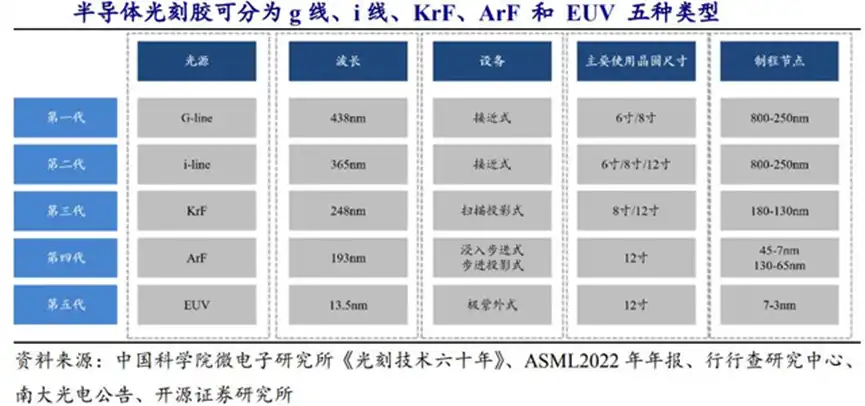
By exposure wavelength, the common generations are G-line, I-line, KrF, ArF, and EUV. The higher the technical requirement, the more difficult the product class, with ArF and EUV generally treated as the crown jewels.
That is only the first layer. Once a resist enters a wafer fab, the required formulation can vary by production line, by device category, and even by process layer on the same chip. Logic chips, DRAM, and NAND flash can each need different ArF formulations. The article argues that this deep formulation library is exactly what helped Japanese suppliers dominate the market for so long and build a formidable barrier to entry.
It traces that history back decades. Tokyo Ohka began a full push into photoresists in the 1960s. In 1972, Japan’s first positive photoresist for semiconductors was introduced. JSR and Shin-Etsu Chemical entered later and kept investing in lithography materials required for semiconductor manufacturing.
The timing mattered. Japan’s photoresist development coincided with the major growth phases of the global chip industry: integrated circuits in the 1970s, Japan’s semiconductor expansion in the 1980s, and continued worldwide fab growth in the 1990s. Each generation of Japanese products, the article says, was built on real industrial demand. That gave those companies a head start in producing and scaling ArF and EUV photoresists.
For this industry, time and field validation are critical barriers. Every new generation has to be proven on customer production lines, and every process upgrade leaves behind new formulation know-how. Over decades, Japanese companies accumulated not only patents but thousands of mass-production-verified process formulas and a technical system built with leading fabs around the world.
China is also too important a market to ignore
The article does not argue that Japan lacks leverage. It argues that an outright cutoff is not a simple economic choice.
Its reasoning is that photoresists are a scale business. Bringing an advanced resist from the lab to mass production takes heavy R&D spending, but the number of customers able to absorb those costs in volume is limited. Citing TECHCET, the article puts the global semiconductor photoresist market at about $3.3 billion in 2025.
China, however, is one of the most important end markets. The article says China’s photoresist market will reach $771 million in 2024, up 42.25% year over year and representing 28.2% of global demand. Industry estimates cited there put China’s current share at roughly one-third of worldwide demand. As domestic fabs keep expanding, China has become more important to Tokyo Ohka, JSR, Shin-Etsu Chemical, and Fujifilm.
The report also reviews Japan’s export-control moves in semiconductors. In July 2023, Japan’s Ministry of Economy, Trade and Industry imposed export controls on 23 types of advanced semiconductor manufacturing equipment. In January 2025, it broadened controls related to semiconductors and quantum technology. In April that year, it added CMOS integrated circuits, GAAFET-related technologies, and quantum computers to the licensing framework.
Even so, the article says Japan has not put photoresists on its export-ban list. Looking at supply and demand, it argues that the Japanese photoresist industry depends heavily on Chinese demand absorption, to the point that a cutoff could hurt Japan more than China.
Domestic substitution in China and alternative supply from South Korea
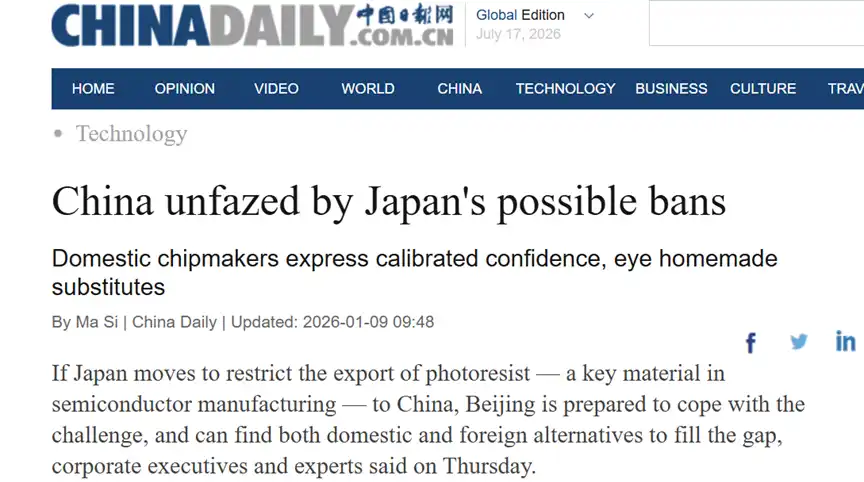
The article says China Daily published a piece in January titled “China is unfazed by potential Japanese restrictions,” based on interviews with companies across the photoresist supply chain. Their common view, according to the report, was that China’s semiconductor sector has spent the past several years preparing for photoresist localization and could move quickly to fill gaps with domestic and overseas alternatives if Japan tightened supply.
It puts overall localization of semiconductor photoresists in China at about 15% in 2024, up from 5% five years earlier. For mature-node G-line and I-line products, localization has already exceeded 30%. KrF photoresists have made key progress, with self-sufficiency rising from below 10% in 2024 to more than 15% in 2025 and entering scaled supply. ArF and EUV photoresists are still being pushed forward.
Beijing Kehua is presented as one of the more commercially advanced domestic KrF players. Public information cited in the article says its products have entered the supply chains of several local wafer fabs, and a new thousand-ton semiconductor photoresist capacity project in Shanghai has entered trial production. The company is also extending into ArF photoresists and upstream resin materials to build a fuller chain from key raw materials to finished resist products.
Nata Opto-electronic is listed as another leading domestic producer. According to the article, by 2025 it had six ArF photoresist products that passed customer verification and were sold commercially, while annual photoresist revenue exceeded RMB 20 million. It also describes the company as the only domestic supplier to achieve commercial batch shipments of 28 nm immersion ArF photoresists, giving it a leading position in higher-end ArF products.
Xuzhou BOC is another company named in the piece. Its products cover process nodes from 28 nm to 90 nm, and more than 30 photoresist products across its lineup have passed validation by several leading customers. The report says its ArF products have entered the supply chains of Semiconductor Manufacturing International Corp. and Yangtze Memory Technologies, and more recently passed validation at a leading domestic wafer fab and begun volume supply.
The article also argues that Japan is not the only country with meaningful capability in advanced photoresists. After the 2019 Japan-South Korea trade friction, South Korea invested heavily in localizing photoresists and has now built a relatively complete ArF supply system. It says products from companies including Dongjin Semichem have entered the supply chains of leading fabs such as Samsung. In EUV photoresists, which are harder still, the article says South Korea trails Japan by only one to two generations. On that basis, it says Chinese companies could route purchases through South Korea if Japan ever cut supply.
The anxiety is real even if the rumor is unproven
The piece ends by saying the most revealing part of this latest “Japanese photoresist giants cut off China” story may not be whether it is true, but why such claims so easily trigger stress in the market.
For a long time, advanced photoresists really were a weak point in China’s semiconductor supply chain, and Japanese suppliers held a commanding position. But the article says conditions are no longer what they once were. Japan still leads, yet Chinese companies are entering mass production, and countries such as South Korea have built advanced photoresist supply capacity as well.
Its conclusion is straightforward: Japan remains a dominant force in the global photoresist market, but it is no longer the only supplier. Even if supply policy tightens in the future, the effect would be more about cost, certification, and supply-chain adjustment than a full industrial standstill.
The article closes on a broader point. For China’s semiconductor industry, what matters most is not proving that nobody will cut supply. It is having the capacity to keep moving forward even if someone does.