
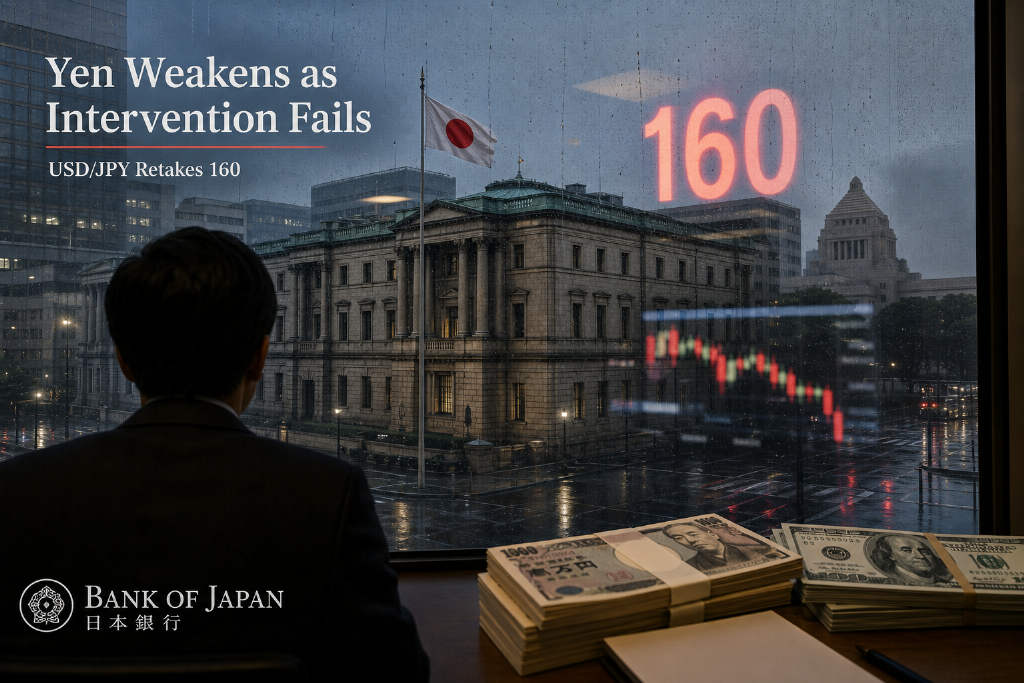
Japan’s record $96.4 billion effort to support the yen has already lost traction, with USD/JPY moving back above 160 in less than a month.
On Aug. 28, the pair climbed about 0.5% intraday to around 160.20 before closing at 160.10. According to the report, that left more than half of the earlier intervention-driven rebound erased and put the 160 line back in focus.
$96.4 billion spent in four weeks, but the yen still slipped back
The report says Japan deployed $96.4 billion over four weeks in the largest market-support operation on record. Even so, one month after the U.S. and Japan entered the market to buy yen, the Japanese currency weakened again, showing that the earlier operation did not hold the line.
That return above 160 has put attention back on whether Japanese authorities will intervene again and whether that level still carries practical weight as a defense point.
Warren challenges the operation, Bessent points to the Treasury market
The setback in the yen was followed by a political fight in Washington over the joint currency-buying action itself.
Senator Elizabeth Warren, a Democrat, said in a press release from the Senate Banking Committee that she was questioning the legitimacy and transparency of the Treasury Department’s move and asked Treasury Secretary Bessent to explain the source and size of the funds involved.
In a written response dated Aug. 28, Bessent did not center his argument on saving the yen. Instead, he said Japan is the largest foreign holder of U.S. Treasuries and warned that if yen moves became disorderly, those holders could be forced to sell positions, rattling global asset prices and pushing up borrowing costs for U.S. households and businesses.
In that framing, Washington’s core concern was the order of the U.S. Treasury market, while yen stability was more of a side effect. Warren, however, was not satisfied by the explanation, and the dispute remained heated.
Mark Sobel says intervention does not solve the root problem
Former senior Treasury official Mark Sobel offered a different view.
He said that if Bessent is genuinely worried about yen-driven stress spilling into Treasury yields, the underlying issue is not the exchange rate itself but the U.S. fiscal deficit. Pouring money into the foreign-exchange market may buy time, he argued, but it does not deliver a structural fix.
The report adds that when a country’s fiscal discipline is itself a source of market concern, using reserves to put out the fire can only address symptoms.
Dollar strength, rates, and short positions are driving the move
Away from the political fight, the report says the main force behind the yen’s renewed weakness is the stronger U.S. dollar.
It says Federal Reserve Chair Warsh stated publicly that inflation needs to be pushed back to target. That lifted both the dollar and U.S. Treasury yields, while markets also raised their expectations for another Fed rate increase this year. Those forces outweighed the impact of official intervention.
Hedge funds have also been adding to short yen positions over the past two weeks, effectively betting that officials do not have enough firepower to push back. Bank of America foreign-exchange strategist Cohen said 160 is a closely watched psychological level. A break above it naturally raises expectations for another official move, but the main driver of this leg is still the dollar and rates, and authorities may show more patience this time rather than rushing in immediately.
State Street Global Advisors’ Luo Zhengyan said the meaning of 160 is changing. It is no longer just a reference point for whether the yen looks cheap or expensive. It is turning into a line watched by both sides of the market. The problem, in his view, is that a level defended in public is often the easiest one for speculative positions to test. Once everyone knows where the red line sits, traders keep pressing toward it to see whether officials will act, and that game itself can prolong volatility.
September BOJ meeting is the next key variable
The report also points to carry trades and the Bank of Japan’s September meeting as the next major variable.
The yen has long been one of the world’s main funding currencies for carry trades, where investors borrow in low-yielding yen and move the money into U.S. stocks, U.S. Treasuries, or other higher-yielding assets to capture the spread. The report says that in August 2024, an unexpected BOJ rate hike, combined with a sharp yen rally, forced a fast unwind of many carry positions, triggering a chain reaction across global equity markets and crypto assets. Bitcoin, it says, posted a double-digit decline within days during that episode.
Now the yen is again nearing 160, and ahead of the BOJ’s Sept. 17-18 policy meeting, the market is pricing in roughly an 80% chance of a rate hike. If the BOJ does move and the increase is larger than expected, a similar unwind could play out again. If it stays on hold, the pressure would be pushed further out, and the exchange rate could keep testing the authorities’ tolerance.
For highly volatile risk assets such as cryptocurrencies, the report says the direction of yen policy is no longer only a foreign-exchange story. It has become one of the variables shaping global liquidity.