
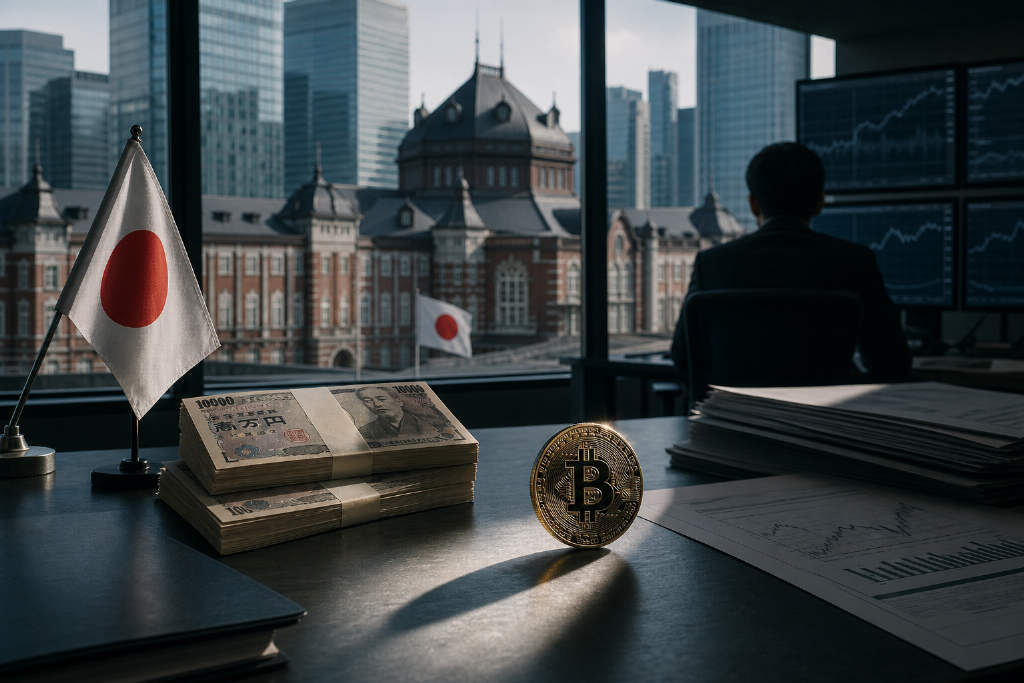
Japan’s borrowing costs have risen to their highest level since 1996, putting fresh focus on whether Bitcoin can stay resilient if the Bank of Japan tightens again in September.
On the same morning, Japan’s 30-year government bond yield climbed to 4.185%, while the 10-year yield stood at 2.945%. For a country that spent years relying on negative rates to fight deflation, that is a major shift.
At the same time, Bitcoin has surged 22% over the past week and moved above $80,000 for the first time since May. The tension is clear: Japan’s bond market is flashing warnings, yet crypto has held up comparatively well.
The carry trade is still central to the picture
For years, the yen carry trade has been a major driver of global risk assets. Investors borrow yen at low cost, exchange it for dollars, and buy assets that offer higher returns.
According to data cited from the Bank for International Settlements, offshore non-bank institutions hold roughly $250 billion in yen loans. Using a broader measure, that figure could reach $500 billion. That amount of leverage rests on one core assumption: Japanese rates would remain near zero for a long time. That assumption is now under pressure.
In June, the Bank of Japan raised its policy rate to 1.0%, the highest level in 31 years. Markets widely expect another increase at the Sept. 17-18 policy meeting. Japan’s monetary setting, long treated as an outlier over the past three decades, is changing. A 2.88% yield on the 10-year Japanese government bond is not just another market print. If the yen strengthens quickly, carry positions can swing from profitable to loss-making in short order.
Goldman Sachs’ Praneet Shah said, 「A move in foreign exchange alone can completely wipe out the entire annualized return on the position.」
That dynamic already played out in August 2024. As the yen strengthened, Bitcoin fell from around $64,600 to $49,000 on Aug. 5. Tokyo’s TOPIX index dropped 12% in a single trading day.
The setup today is not identical. This month, the yen gave back more than half of the gains created by currency intervention and weakened to around 159 against the dollar. A weaker yen improves the appeal of the carry trade again, which is why the Bank of Japan’s next signals on the currency matter so much.
Debt pressure complicates policy choices
Japan’s government debt reached a record high of 1,346 trillion yen, or about $9.1 trillion, at the end of June. The government expects that figure to climb to 1,492 trillion yen by the end of the current fiscal year.
Prime Minister Sanae Takaichi said the consumption tax will be cut to 1% for two years starting in April 2027, creating an additional 5 trillion yen fiscal gap. That leaves Japan with a difficult trade-off. Higher rates may be needed to stabilize the yen and contain inflation, but rate hikes also raise debt-servicing costs on an enormous stock of government bonds.
The Bank of Japan has said it will slow the pace of balance-sheet reduction starting in April 2027. That points to a preference for preserving market stability rather than rushing monetary normalization. Even so, the bond market has already shown signs of weaker confidence.
Japan also sold part of its U.S. Treasury holdings to fund its August currency intervention. Its Treasury position fell by $26.4 billion in June to $1.117 trillion. The report describes that as the largest monthly reduction among all countries, and says it directly pushed the U.S. 10-year Treasury yield up to 4.74%.
The article argues that debt strain is not unique to Japan. It reflects a broader global debt adjustment trend, with part of the tension rooted in the United States.
Bitcoin decoupling or a temporary illusion?
Against that macro backdrop, Bitcoin has stayed above $78,700 and appears largely unaffected for now. That resilience challenges the standard risk-on framework. The question is whether this is real decoupling or only a brief pause before macro stress hits crypto too.
The bearish case is straightforward. If the Bank of Japan raises rates sharply and the yen strengthens, concentrated carry unwinds could trigger deleveraging across global risk assets. The August 2024 selloff showed how tightly Bitcoin and Japanese equities could move together. Bitcoin was not insulated then, and the same could happen again. Higher Japanese yields would also improve returns on income-producing assets, making a non-yielding asset like Bitcoin look less attractive by comparison.
The bullish case follows a different path. If the yen keeps weakening, Bitcoin could become a more attractive hedge for Japanese investors.
The report says that is not just a theoretical argument. Ray Dalio has said Japan’s debt situation supports the case for holding Bitcoin in a portfolio. He recommended a small Bitcoin allocation while putting 10% to 15% into gold.
Institutional participation in Japan is also increasing. Laser Digital, the crypto subsidiary of Nomura, received Japan’s first new crypto exchange license in four years. A Nomura survey found that 79% of respondents plan to invest in Bitcoin over the next three years.
On the regulatory side, Japan’s revised Financial Instruments and Exchange Act has reclassified cryptocurrencies as financial products. The article says that could pave the way for spot crypto ETFs in 2027, along with separate tax rules. Japan Exchange Group could list a spot crypto ETF as early as 2027.
Clearer regulation is emerging, but macro pressure is building at the same time.
September is the next major policy window
The Bank of Japan’s next policy meeting is scheduled for Sept. 17-18, and most institutions expect the policy rate to rise to 1.25%.
Bond markets can price in that expectation, but Bitcoin may not fully absorb the implications. The article says the real point to watch is not the rate hike itself, but what the central bank says about future limits on policy.
If the Bank of Japan signals that 1% is only a transition toward a 2% rate, the yen could strengthen quickly and force a broad carry unwind. If officials instead emphasize concerns about debt sustainability and hint that rate hikes have less room to continue, the yen could weaken further, while Bitcoin could benefit from a softer dollar and domestic Japanese buying.
In that framing, yields returning to 1996 levels should be treated as a risk warning rather than a direct trading catalyst. What matters most is the direction of the yen, not one specific exchange-rate level.
For now, the market’s dominant view appears to be that Japan’s debt problem will unfold gradually rather than in a sudden collapse. Bitcoin investors are not simply waiting for a carry reversal; they are also trading on expectations of further yen weakness and continued institutional inflows.
Even so, the article argues that the thesis needs to be judged carefully against Japan’s rate history. For the first time in three decades, the country’s 30-year government bond yield is nearing 4%, and that shift is unlikely to be a minor market event.