
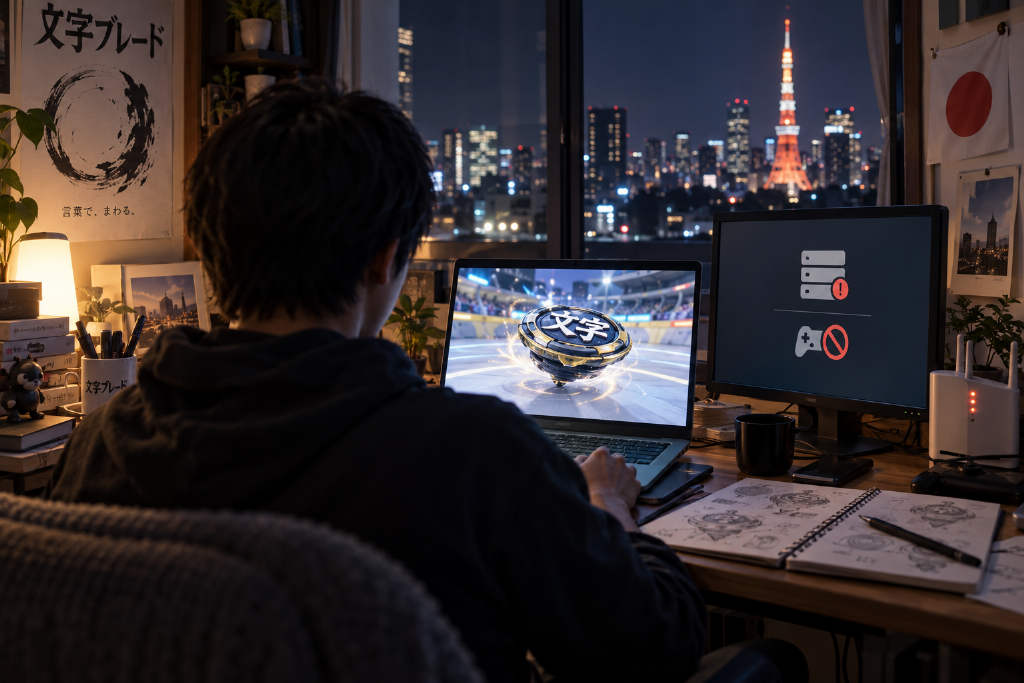
Moji Blade, a free browser game created by Japanese solo developer ru, has exploded in popularity by turning a single typed character into a 3D spinning top that battles in an arena. According to the source report, the introductory post for the game had reached about 19.5 million views as of Oct. 7.
The game’s sudden popularity has also forced a rollback of its online features. In a notice posted on Oct. 4, ru said estimated server costs for multiplayer matches were too high for an individual developer to keep covering. As a result, online battles and ranking updates were suspended. Modes that do not require server support, including consecutive battle challenges and matches against the computer, are still available.
Released on Oct. 1 as a free web game
Moji Blade went live on Oct. 1. Its core idea is simple: a player enters one character, and the game turns that character into a 3D spinning top. After both sides choose their character tops and collide, the winner is the one still spinning in the arena at the end. If neither side wins within 45 seconds, the match is ruled a draw.
Players can switch between four font styles: Gothic, Mincho, POP and semi-cursive. The same character can perform very differently depending on the selected font.
Character size, density and balance shape performance
The game’s official page says larger characters create heavier tops with lower speed, but they are harder to knock away and carry more power on impact. Rounder shapes, or characters that are less skewed to one side, have higher balance values, and the rotation axis is automatically placed at the character’s center of gravity.
In replies to players, ru also said in-game stats are determined by a character’s density and overall balance. Characters with lower density tend to be weaker but faster.
Usable inputs are not limited to Japanese text. The report says that as long as a character is included in Unicode and can be displayed properly, it appears to work in the game. That includes Greek letters, Thai characters, symbols and emoji. The report also notes that Traditional Chinese characters have been especially strong in testing.
Under the official rules, a character can be used if it exists in the selected font. Ranked matches, however, do not allow device-dependent special characters. ru said the idea for the game came from Type Spin, a mobile game by Japanese game company KAYAC.
Dominant characters changed quickly as players searched for the strongest pick
Players quickly began testing which character might be the strongest. On X, users reported that many people were choosing dense, high-stroke Chinese characters such as 「鬱」 and 「殺」, often in the POP font, using weight and density to push through opponents. Others tried symbols with unusual shapes, including 「}」, 「㍿」 and 「☆」.
In the consecutive battle challenge mode, players use the same character repeatedly against the computer and compete for the longest win streak. According to the report, the upper ranks were first filled by high-stroke Chinese characters in the POP font, then replaced by the black circled number 「❽」. Later that same day, 「闢」 in the POP font took over and recorded a 388-win streak against the computer.
ru specifically pointed to 「闢」 and 「櫻」 in the POP font, as well as 「暇」 in the semi-cursive font. He said those three showed "unexpected stability and power for unknown reasons," adding that it was "probably a bug." The report notes that 「櫻」 is an older form of the commonly used Japanese character 「桜」 and is also widely used in Taiwan.
The report also says that within six hours of ranked play, the POP-style 「〇」 was used 41,490 times.
Built as a casual single-player project, with no timeline yet for restoring online play
ru said in his notice that the game was originally designed as a casual single-player title. It was also his first release as an individual developer. According to AUTOMATON, Moji Blade is the first title on ru’s game website, Tsukuruum.
As player demand grew, ru gradually added online battles and ranking features, but the response exceeded expectations. The game page now marks ranked matches, event matches and friend room battles as under maintenance. The page states: 「Online features and ranking updates are under maintenance. Consecutive battle challenge can still be played without saving records.」
ru said he will review server arrangements and operating policy in an effort to restore the online features, but no schedule has been announced.