
Jason Hughes, VP of Development and Engineering at Ocean Mining, said BIP-110 appears headed for failure because miner signaling remains below 1%. The piece was first posted on X and later published by Bitcoin Magazine with the author’s permission. Hughes said the views are his alone and do not necessarily reflect those of BTC Inc. or Bitcoin Magazine.

Hughes opened by saying he is neither pro-BIP-110 nor anti-BIP-110. If the proposal eventually wins real consensus across the network and is enforced by a majority, he wrote that he would accept that outcome because the network would have made its choice. But by every measurable standard available today, he said, that is not what the data shows, and he does not see a trend suggesting that will soon change.
He then laid out several points he said were meant to push back on what he described as exaggerated claims from some supporters of the proposal:
- BIP-110 is not inevitable.
- It can fail.
- In a minority hashrate scenario, it can and will cause a chain split or fork.
- It is not risk-free for miners who choose to adopt it.
- Miners who do not support BIP-110 are not suddenly mining invalid blocks simply because an unadopted proposal exists.
- Not liking or supporting BIP-110 does not make someone a bad person or evil.
Hughes said he had originally intended to write a long note for miners about the issues they should keep in mind as the process unfolds, then realized he had already done much of that work months earlier in a document he wrote for OCEAN as a potential miner education piece. That document was never published, so he updated it and released it as a personal document instead. He added that the original version had been written in as neutral a tone as possible in hopes it could work as a corporate post, but that effort did not succeed.
His argument is that miners making operational decisions need the full picture without what he called sugarcoating or outright misleading claims from some BIP-110 advocates. He also noted that misleading information exists on the opposition side as well, though he said nothing he has seen there matches the premature declarations of victory and hyperbole he attributes to the BIP-110 camp.
Advice to miners as block 961632 approaches
Hughes summarized his guidance in simple terms: if a miner supports BIP-110, signal for it. If a miner does not support it or does not care, do not signal. In either case, he said miners should watch the network on, around, and before block 961632.
If major pools continue to produce non-signaling blocks near that point, he wrote, miners can be reasonably confident those pools are unlikely to reverse course later and give up millions of dollars in revenue to support BIP-110. If those same pools do begin signaling, miners should keep watching and consider switching as needed to stay on the heaviest chain.
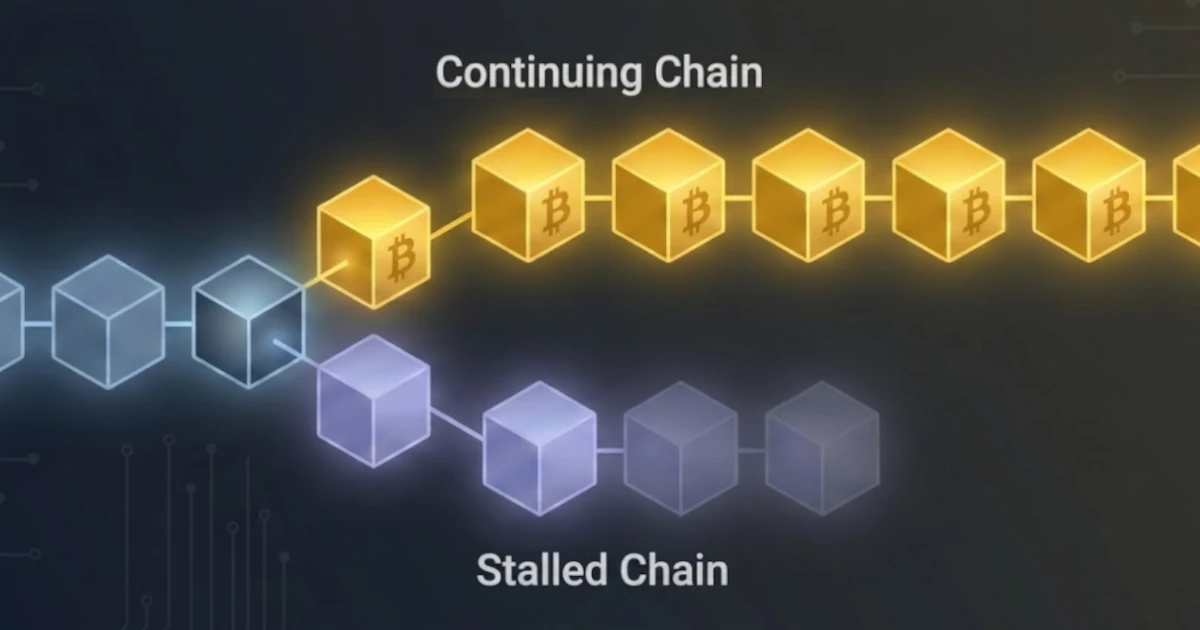
His bottom line was blunt: only one side can realistically win. Either BIP-110 succeeds and miners not on the BIP-110 side lose, or BIP-110 fails and miners on the non-BIP-110 side come out ahead.
The numbers he says matter most
Hughes cited two headline figures.
First, he said between 7% and 15% of Bitcoin nodes are signaling support for BIP-110, depending on which centralized crawler is used. He added that his own private crawler places the number much lower, though he did not expand on that point here. Even at 15%, he wrote, the figure is nowhere near a majority.
Second, he said only 0.6% of blocks over the past 60 days have signaled support for BIP-110. In his view, that is a sharp contrast even against Segwit’s relatively low starting level of support.
He acknowledged that signaling has ticked up slightly in recent weeks, but said there have been no new entrants. Instead, he described the increase as more visibly rented hashrate from one of the same small supporters.
Why he rejects comparisons with Segwit activation
Hughes addressed a common counterargument directly: UASF helped activate Segwit with fewer signaling nodes. His response was that Segwit had broad support from miners, merchants, users, and other parts of the Bitcoin economy. There was real economic and community weight behind it.
He argued that BIP-110 and Segwit are not directly comparable. By the time Segwit entered UASF territory, roughly one-third of network hashrate was already signaling support. In that setting, using UASF to push MASF over the tipping point made sense. He said that logic does not apply to BIP-110 as things stand now.
DATUM signaling on OCEAN before the fork point
Another part of the article focused on BIP-110 signaling blocks mined through DATUM on OCEAN. Hughes said that before the fork point at block 961632, doing so carries virtually no risk for the miner. The cost is negligible, he wrote, because rental costs and related expenses are effectively guaranteed to be recovered.
He said he is glad that capability exists, but urged miners to keep that context in mind when weighing the meaning of signaling blocks from a risk-reward and money-on-the-table perspective.
No evidence for the “last-minute signaling” theory
Hughes also pushed back on another argument from supporters: that miners have no incentive to signal until the final moment, so current support figures should not be read too strictly. He said he sees no evidence for that claim.
He also disagrees with it on the merits. In his view, it is not in a mining pool’s interest to destabilize the network that way. Early signaling and lock-in periods exist to help coordinate upgrades smoothly. Waiting until the end removes that benefit, and he said he sees no compelling rationale or upside in doing so.
The node software he says major pools are running
As part of his own monitoring setup, Hughes said he tracks nodes known to belong to a range of entities, including other mining pools, exchanges, large Lightning nodes, and merchants. He added that a supermajority of that monitoring is done with explicit permission and confirmation or coordination.
Based on that monitoring, he said all major mining pools he watches are currently running some variant of Bitcoin Core v30 or v31, with OCEAN the lone exception.
He expanded on that point by saying most of those pools have updated their nodes since BIP-110 was released and spread, and even since the release of Knots 29.3. He also noted that many pools run modified versions of node software to support the requirements of their own infrastructure. To move to a BIP-110-compatible client, those changes would need to be ported, tested, evaluated, and deployed in advance. He said he sees no evidence that this work is happening. As far as he can tell, the pools are aware of BIP-110 and are ignoring it.
His response to the “miners do not determine consensus” argument
Hughes spent part of the piece responding to the claim that nodes, not miners, determine consensus, and that otherwise miners could simply cancel halvings. He called that one of the most ridiculous arguments he has heard from the pro-BIP-110 side.
His reasoning is that a consensus change that miners can unilaterally enforce and that existing nodes will accept is a soft fork, while canceling a halving would be a hard fork that existing nodes would not accept.
- Tightening rules, such as BIP-110 in his framing, is a soft fork and can be enforced by miners if they choose.
- Loosening rules, such as canceling a halving, is a hard fork and cannot be enforced by miners without something close to 100% buy-in from the entire network.
Putting the two in the same category, he wrote, is not a fair comparison.
What would have to happen for BIP-110 to be enforced
Hughes said warnings that failing to upgrade to the latest consensus rules will leave users insecure, cause them to lose funds, or lead miners to produce invalid blocks only apply when a consensus change actually has consensus.
In his view, BIP-110 has not reached a measurable majority anywhere that matters at what he described as the eleventh hour. Not in node count, not in hashrate, and not in the social layer. He specifically referenced consensus.health and said readers would find him in the middle of its visualization.
Still, he drew a clear line: if BIP-110 somehow reaches more than 51% of network hashrate on or before block 961632, then it is enforced. He said that in the absence of a fully adopted URSF, a majority of miners can unilaterally enforce a soft fork, though he added that the label URSF becomes something of a misnomer in that situation because it would in some ways resemble a hard fork.
Seven months have passed, with about three weeks left
On the argument that BIP-110 cannot gain consensus without being given a chance to gain consensus, Hughes said first that he is under no obligation to accept that premise, though he believes he has already given it a chance. Second, he called BIP-110 a rushed proposal that never had enough time to win real agreement.
He pointed to the timeline: seven months have passed since the first BIP-110 client was released, and as of the time he wrote the article, about three weeks remained before mandatory signaling would begin, with even less time by the time readers saw the post. That means roughly 90% of the available time had already elapsed, with no shift in overall sentiment from relevant players. If it has not secured sufficient adoption in seven months, he wrote, it is unlikely to do so in the next three weeks.
CSAM, OP_RETURN, and the technical argument he now makes
Hughes also addressed the part of the debate centered on CSAM, child abuse material, and the risks of data on-chain. He said that even he personally overstated that risk early on when Bitcoin Core proposed its OP_RETURN default change.
At the time, he expected especially egregious material to appear on-chain almost immediately, but to the best of his knowledge that has not happened yet. He allowed that it still could happen.
Even so, he argued that on a technical basis, byte for byte, the same contiguous arbitrary data can be shown to end up stored on both the current chain and a BIP-110 chain without much trouble. For that reason, he said this line of argument for BIP-110 now falls flat for him.
He added that he does not want CSAM on the chain, but said not supporting BIP-110 does not make someone a pedophile.
His closing assessment: less than a 5% chance of success
Hughes ended by saying he could keep going, but stopped there. Because he has not adopted either side’s position, he expects criticism from both camps.
His broader view is that trying to address what he called a real issue, the OP_RETURN default change in Bitcoin Core, with what he described as a maximum anti-spam manifesto-based soft fork was misguided. He wrote that the proposal can be shown not to stop spam or arbitrary data. He also acknowledged that supporters dispute that framing and argue both that the proposal is not really about spam and that it does stop data in some sense, but said neither point appears correct to him.
He did leave room for being wrong. He wrote that he is not Nostradamus and cannot predict the outcome with complete certainty. He can only follow the data in front of him, and based on that data he gives BIP-110 less than a 5% chance of succeeding, a figure he said is already generous.
His final message to miners was to avoid being gaslit by either side, pay attention to the actual data, remain vigilant, and make the choice that best protects their operations and mining revenue.