
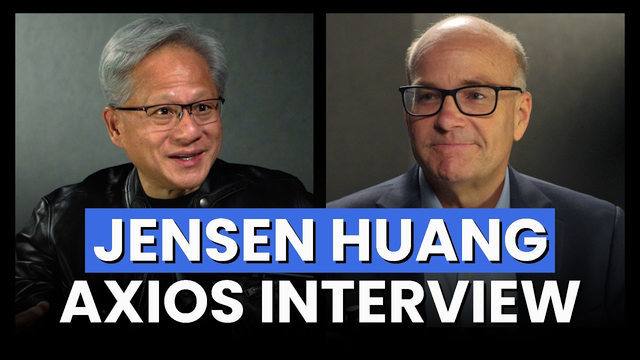
NVIDIA co-founder and CEO Jensen Huang said Wall Street has misunderstood the impact of Chinese AI models, argued that AI doomsday claims are "nonsense," and said the semiconductor industry will need to grow by 5x to 10x over the next decade to support the buildout of AI infrastructure.
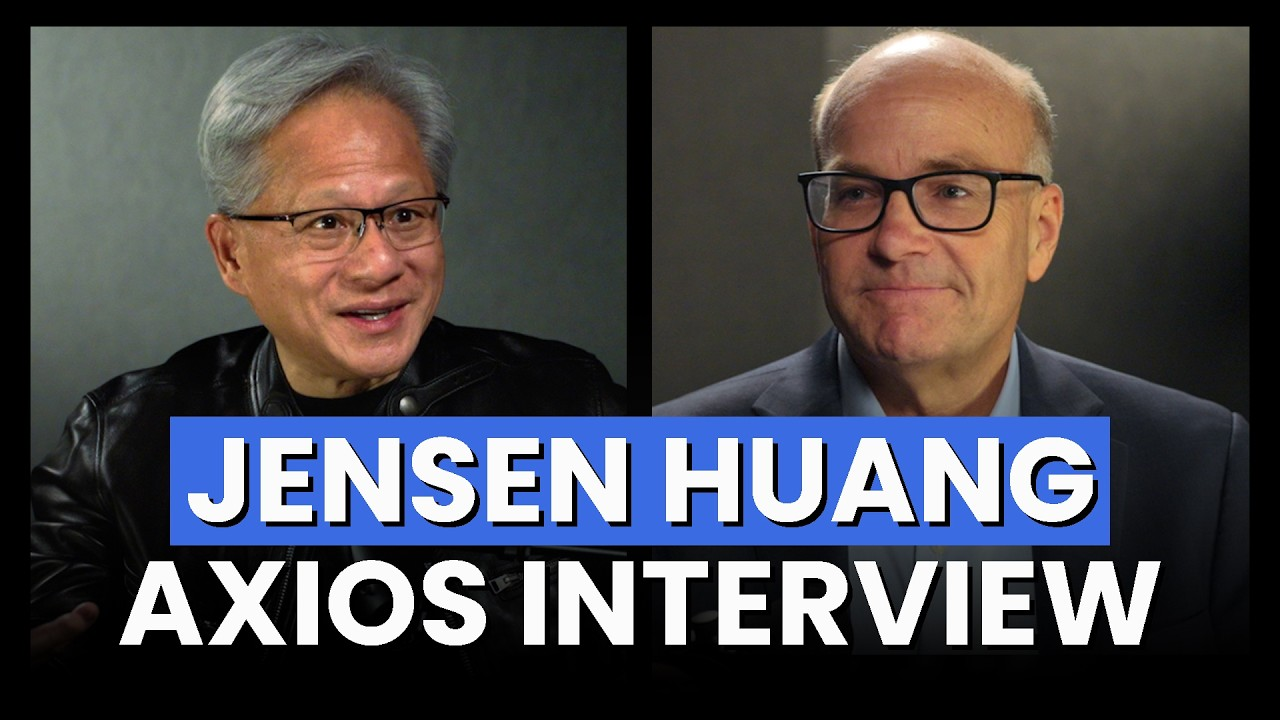
Huang made the remarks during a 70-minute conversation recorded at NVIDIA’s factory in Fort Worth, Texas, in an episode of Axios’ Behind the Curtain. According to the input material, Huang holds about 3.5% of NVIDIA and has a personal fortune of about $181 billion, and the discussion touched directly on issues tied to his financial interests, including AI industry expansion, chip demand, and regulation.
China AI and Wall Street’s reaction
Host Mike Allen opened with one of the most politically sensitive questions in the interview. He referenced a Financial Times report that China was considering tighter export controls on AI models and semiconductors, and noted that the launch of Kimi, a Chinese model, was followed by a sharp drop in NVIDIA shares, while chip stocks fell 18% over one month. He asked Huang what Wall Street was getting wrong.
Huang said the market had already made the same mistake with DeepSeek and was now doing it again with Kimi. His argument was straightforward: better models lead to more use, more use means more NVIDIA computers sold, more data centers built, and more services delivered into more industries. As he put it, good models lead to good applications, good applications lead to growth, and growth requires more compute.
Asked whether Chinese models such as Kimi should be banned, Huang said the opposite. "Of course you should use it. That’s smart," he said. He argued that once a model is downloaded, users can fine-tune it, improve it, and place safeguards around it. In his description, the model runs inside a harness, the harness runs inside a sandbox, and that sandbox provides privacy protection, security controls, and access controls. He compared open AI models to Linux, saying open-source software can be trusted because millions of people inspect, test, and harden it.
Huang also said open and closed models are not in conflict. In his view, the users most likely to upgrade to stronger services from Anthropic or OpenAI are the ones already using AI. Free models lower the barrier to experimentation, and once users see value, some of them will pay for better closed offerings. By that logic, more open models can also expand the opportunity for closed-model providers.
On NVIDIA’s sales in China, Huang gave one of the interview’s most striking lines: "Our sales in China today are approximately zero." He said the company had already told investors not to expect revenue from China and that if China’s government and market welcomed NVIDIA back, it would be "a great honor." Until then, he said, investors should treat China revenue as zero.
The source material also noted that this was Huang’s phrasing. Public filings show U.S. export controls have pushed NVIDIA’s high-end chip sales in China down to very low levels, but the exact figure should still be taken from company financial reports.
Why Huang rejects AI doomsday claims
The sharpest exchange in the conversation came when the discussion turned to AI risk. Allen asked whether some people in the tech industry had exaggerated the dangers. Huang said warning people is fine, and better still if the warning comes with solutions, but making things up is not acceptable.
He then took direct aim at several common narratives. "To say AI will destroy humanity is nonsense. To say AI will eliminate half of all U.S. jobs is nonsense. All the facts and evidence point the other way," he said.
To support that view, Huang cited several labor examples. He said the number of radiologists had risen by about 20% because AI had automated scan analysis, allowing doctors to see more patients while demand for care remained strong. He said the number of paralegals had increased by about 10% for similar reasons. He also said manufacturing jobs had risen by about 50% in recent years because AI data centers need to be built and chips need to be made.
His broader argument was that productivity gains create opportunity. Looking across history, he said, technology has made society more efficient and created more jobs rather than fewer. He added that if that pattern were not true, the United States would have ended up with only a tiny number of jobs by now.
Huang also criticized what he described as AI leaders spending too much time theorizing science-fiction endings, suggesting that doing so may make them sound smart. When Allen pressed him on whether he meant some AI company CEOs, Huang did not back away. Instead, he said that if the goal was to alert the world to the extraordinary capabilities of the technology, that goal had already been achieved. The next step, he said, is to focus on making the technology safe, which he called the responsibility of leaders in the field.
Allen pointed out that attitudes toward AI in Asia look very different from those in the United States, where Huang is often mobbed by fans asking for autographs. Huang replied that perhaps this is because doomsayers have spent too much time inventing science-fiction outcomes. In Asia, he said, AI is treated more as a tool and an opportunity than as a threat.
The source material added an important caveat: Huang’s figures on a 20% increase in radiologists, a 10% increase in paralegals, and a 50% increase in manufacturing jobs were cited orally in the conversation and were not sourced during the exchange.
A 5x to 10x expansion in semiconductors
Allen also asked where the bubble risk sits in this generation of AI, given that industrial revolutions have often gone through bubbles. Huang’s answer was careful but clear. A bubble will come one day, he said, but not now. In his view, the industry is still at the very start of the buildout.
He put a time frame around that view. Within five years, he said, a bubble is unlikely. The period from five to 10 years out is less certain. His reasoning was based on supply constraints rather than weak demand. The industry could be building faster, he said, but chips are short, memory is short, land is short, electricity is short, and even construction workers are short. "We’re constrained in every direction, in every dimension," he said.
Huang said those constraints are actually helpful because they slow the system down and buy time to build infrastructure. Demand is strong, but the ability to convert demand into productive supercomputing capacity is delayed by physical limitations. That pushes back the moment when supply would exceed demand.
His bigger claim was about the scale of the industry still to come. Huang said he believes the semiconductor sector needs to expand 5x to 10x over the next 10 years. In his telling, the current chip industry is still far too small for the AI infrastructure layer now being built.
He argued that this cycle differs from past semiconductor cycles because it is not seasonal, not consumer-led, and not driven by ordinary demand patterns. It is an industrial infrastructure build. Just as the world needs energy, the internet, roads, and railways, it now needs an AI intelligence layer on top of existing infrastructure. That layer requires chips.
Asked whether he worried about customers taking on debt to buy NVIDIA products, Huang said he was not especially concerned. These are excellent companies that generate large amounts of cash, he said. He added that the AI monetization flywheel has already started. AI is useful, and because it is useful, it can make money. Coding agents, in particular, are "extremely profitable" in his description because they do useful work in high-paid roles, and many companies are willing to spend hundreds of millions of dollars a year to strengthen their coding capabilities.
Why Huang thinks tokens become more valuable as intelligence improves
One of the interview’s more technical sections focused on token economics. Allen asked what made Huang confident that tokens would become increasingly profitable. Huang said a token is an embedding, one that embeds knowledge and intelligence rather than a static number like pi.
His point was that the intelligence encoded in that number is not fixed. It gets smarter over time. As that intelligence improves, it becomes more useful. As usefulness rises, value rises too. And when value rises, users will pay more for it.
Huang contrasted that with the older software model. Traditional software, he said, was asset-light, which helped software companies maintain high gross margins. The AI era changes that. Software becomes more capital-intensive because producing modern software now requires machines like the supercomputer sitting in front of him to generate intelligence. In his view, every industry will become more capital-intensive, but the payoff will be extraordinary intelligence, productivity, and growth.
"We are laying foundations and building infrastructure. This is the largest industrial infrastructure buildout in human history," he said.
He also rejected the idea that AI has already peaked. That is impossible, he said, because AI penetration across society and industry has only just begun. Huang added that $300 billion had gone into venture capital and startups in the United States over the past six months alone, creating new jobs and new companies.
Trump, regulation, and the role of government
When the conversation turned to Donald Trump, Huang offered a notably detailed description. He said Trump is smart and remembers everything, and called him the only president who can remember NVIDIA chip names such as H20, H200, and Blackwell, while also knowing that the next-generation product is called Rubin.
Huang also described his first meeting with Trump. According to Huang, Trump said he wanted to restore U.S. manufacturing capacity, reindustrialize the country, build secure and resilient supply chains, and bring semiconductor manufacturing back to the United States. Huang said the Fort Worth factory where the interview was being recorded was a direct result of that conversation.
On policy, Huang’s concern was overregulation and overcorrection. He said some companies want the government to create rules that favor them, but he believes competition should take place out in the open.
He also dismissed the idea that AI competition is like a 100-meter sprint. Calling that framing "nonsense," Huang argued that ultimate victory depends on whether a society adopts the technology, not on who invented it first. The United States did not invent electricity or manufacturing, he said, but it adopted both faster and with more enthusiasm, which helped make the country what it is today.
Allen then asked what Huang would say if Trump called and asked for an equity stake in NVIDIA. Huang replied that there was no need because the United States already has a stake in NVIDIA. He pointed to the company paying $10 billion in taxes last year, with more expected this year, along with the jobs and tax revenue it creates. He added that most Americans now have exposure to the stock market, so they benefit when the market rises.
Open models, Mythos, and distillation disputes
Huang was equally direct when asked whether Anthropic’s Mythos model, which is currently limited to certain institutions, should be opened to everyone. "Of course it should be open to everybody," he said.
He said it is Anthropic’s responsibility to make the technology safe, just as software companies are expected to fix vulnerabilities quickly when flaws appear. Referring to a jailbreak incident involving Mythos, Huang brushed it off by saying everything was fine and that the interview itself was proof that the world had not ended.
On the dispute over whether open-model companies should be allowed to distill closed models and resell products built from them, Huang took a more measured line. It depends on the terms of service, he said. If a service provider is unhappy, it should contact the company involved. He added that many traditional legal tools already exist to handle that kind of dispute.
At the same time, he said AI learning from other sources is a basic feature of intelligence itself. The earliest AI systems, he noted, were trained by scraping the internet’s stock of knowledge. He also said AI-generated content now exceeds human-generated content and predicted that within a few years, 99% of online content will be generated by AI. In that sense, he argued, AI is already in a constant process of distilling intelligence from other AI systems.
Robotics, the ChatGPT moment, and a trillion-agent future
Allen asked when robotics would reach its ChatGPT moment. Huang’s answer was simple: that moment has already arrived.
He drew a distinction, though, between the stage when a technology feels surprising and the stage when it becomes genuinely useful. In his telling, ChatGPT in 2022 produced a reaction of "interesting" and "surprising," while the point at which it became broadly useful came years later. Robotics, he said, is now in that earlier stage of surprise.
His example was a robot told to put an apple in a drawer. A capable machine can infer the task sequence, including opening the drawer before placing the apple inside. The first time people see a physical robot carry out that reasoning chain, Huang said, it expands their sense of what robotics could become.
As for when robotics turns broadly useful, Huang gave a time frame of three to four years and said he would not be surprised if that happened.
He painted an even bigger picture for AI agents. Today, about 1 billion people use computers, but those machines sit idle much of the time. In the future, every person will be assisted by many agents, and those agents will use computers around the clock. Huang said there will be 100 billion, even trillions, of agents running continuously: smart agents, less smart agents, specialized agents, and super agents. The result, he said, will be a dramatic increase in the number of computers needed.
On strategy, pain, and America
The final stretch of the conversation turned to Huang himself. Allen noted that Huang founded NVIDIA at age 30, that the company is now worth $5 trillion, and that it has about 50,000 employees. Huang said that even 10 years from now the company may only have 75,000 employees, because he wants it to stay as small as possible.
He defined the CEO’s job as strategy, which he described as using limited resources as efficiently as possible to realize a future vision. Huang said he started doing that work at age 30 and may now be one of the longest-serving CEOs in tech history. "This is my craft. This is my kung fu," he said.
Asked about his idea that pain and suffering are essential to greatness, Huang clarified that he was not referring to any single painful event. He described it instead as a continuous condition. No great athlete becomes great by accident, he said. Greatness comes from countless hours of practice when nobody is watching, along with repeated failure, pain, and hardening.
That process, in his view, sharpens craft, builds character, and creates confidence and resilience. Borrowing from athletes again, he said that at moments of maximum pressure, time seems to slow down. He feels that too, and he attributes it to practice and repeated exposure to doing the same thing again and again.
When asked what he would say to his 9-year-old self arriving in the United States, Huang answered with an emphatic defense of the country. He said America is the greatest country in the world, full stop. Even with its challenges and divisions, he said, those very challenges and divisions are part of what makes it great, because they exist inside an open system that allows freedom, speech, innovation, entrepreneurship, and collaboration. He added that the country was built by immigrants and will continue to need exceptional immigrants in the future.
On why he does not wear a watch, Huang gave a characteristically compact answer. The present is the most important time, he said. He refuses to let a schedule run his life or a watch run his life. If he is late, someone will tell him. Until then, he said, he is 100% present.