
ABMedia reported that U.S. President Donald Trump has set the policy direction for artificial intelligence as “Superintelligence,” or SI, through an executive order. The report said Trump believes the term should move past “Artificial,” recasting AI as SI and presenting it as a new way to think about the technology sector.
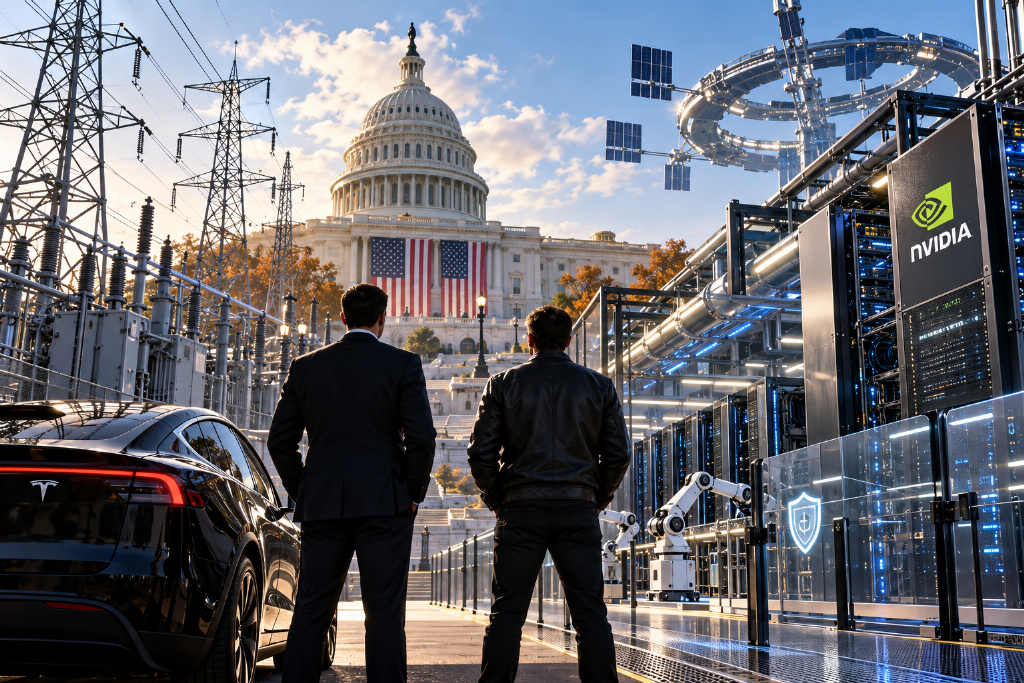
At an America.gov event, Nvidia CEO Jensen Huang and Tesla founder Elon Musk discussed what that concept could mean in practice. Their discussion described superintelligence as a kind of “superintelligence factory” that combines energy supply and cybersecurity defenses while creating economic value across multiple layers.
Power supply at the center of SI development
The report said Musk sees energy output as the core foundation for superintelligence. He argued that grid capacity and economic output are closely linked, adding that each 1% increase in electricity consumption creates an opportunity for gross domestic product, or GDP, to rise by 1% as well.
To meet large-scale generative computing demand, the industry is working on grid upgrades and market-based mechanisms that do not rely on government subsidies, according to the report. It listed fusion, fission and advanced battery storage as part of the sustainable energy options under discussion.
Orbital computing as one answer to Earth-based power limits
Musk also raised the idea of “Orbital Computing,” which would use heavy-lift rockets to place computing hardware into orbit. In the report’s description, that approach could tap solar power in space and work around the electricity limits faced on the Earth’s surface.
From data centers to “superintelligence factories”
Huang and Musk also reframed the role of data centers in the superintelligence era. ABMedia said traditional data centers are evolving into “superintelligence factories,” facilities that do more than store data and instead continue to generate economic value.
These facilities combine high-performance computing, networking architecture and dedicated cooling systems. The report said their construction and maintenance can support blue-collar work such as building and pipeline installation while also creating white-collar research and development roles that require advanced technical skills. In that framing, they become a driver of regional reindustrialization.
Open Shell and Bluefield highlighted in agent safety controls
On safety, the report focused on the risk that SI agents could introduce subjective decision bias or other concerns when operating autonomously. It said the industry is bringing in stricter monitoring and protection measures.
Huang described the use of Open Shell technology to build a sandbox system that isolates agent programs and restricts access permissions. The report also said Bluefield and other specialized processing chips are being used for external real-time tracking to make sure operations stay within safety rules.
ABMedia added that the industry has signed a joint statement with the White House, committing to internal controls and third-party audits as part of a more formal safety standard.
Key points listed by ABMedia
- “Superintelligence” was presented as a new naming direction for AI, with Huang and Musk offering an industry-level interpretation of the term.
- Growth in electricity consumption was described as positively linked to GDP growth, making expanded power generation a key condition for SI development.
- Data centers were recast as “superintelligence factories” that can support local employment and economic activity through integrated computing, cooling and network infrastructure.
- Orbital computing was presented as a forward-looking way to address Earth-based power bottlenecks by using space-based solar energy and heavy-lift launch systems.
- Open Shell sandboxing, Bluefield-based real-time perimeter monitoring and third-party audits were described as part of a layered defense model for autonomous agents.