
Stifel makes a leadership transition its base case
Jensen Huang’s future at Nvidia has moved from a low-probability risk to a central variable in Wall Street valuation models. On Nov. 12, Investing.com reported that Stifel cut its price target for Nvidia from $315 to $205, a reduction of about 35%, while keeping a Buy rating. Nvidia had not announced a leadership change as of the report, but a management transition had already become Stifel’s base-case scenario.
The revision was driven mainly by the valuation multiple rather than by a sharp change in Stifel’s near-term operating view. The firm lowered the forward price-to-earnings multiple used for its fiscal 2028 target from 20 times to 13 times. Its fiscal 2028 earnings-per-share assumption was $15.65. At 13 times earnings, the implied value is about $203, close to the new $205 target.
On Nov. 10, Scott Galloway said on the Pivot podcast that the artificial-intelligence industry seemed that night to be “held together by a single leather jacket.” Huang’s trademark jacket has since become a shorthand for the market’s debate over the founder’s value to Nvidia. After Nvidia’s board began an independent investigation into Huang, investors started pricing a scenario they had rarely treated as a concrete valuation question: how much would Nvidia be worth if its founder left?
The first adjustment is a lower earnings multiple
A price-to-earnings ratio measures how much investors are willing to pay for each dollar of earnings. If the earnings forecast stays broadly intact, a lower multiple means the market is assigning a lower price to the company’s future growth. Stifel remains relatively constructive on Nvidia’s near-term performance. It expects the company’s fiscal third-quarter results, scheduled for Nov. 17, to come in slightly above expectations. The firm also sees supply as the main constraint on growth and believes there is room for an upward revision to its fiscal 2028 earnings forecast.
The longer-term picture contains more open questions. The identity of a successor, the timing of a transition, the retention of key executives, and possible changes to sales channels and export-compliance arrangements could all affect expectations for future growth. Bernstein downgraded Nvidia from Outperform to Market Perform and lowered its price target to $200, according to Investing.com. Morgan Stanley removed Nvidia from its list of preferred stocks but retained an Overweight rating and a $300 target. The firms are now drawing different lines between earnings potential and the multiple investors should pay for it.
Stifel’s price-target cut does not mean the firm expects Nvidia’s profits to collapse immediately. The more direct change is that investors may no longer apply the same high multiple to a similar earnings forecast.
Huang connects technology, customers and financing
Huang’s importance is also reflected in Nvidia’s organizational structure. Robert Cyran, a columnist for Reuters Breakingviews, wrote that more than 60 people report directly to Huang, while four senior executives below him hold equivalent standing. A structure built around the founder leaves a successor responsible for technical judgment, internal coordination and customer communication at the same time. It also makes an emergency handover more difficult.
The challenge extends beyond Nvidia’s internal hierarchy. Large customers such as Microsoft, Amazon and Google continue to buy Nvidia chips, but they also have incentives to develop lower-cost products of their own. Huang has expanded Nvidia’s hardware and software ecosystem, raising the cost for customers that might want to switch suppliers. He has also built financing partnerships with Apollo and Blackstone to help customers raise money for chip purchases.
Cyran wrote that investments in and financing support for smaller customers can broaden the buyer base and limit the negotiating power of a small group of large customers. The arrangement links product competitiveness, customer financing and order growth. A successor’s ability to continue those relationships will affect investors’ views of future revenue and margins, as well as the amount of valuation premium Nvidia can retain.
The probability of departure matters as much as the size of the shock
Before Stifel cut its target, Dan Ives and Gene Munster had already tried to quantify the effect of a Huang departure. Dan Ives of Yorkville Ives & Co. said on Nov. 10 that Nvidia’s corporate and stock value could fall 25%-30% if Huang were removed as chief executive. He put the probability of that outcome at about 15% at the time.
Gene Munster of Deepwater Asset Management estimated the potential shock at about 20%. He said the stock might already have reflected a roughly 25% probability of Huang leaving, while his own estimate was 10%-15%.
TIKR used those assumptions for a simple probability-weighted calculation. Under Ives’ view, a 25%-30% valuation loss multiplied by a 15% probability produces an estimated 3.75%-4.5% effect on overall valuation. Under Munster’s view, the impact would be about 2%-3%. Based on those assumptions, TIKR wrote on Nov. 11 that Nvidia’s decline over two consecutive trading sessions might already have priced in most of the departure risk.

That conclusion depends heavily on when the information became public. The Wall Street Journal later reported that Nvidia’s board was preparing to replace Huang. Bloomberg reported that the company had hired a search firm and was considering appointing an interim chief executive. By the time Stifel issued its latest view, a leadership transition had entered the firm’s base case. The earlier 10%-15% probability assumption therefore needed to be reassessed.
If investors conclude that Huang’s departure is becoming more likely, the risk discount required in the stock will expand even if the estimated loss after his departure stays unchanged. Deciding whether the risk is fully reflected in the share price requires two separate estimates: the probability of departure and the actual effect of a management change on Nvidia’s value.
Unchanged earnings could still leave Nvidia at a 10-12 times P/E
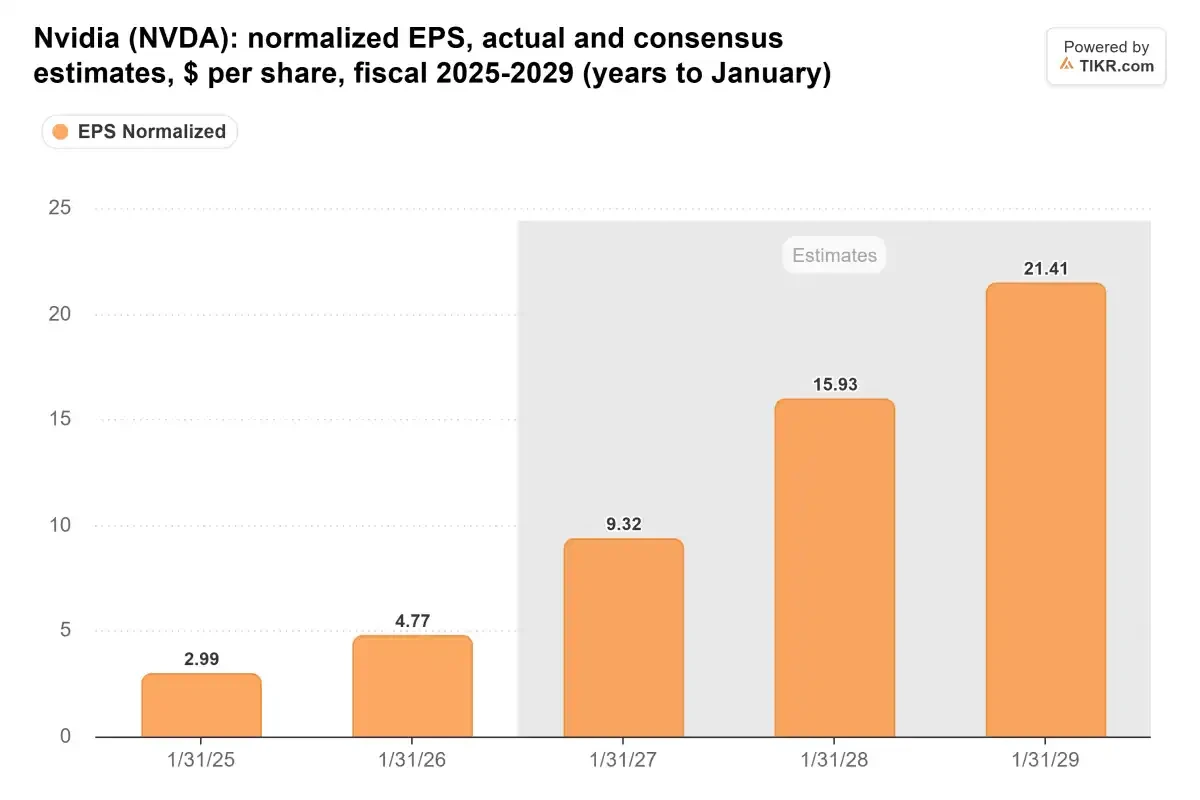
TIKR sees continued earnings growth as the main support for Nvidia’s valuation. The consensus estimates cited by TIKR show adjusted earnings per share rising from $9.32 for the fiscal year ending January 2027 to $21.41 for the fiscal year ending January 2029, more than doubling over two years.
TIKR data showed that Nvidia’s forward 12-month P/E was about 14.8 times on Nov. 9, near a three-year low and below the roughly 30.1 times average for the same period. The latest figure in the chart was 14.75 times. The chart covers Nvidia’s adjusted earnings-per-share expectations for fiscal 2025 through fiscal 2029, with the gray area representing market consensus estimates.
If the earnings forecast remains unchanged and the stock takes a 20%-30% discount from that valuation base, the implied multiple would be about 10.4-11.8 times. That is the basis for TIKR’s description of a post-Huang Nvidia as potentially “a 10-12 times P/E stock.”
The calculation used the share price and earnings expectations available at the time. The implied multiple will change as the price and market assumptions change. TIKR used forward 12-month earnings, while Stifel used fiscal 2028 earnings, so the two frameworks are not directly identical.
Both approaches point to the same tension. The market still expects Nvidia’s profits to grow, but it is reconsidering how much it should pay for those profits. An unidentified successor, uncertainty around management stability and questions about strategic continuity could all push the multiple lower. The eventual size of the discount will depend on whether Nvidia can present a credible transition plan and whether a successor can maintain product execution, customer relationships and financing partnerships.
A lower earnings forecast would deepen the repricing
The calculations above share one important assumption: that the profits in analysts’ forecasts are delivered. TIKR said that if a later review leads to tighter export rules and affects sales already included in those forecasts, analysts would need to cut their earnings-per-share estimates. Nvidia’s target price could then face two pressures at once: lower earnings and a smaller valuation multiple.
Nvidia’s earlier outlook already assumed no revenue from data-center computing business in China. The effect of any later policy change therefore has to be assessed against specific customers, regions and sales channels. The key question is whether new restrictions reach revenue that is already included in the company’s forecasts.
The Nov. 17 earnings report will offer one test. Nvidia’s previous quarterly revenue guidance was $108 billion, plus or minus 2%. Stifel expects the actual result to come in slightly above expectations. Investors will also be watching the company’s subsequent growth guidance and management commentary on supply, customer demand and the leadership arrangement.
How much is Nvidia worth without Huang? The answer currently turns on two groups of variables. If the company continues to deliver earnings growth, the main adjustment will be the P/E multiple investors are willing to pay. If a management change begins to affect execution and order expectations, the earnings forecast could also be cut. The succession plan’s ability to stabilize the core team, keep product plans on schedule and preserve customers’ access to financing for computing capacity will determine whether the current discount is a temporary transition premium or a longer-lasting valuation reset.



