
Circle founder Jeremy Allaire published a research paper on July 13 titled The Agentic Economy, examining how AI agents could merge with the future economic system. His central claim is that as AI agents begin to take on corporate work and value starts moving natively across open, programmable networks, the agentic economy and the onchain economy will end up as two sides of the same system.
Explaining why he wrote the paper, Allaire said: “This paper is the result of decades of building internet infrastructure and of a question I have cared about from the start: open software and open networks can change not only how we share information, but also how our social, political, and economic systems are organized. Many of the ideas in this paper came from two beliefs that formed when I started Circle. First, money can move through open protocols the way information moves across the open internet. Second, blockchains are a network computer: a foundational platform where autonomous software and machines can store value, exchange value, and coordinate economic activity directly without human intervention.”
He added that those early ideas matured over time into a broader theory about the way finance and the economy could merge with software and the internet. With the arrival of more capable AI and agent systems, that theory now stretches beyond a new form of money or a new network. In his telling, it points to a new way an economy functions and to the consequences that shift could have for people, labor, capital, ownership and the social contract.
The original paper runs 89 pages. Odaily translated and summarized its main arguments.
Firms are likely to be decomposed before they are rebuilt
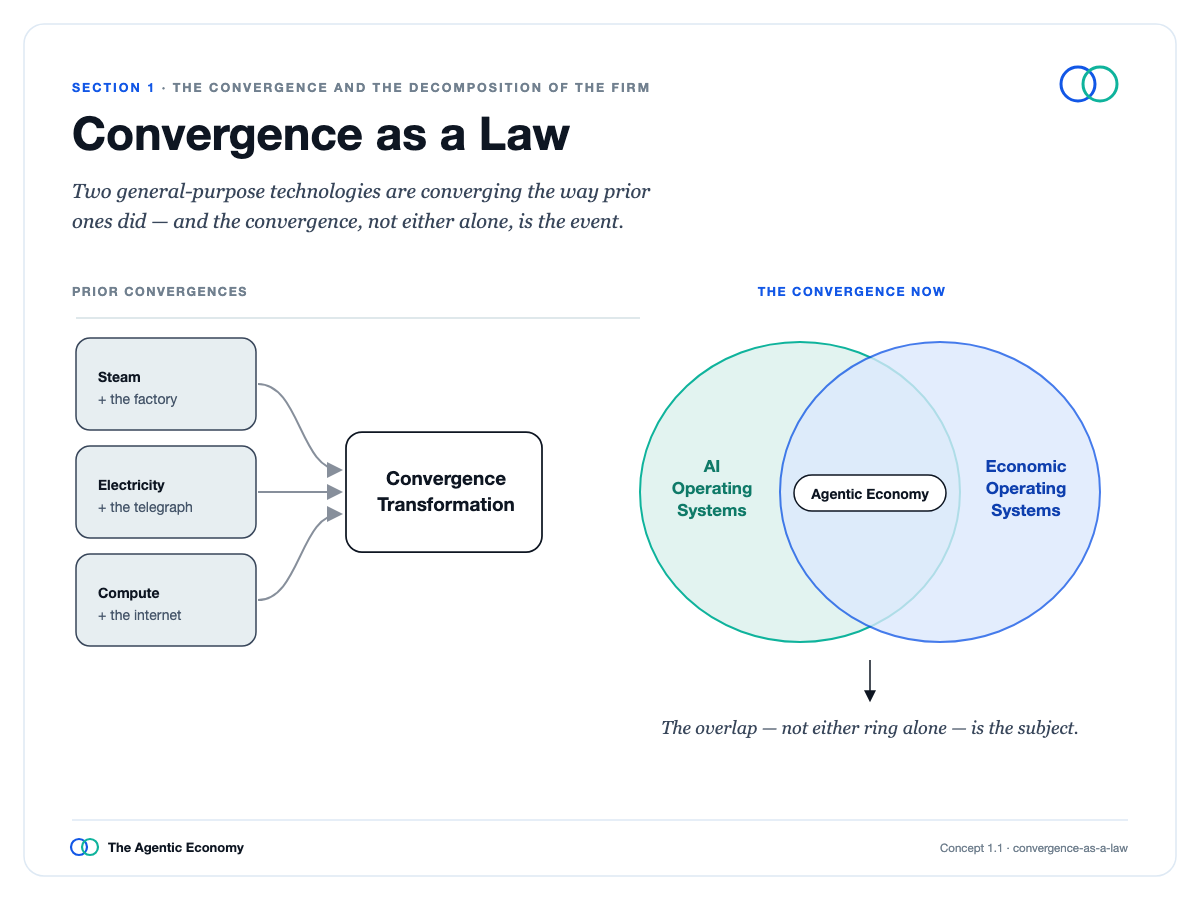
Allaire opens by arguing that major internet-era shifts tend to come from convergence rather than a single invention. Networks, mobile computing, cloud infrastructure and social media each followed that pattern. Once several capabilities mature at the same time, the cost of something that used to be expensive can fall toward zero, and when the cost approaches zero, scale tends to explode.
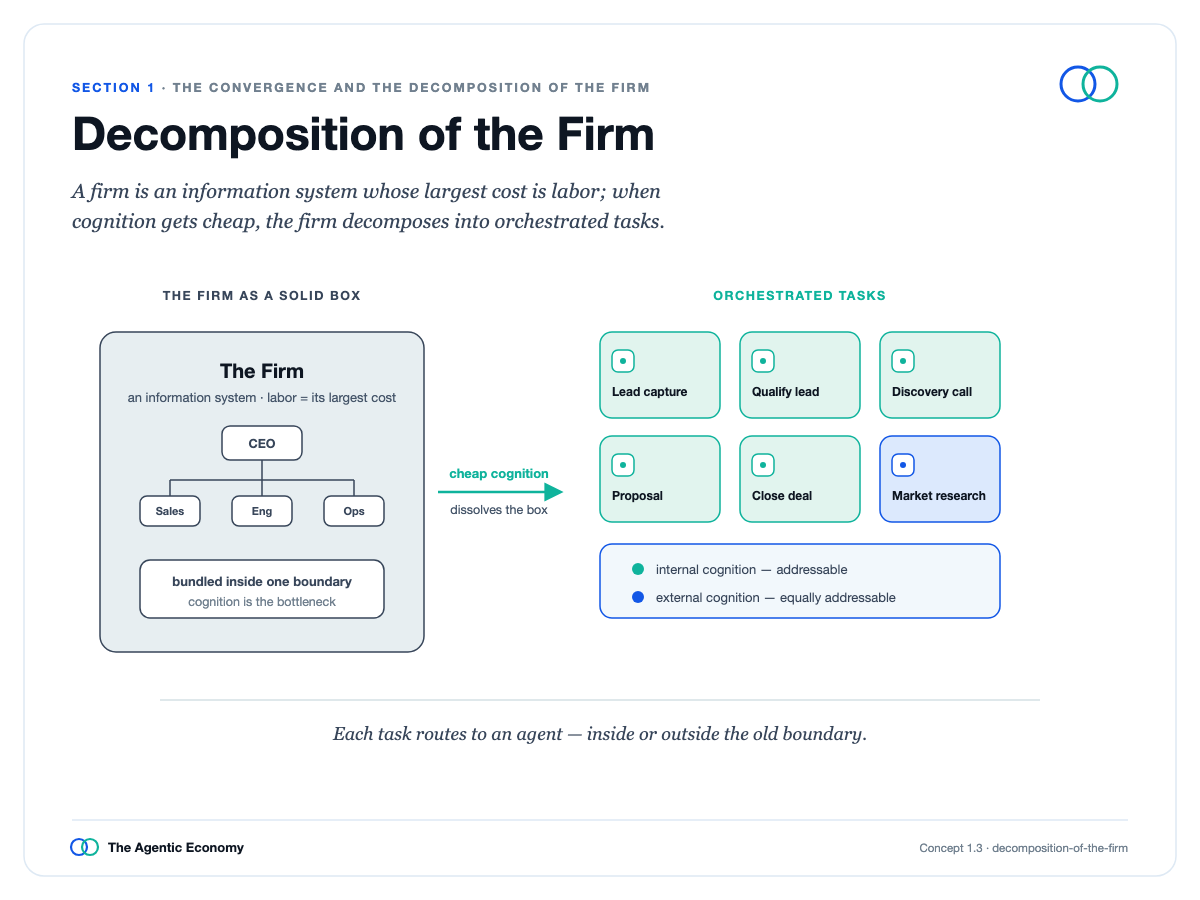
He says two systems are now converging. One is the intelligence system, built from AI models and the agents running on top of them, which pushes down the cost of thinking and work. The other is the economic system, built on blockchains, where money, contracts and coordination run as software and push down the cost of transactions. His broader argument is that these are not separate lines of change. They are two expressions of the same economy.
That shift changes what software is. Instead of writing every step explicitly, users can issue instructions in natural language and let the system reason its way to an answer. In the paper, the basic unit is the agent: a reasoning process that can be assigned work. Software, in that framing, stops being only a rigid sequence of machine-executed steps and starts becoming a form of machine labor that can be entrusted with tasks.
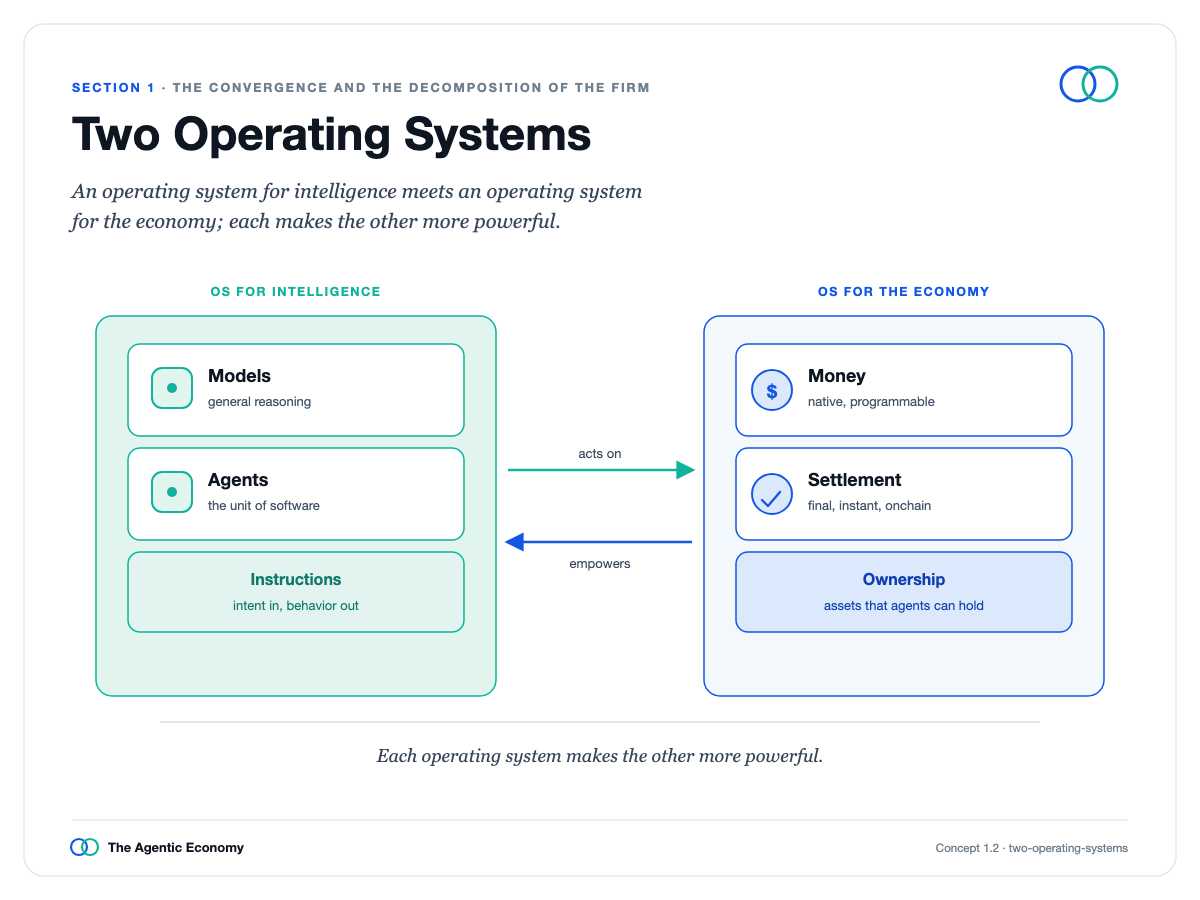
Allaire then reduces the firm to what he calls organized thought. Beneath the brand, office and hierarchy, a company is made up of product work, marketing, sales, finance, legal work and the outside firms it hires to perform related functions. Most of that is labor, and labor is one of the largest costs in the economy. Cheap and capable intelligence goes directly after that cost center.
That also weakens the classic explanation for why firms exist. Companies grew by internalizing work because coordinating it externally was expensive. If most non-physical work can be found, hired and paid for instantly through agents, that logic weakens. One person, paired with powerful agents, may be able to do work that used to require a department.
The paper says the transition will arrive first in software and other information-heavy sectors. It should move more slowly in the physical world, where robotics still has to catch up. Allaire does not reduce this to headcount cuts. A human paired with powerful agents may become far more productive, while judgment, relationships and final responsibility remain human. He flags a tension he returns to later: even if the economy pays a smaller share of output to human labor, individual capability can still expand.
Why firms would move onchain
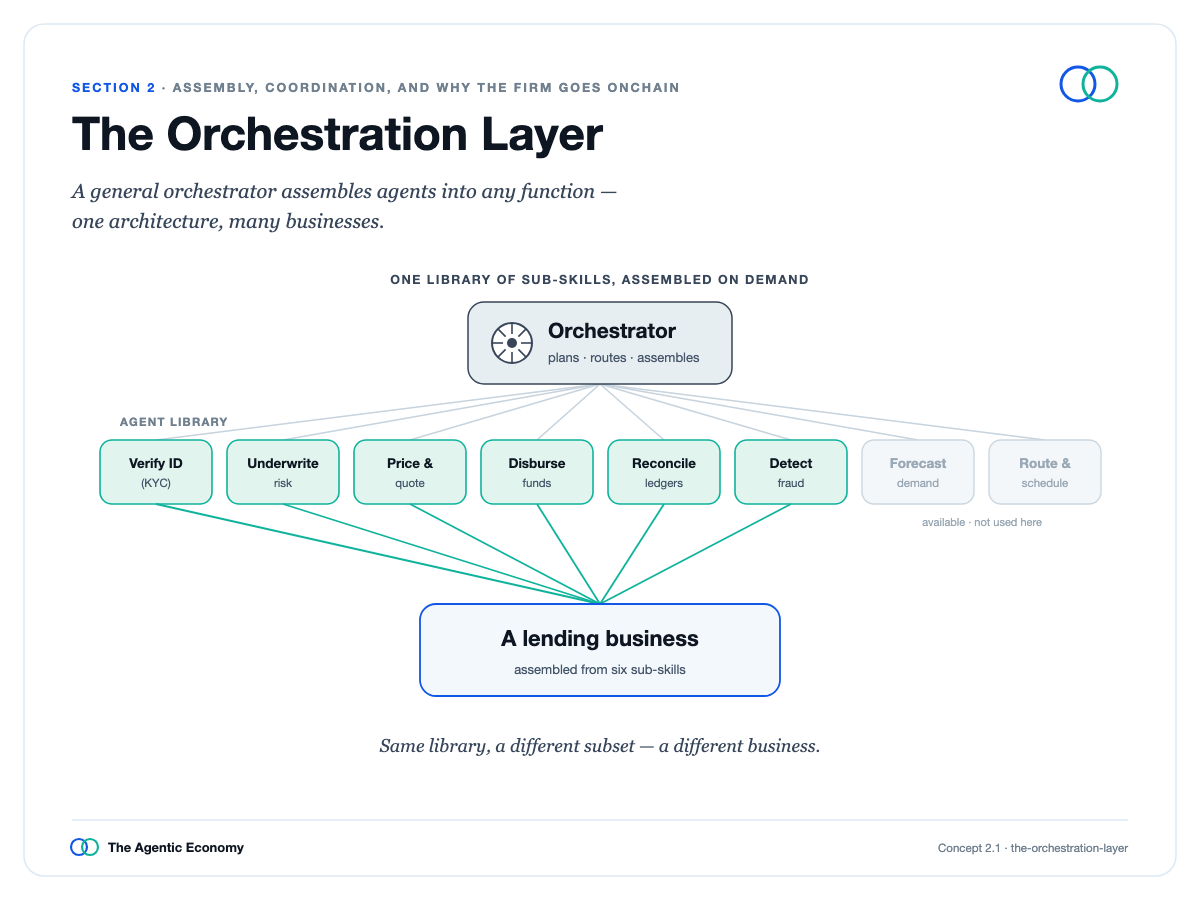
The second section shifts from asking what can be automated to asking how fragmented work gets put back together. Allaire’s answer is an orchestration layer. A manager agent takes in a goal, breaks it into tasks, assigns those tasks to specialized agents and combines the outputs. Supporting software carries memory and context across each step. Under that model, functions like marketing, finance, sales and product are less distinct categories than variants of the same machinery applied to different work.
People do not disappear. Some remain inside the loop to execute or verify work that still requires human judgment. Others move above the loop to set goals, define standards, monitor quality and decide when a machine should stop and escalate. In Allaire’s framing, the real shift in human oversight is from doing the work to supervising the work.
Once a company describes a task clearly enough to run it internally through agents, the task is usually clear enough to source externally as well. That is how an open market for agents can emerge almost as a byproduct. The paper sketches two paths for that market. One is a utility-style outcome where a small number of large platforms sell intelligence at scale. The other, which Allaire treats as more interesting, is a true labor market for specialized agents, where deep expertise still matters and durable firms are the ones that build durable competence in a narrow field.
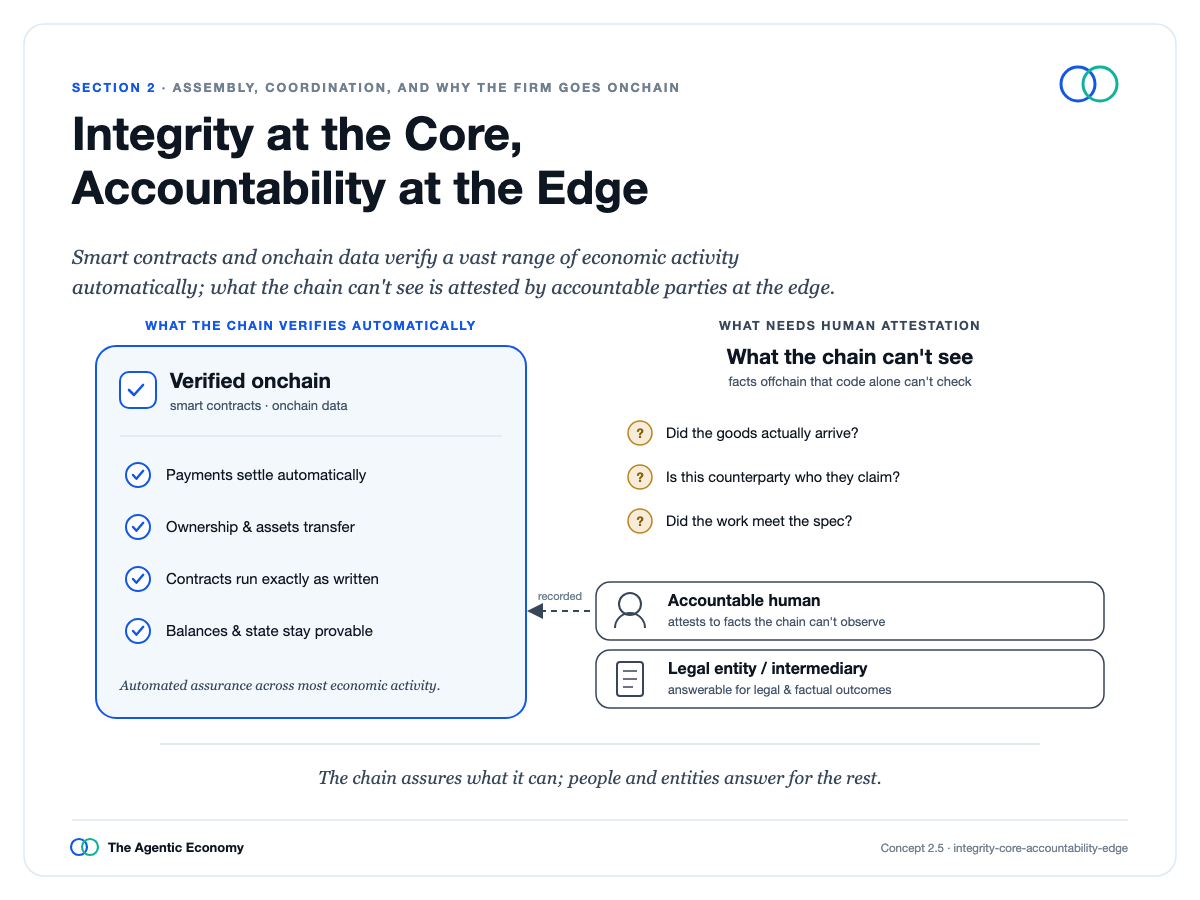
But if companies are going to hire, assemble and pay software-based agents across the world, trust becomes the hard problem. That, for Allaire, is one reason firms move onchain. His solution is a layered identity system: a public blockchain anyone can verify at the base, real-world identity checks above it of the kind banks already use at scale, agent wallets and credentials on top of that, and reputations that accumulate over time while remaining tied to a verified human or corporate creator.
Together, those layers form an accountability chain. Every action taken by an agent can be traced back to a real person or company responsible for it. A private database owned by one company cannot do the same job, he argues, because trust locked inside a single operator does not travel. Trust anchored in public chains and real-world verification can. In this architecture, autonomy is not anonymity. Every autonomous agent still has someone behind it who is accountable.
The monetary base has to support machine-speed activity
The third section asks what kind of money agents need. Allaire’s answer is money that agents can hold and transfer at machine speed, in both large and tiny amounts, without stopping at every payment to re-check whether the money itself is sound. That leads him to a conventional-sounding foundation: fully reserved money with final settlement running on an open network.
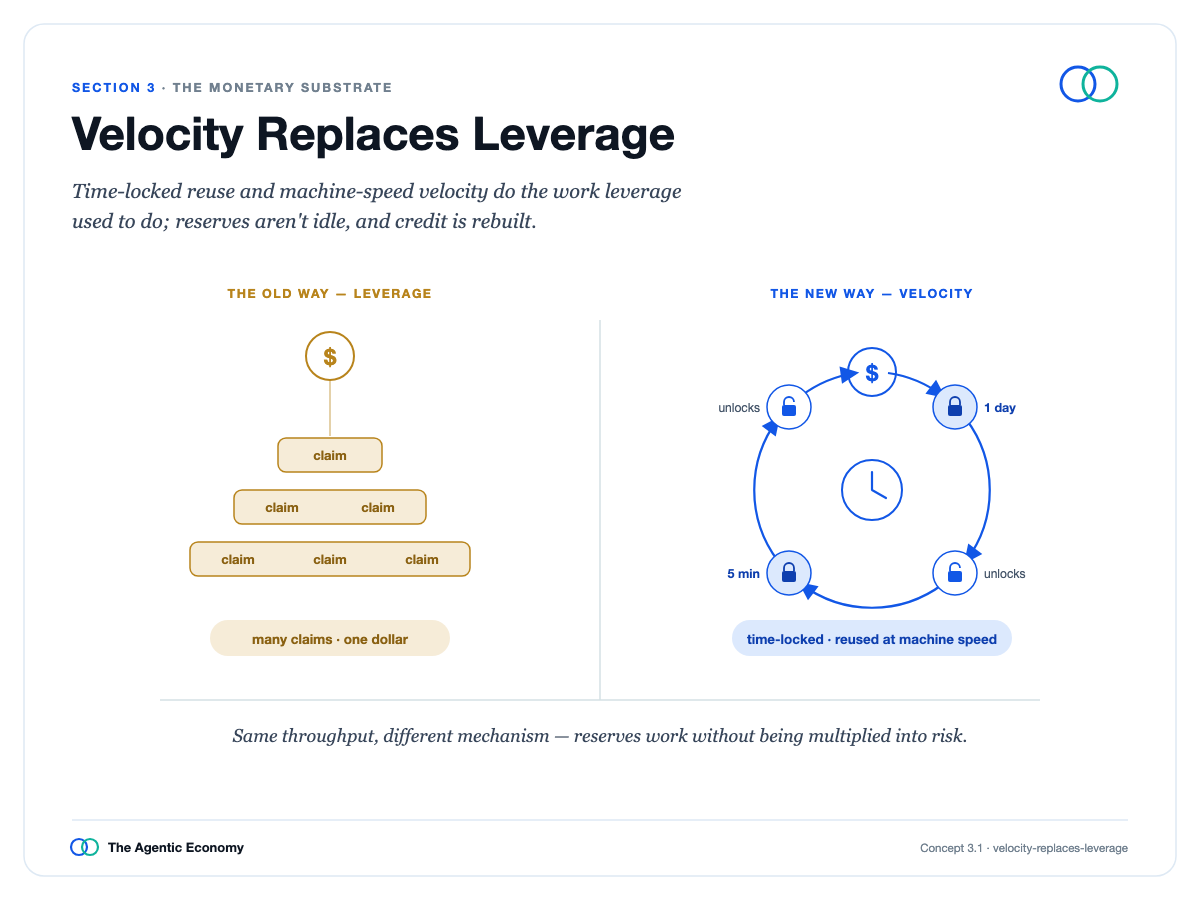
Speed sits at the center of this argument. If moving money costs almost nothing, settlement happens almost instantly and the money is controllable by software, the same dollar can be reused repeatedly in a short window. Funds become available the moment they arrive, and micropayments between agents become practical. For Allaire, that is simply the internet pattern for information and software extending into money.
He addresses the obvious objection that banks already create speed by lending the same deposit repeatedly, so fully reserved money might choke off credit. His answer is no. If the turnover of money becomes fast enough, one dollar can be locked for seconds and then lent again. Speed starts doing part of the job that leverage used to do. Credit is rebuilt on top of the base rather than removed from the system.
He insists the base money itself cannot carry risk. The faster money moves, the faster risky money can break. A bank run that once took weeks might happen in minutes, and agents that settle instantly cannot pause to decide whether each dollar is still trustworthy. In the paper’s terms, only fully backed money can reliably be worth exactly $1 to everyone, everywhere, without leaning on national safety nets that do not scale across a global system.
Settlement, in this model, must also be truly final. Not “probably final later,” but final in one second. Settlement means settlement. Refunds and fraud protections still exist, but they sit as optional layers above the base: escrow, refund pools and insurance, rather than features built into the money itself.
He is clear that these protections depend on institutions that are still being built. Large issuers need to be regulated, bankruptcy remote and backed by increasingly safe reserves. He also draws a bright line between money and yield. Holding money should not generate return. If someone wants yield, they are no longer merely holding money; they are lending it out and taking risk. Combining the two would weaken the entire safety case.
Credit shifts toward machine underwriting and agent working capital
The fourth section argues that credit does not disappear when the monetary base becomes fully reserved. It simply moves to the other side of that line. In Allaire’s view, it could return in stronger form, reach a broader set of borrowers and price risk more precisely, while making failures easier to see rather than hiding them inside the monetary base.
He reframes the problem of under-served borrowers. Small merchants, gig workers, households and future agent operators are often excluded not because they are necessarily poor credit, but because underwriting each small loan costs more than the loan is worth. Credit rationing, in this telling, is often driven by underwriting cost rather than borrower quality. Lower that cost, and many borrowers who were previously ignored can become financeable.
The engine behind that change is what the paper calls a data flywheel. Onchain activity is structured, verifiable and real time. That should produce risk models that are stronger than older approaches built on fragmented records. Better data leads to better loans, which attracts more activity, which produces more data.
Allaire also addresses the concern that putting lending onchain means exposing everyone’s finances on a public ledger. His answer is that onchain does not have to mean public. New privacy technologies can let borrowers prove the information lenders need, such as credit standing or loan balances, without revealing the underlying details.
The most novel lending category in the section is working capital for agents. He argues that this form of credit can be unusually predictable because it removes one of the biggest variables in human lending: whether the borrower wants to repay. Instead, the risk is narrowed into a short-duration, bounded question tied to a specific job.
His example is simple: an agent borrows $4 of compute resources to complete a job that has already been hired for $10. The lender is not trying to price character. It is pricing the probability that the work gets accepted. Collateral works differently too. Instead of relying first on courts to seize unrelated assets, the loan is secured first by the payment attached to the work itself, then by automatic claims, agent-posted margin, reputation and ultimately the real human behind the agent.
That could make credit cheaper, more widespread and safer at the same time, he says, though not without limits. Predictability falls as duration extends. A task completed in seconds looks almost mechanical; financing over months returns toward more ordinary risk. Machine credit does not replace human credit. It creates a new low-risk benchmark, with traditional lending repriced around it.
He also says the system needs monitoring and brakes. As exposures build, the cost of crowding into the same pattern or provider should rise through automatic controls, and insurance pricing should reflect live conditions rather than stale averages.
An architecture that is global by default
In the fifth section, Allaire describes the structure as a three-layer stack. At the bottom is stablecoin money used as the unit of account and final settlement asset. In the middle is an economic operating system where coordination, contracts and exchange happen through programmable smart contracts with final settlement. On top sits an execution layer where AI and cloud systems perform the actual work.
All three layers are software and all run on the internet. Each replaces something that used to be tied closely to nation-states. Software money replaces national banking systems linked together through slow correspondent rails. The middle layer moves contract execution out of national courts and into code that runs the same way everywhere. The execution layer replaces local labor with work that has no fixed home jurisdiction.
That is why, in his view, the economy built on top of the stack is borderless by default. “Global by construction” is how the argument works. It is not an extra feature bolted on later; it follows from the materials the system is made of. Historically, economic activity started as national and only became cross-border through added effort. In this architecture, economic activity starts global and national framing gets applied afterward.
A homeland-free economy does not escape law, though. The paper says it can end up subject to too much law at once, with overlapping jurisdictions and no single place that decides which rulebook controls. Allaire’s proposed answer is to stop asking where something happened and ask who stands behind it. Regulation should target the accountable entity each agent traces back to, while the country where a user actually lives sets access conditions for that market.
Enforcement moves to the edges, where money and identity cross between the open world, the regulated world and the private world. Checks happen before payment and settlement, not as reporting after the fact. At the same time, he says that does not require a public ledger of everyone’s finances. Disclosure should stay private by default and be shared only with permission.
He also argues the system should preserve a genuinely private space, a digital equivalent of cash. Control should sit at regulated edges rather than in the core. The strongest powers, such as freezing or reversing funds, are legitimate only under due process: recorded, time-limited, multi-party and appealable.
On foreign exchange, the paper imagines conversion becoming invisible. As major currencies move onchain, one side can hold its home currency while the counterparty receives theirs, with conversion handled underneath at the best available rate. Sovereignty, in this account, is reworked rather than erased. A neutral network can let states issue their own money on the same rails instead of depending on someone else’s. The real danger lies in the transition, since people could flee weaker currencies faster than before.
The section ends on a tension that runs through the whole paper. The same system carries both equalizing and centralizing tendencies. Concentration is the default. Broad sharing is harder, but it can be built. The same machine can enforce accountability or censorship depending on how its control points are governed.
From software subscriptions to payment for outcomes
The sixth section focuses on the supply side of the agent economy. Allaire says agents need services they can call, hire and pay for, and that supply stack should emerge in two waves. First, existing software and data products will package themselves so machines can use them, with pricing designed for agents rather than individual users. Second, new specialist agents will be built to go deep in specific domains and sell finished work.
The deeper shift is in pricing. For three decades, software has largely been sold by seat, charging recurring fees for each human account. But when the customer becomes an agent performing a task, the thing being bought is the work rather than the login. Seats lose their status as the main billing unit. Subscriptions may remain, but pricing gets rebuilt around units of work, from usage-based charges to committed budgets to outcome-based fees.
The same logic extends one layer down to the model market. As specialized agents proliferate, buyers purchase outcomes from agents rather than raw output from model providers. Agents then shop across competing models to complete work as cheaply as possible while maintaining acceptable quality.
Allaire writes that tools routing each request to the most appropriate model have gone from optional to necessary within a year. Price gaps between models are large enough that using an expensive model for a simple task is wasteful. In that environment, the model becomes a cost input while the agent becomes the business. Value moves toward the party that owns the customer relationship, the context and the accountability for results.
He does not claim that outcome is universal. Builders of the very best frontier models still retain pricing power on the hardest tasks, and they may move up the stack themselves. The likely result, he suggests, could look like a barbell: a large commoditized middle with durable value held at the frontier.
Below that sits an older dream that never really landed in the consumer internet: micropayments. In Allaire’s view, they failed partly because settlement was too expensive, but mainly because humans dislike deciding whether every tiny item is worth paying for. Machines do not have that hesitation, and settlement is now close to free. So micropayments may finally work, not for content, but for small units of work exchanged between agents.
That optimism comes with a warning. If agents can freely hire other agents and tools, spending can spiral quickly. The economy will need a dedicated spend-control layer with caps, budgets and approval rules. He treats that as a product category in its own right, one that completes the broader architecture.
Onchain companies as the natural home for agent-run firms
The seventh section widens the frame from agents to the company itself. If agents are taking over more corporate work, the firm needs a new habitat. A company whose agents hold money, sign contracts and operate around the clock needs a place where that can happen directly: money flows programmatically, rules run in software and outside transactions settle at machine speed. For Allaire, that place is the onchain economy.
That is why he says agentic companies and onchain companies are two sides of the same thing. One describes who performs the work. The other describes the form that work takes. This is one of the paper’s central claims: an economy run by software agents must run on software money, software contracts and software governance, or it will not function coherently.
He draws an important boundary. This does not mean every company dissolves into a token-governed collective. The future, in his view, is hybrid and moves on two tracks. Existing firms will gradually bring equity and governance onchain while keeping familiar legal structures, a slower process likely pushed by the most cautious institutions in finance. At the same time, new and highly agentized companies will be built onchain from day one, pulling the rest of the market forward.
Even those new companies cannot escape law simply because they are software-native. Legal existence and limited liability come from governments, not from code, so they still need a legal shell. What changes is the balance: the shell gets thinner, while the onchain entity that actually does the work, settles value and carries governance gets thicker.
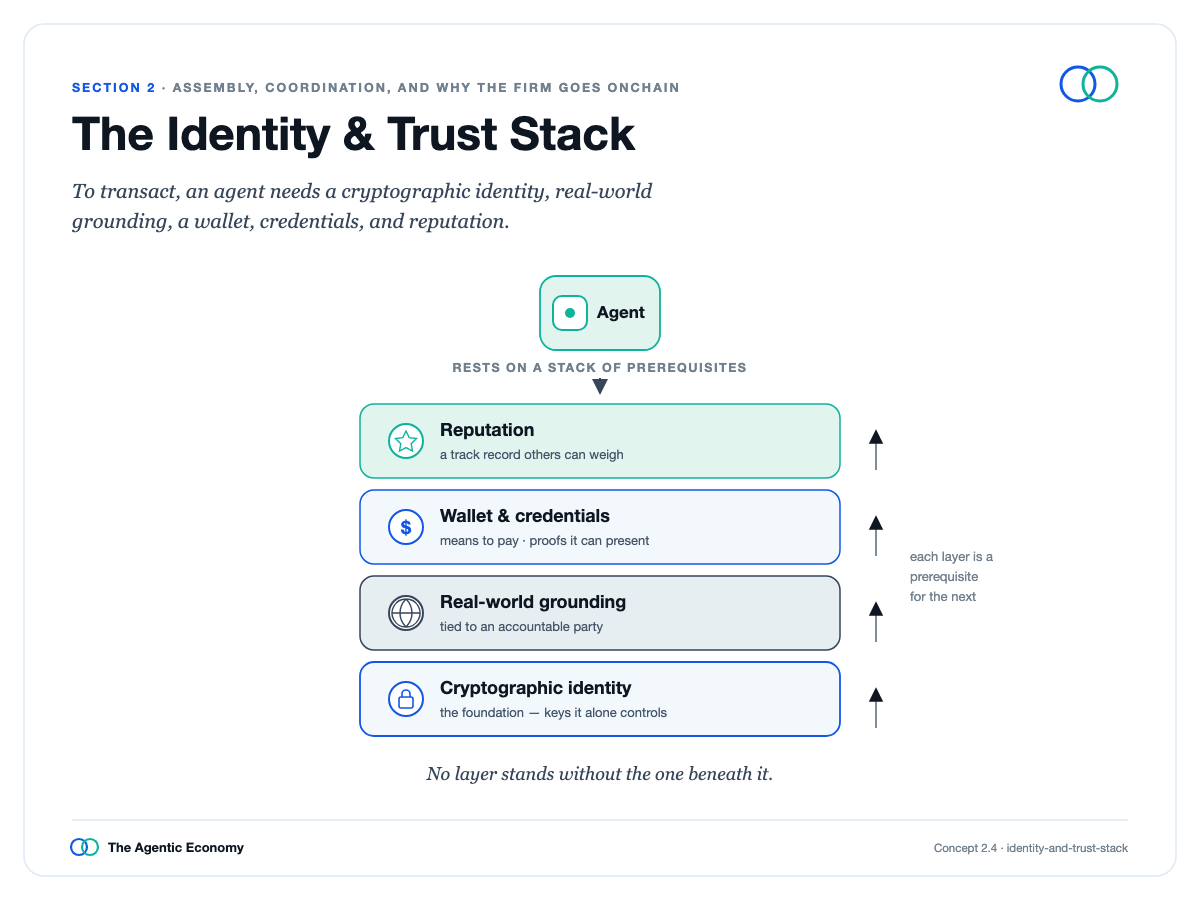
Allaire adds two cautions here. First, a shared ledger can prove what happened, in what order and by whom. That is real progress. But it cannot prove that an action was authorized, wise or faithful. A perfect record of self-dealing is still self-dealing. The ledger is a better witness, not a better conscience, so responsibility still rests with the humans who designed and were supposed to oversee the agent.
Second, contracts become more program-like in how they execute, especially in clear and repetitive cases, but they remain legal documents in how they are judged. Code runs literally. Law has to leave room for intent, mistake and fraud. The ideal arrangement, he argues, is a reliable core with human judgment at the edges. A small set of disputed cases can then be handled through external data feeds, arbitration and shared override mechanisms that are time-limited and recorded. Whoever controls the override ultimately controls the company.
The key risk is not only jobs, but labor share and concentration of power
The eighth section turns to consequences. Allaire says the agentic economy holds the biggest upside and the sharpest danger of the period in the same hand. These are not two separate futures. They are two outcomes that can emerge from the same machine.
On labor, he avoids the oldest automation debate, which is whether technology destroys employment in the aggregate. His focus is narrower and more structural: the share of national income paid to human labor, and the wage level human work can still command. People may remain employed but only in tasks where machines are weakest, with pay pushed below what is needed to support a household. On paper, that can still look like full employment. In practice, he says, it would amount to crisis.
He argues that outcome becomes more plausible if software takes over new tasks faster than workers can retrain, if the price of agent labor keeps falling with compute costs and drags wages down with it, and if capital can finance its own expansion because agents can earn money that then funds the creation of more agents. A loom never earned the money to buy another loom. An agent might.
Still, he stops short of inevitability. First, even if all of that happens, the issue is one of distribution rather than scarcity, because output could still be very large. Second, the pessimistic story often assumes humans will have no remaining advantage and no ownership stake in the new economy. He rejects both as foregone conclusions. Human labor may continue to command a premium in care, status and authenticity, and if displaced workers own capital, a falling labor share can be offset by capital income.
That is why he collapses the labor question into the ownership question. A declining labor share becomes disastrous only when ownership is concentrated. If ownership is broad, the same automation can look like shared abundance.
The paper then asks where concentration is most likely to form. Allaire does not present concentration as a law of nature. Open standards and forkability have a long history of spreading power. Concentration tends to win where strong network effects meet bottlenecks that cannot easily be forked: dominant money, licenses, deep liquidity pools or override keys. He argues the most important control points are less likely to be AI models, which tend to commoditize, and more likely to be the identity layer, override rights and dominant money issuers that earn income from the currencies they process.
He acknowledges that he operates in the last of those categories. He then advances an argument that cuts against his own immediate interest: that this income is a policy choice, and what policy creates can be redistributed by policy. The same control points that gather profits can also be turned into instruments. The outcome depends on whether those points remain open or get captured.
A civic vision built around broader ownership
The final section moves into political economy. If the agentic economy weakens the link between labor and the share of output people receive, Allaire argues the answer is not simply to defend old jobs. It is to expand ownership of the capital that captures value: agents, models, infrastructure and companies.
He says the same architecture that can centralize by default could also distribute ownership, rewards and governance more widely than earlier systems if it is designed to do so. The corporation once allowed strangers to pool capital and share in enterprise success beyond a narrow elite. The onchain economy could push that further because it finally offers tools for giving large numbers of users ownership, governance rights and upside at close to zero administrative cost.
But he does not romanticize it. Earlier movements for broad ownership failed, in his account, not because paperwork was too hard, but because power was. Onchain systems can reduce the cost of shared ownership and remove some gatekeepers, but they do not automatically solve the power imbalances that crushed those movements.
More than that, the default settings point back toward concentration. Internal allocations and open secondary markets can pull value toward the largest holders once tokens begin trading, and one-token-one-vote governance tilts toward rule by wealth. He states the tradeoff directly: liquidity becomes the enemy of broad ownership.
So any serious design for shared ownership has to account for that pull. Ownership may need to be earned through participation, transfers may need to be limited, and caps may need to exist. The system also has to accept that liquidity and breadth cannot both be maximized at the same time. There is a deeper trap too: shared ownership is not the same as shared power. A billion people can participate economically while a much smaller group still controls final decisions. Distributing governance is a separate and difficult task.
His position is that ownership should be broadened by design and tied to fairer capital and automation taxation, the broad distribution of public goods and public benefit sharing, so that the public shares in the value created by the infrastructure. He uses stablecoin reserve income as his clearest test case. In his view, that income is created by policy, should be compressed through competition and should ultimately flow back to the holders of those funds, including at issuers connected to him.
He closes by saying none of this will happen automatically because the winners are often also the rule-makers. Counterweights are needed: open standards that prevent extraction from becoming a locked gate, public direction over control layers and a large base of owners with real stakes to defend. If labor no longer serves as the main route to status and voice, ownership may have to fill that role. The infrastructure does not decide the outcome on its own. Whether this becomes the most balanced economy in history or the most concentrated one is not a prediction to wait on. It is a design problem and a political contest that must be confronted directly.
The original paper was written by Circle founder Jeremy Allaire. Odaily’s Chinese translation and summary was credited to Qin Xiaofeng (@QinXiaofeng 888). The full paper is available at https://agenticeconomytreatise.com/treatise/index.html, with separate links provided in the article for each of the nine sections.