
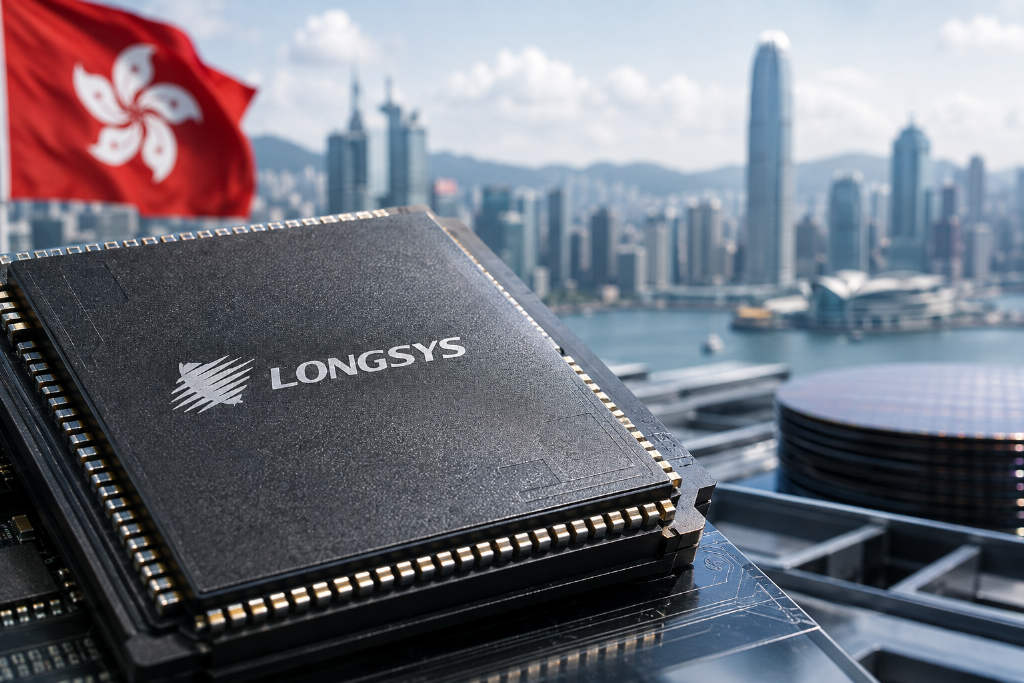
Jiangbolong began trading on the main board of the Hong Kong Stock Exchange on Sept. 8, completing its A+H listing structure. The company priced its H shares at HK$236 each, and the stock opened at the same level, giving it a market capitalization of about HK$107.5 billion. Its A-share market value currently stands at about RMB 154 billion.
The company was founded by twin siblings Cai Huabo and Cai Lijiang from Jiujiang, Jiangxi. Twenty-seven years ago, the pair started a memory business from a counter of just a few square meters in Shenzhen’s Huaqiangbei. Jiangbolong has since grown into what the source article described as the world’s second-largest independent semiconductor memory maker, and its Hong Kong debut arrived during a strong cycle for the memory industry.
Its financial results were a major backdrop to the listing. In the first half of 2026, Jiangbolong posted revenue of RMB 24.088 billion, up 136.26% from a year earlier, while net profit attributable to shareholders reached RMB 10.577 billion, up 71,528.66%, or about 715 times.
The earnings surge also lifted the founders’ paper wealth. In July this year, Jiangbolong’s A shares touched a record intraday high of RMB 749.88, briefly pushing total market value above RMB 322.45 billion. Based on the siblings’ combined stake of about 42%, their holdings were worth about RMB 135.4 billion at that point.
HK listing raised about HK$6.136 billion
Jiangbolong sold 26.0778 million shares in the global offering. Based on the offer price of HK$236, total proceeds came to about HK$6.136 billion. Cornerstone investors included Transsion, Lenovo, Lens Technology, TCL-affiliated investors, Ingenic, and CITIC Asset Management Hong Kong. Together they subscribed for $151 million, or about HK$1.185 billion.
Using the Sept. 7 exchange rate cited in the article, HK$236 was equivalent to about RMB 202, representing a discount of about 44% to the A-share closing price of RMB 358.22.
Just one month earlier, Jiangbolong had completed a private placement in the A-share market worth about RMB 3.7 billion. It sold 6.6071 million shares to 21 investors at RMB 560 each. Since then, the A-share price has fallen below that placement price. The contrast between a high-priced A-share placement and a discounted Hong Kong offering became one of the market’s main questions around the deal.
According to the company’s disclosed use of proceeds, the Hong Kong fundraising is not only about adding cash. The money is set to go mainly to research and development, strategic investments and acquisitions, and working capital. More broadly, the company wants to keep moving upstream in the memory supply chain and strengthen chip design, product development, and supply-chain integration.
From a Huaqiangbei counter to a Hong Kong listing
Jiangbolong’s story began in Huaqiangbei.
In 1996, after finishing high school, Cai Huabo left Jiujiang, Jiangxi, for Shenzhen and started selling electronic components in Huaqiangbei. In 1999, at age 23, he teamed up with his twin sister Cai Lijiang to launch a business. The company name combined the final characters of their given names and added “Long,” a reference to their zodiac sign.
In its early years, Jiangbolong mainly traded memory products, making money by buying low and selling high. But memory is not an ordinary commodity. Prices swing sharply, inventory cycles are long, and the right stock bet can magnify profits quickly, while the wrong one can put immediate pressure on the balance sheet.
The company ran into exactly that problem in 2002. A large batch of Hitachi AG-AND flash memory it had stocked up on did not sell, and the cash chain nearly broke. The turning point came with Apple’s iPod, which lifted NAND flash demand and tightened the USB drive market. Cai Huabo turned the unsold flash chips into USB drives and eventually cleared the inventory.
That close call changed his view of the business. If Jiangbolong remained only a trader or contract manufacturer, it would struggle to control its own future. Cai once led a team to Taiwan in 2002 to look for technology partners, but was turned away. Looking back years later, he said, 「That was a deeply frustrating experience, but it forced me to reflect.」
From that point on, the company decided it needed in-house research and development rather than full reliance on outside suppliers.
Three major shifts: own brand, Lexar acquisition, chip design
Moving from OEM work to proprietary products
By 2010, Jiangbolong’s OEM business had surpassed RMB 200 million. Cai Huabo was not enthusiastic about that model. As quoted in the article, he said, 「The company experienced the helplessness of doing OEM work and could only earn thin, high-risk profits from brand owners.」
In 2011, Jiangbolong began making embedded eMMC and solid-state storage products and launched its own FORESEE brand, gradually shifting away from OEM manufacturing toward proprietary products.
Acquiring Lexar from Micron
In 2017, Jiangbolong acquired the Lexar brand and related assets from Micron.
The logic was straightforward. The company had tried to build a consumer-facing brand through large distributors, but found that even a stronger product could not easily change established consumer perceptions. It chose instead to buy a brand already recognized by global consumers.
After the acquisition, Jiangbolong did not rush to remake Lexar into a “Chinese brand.” It kept the international team in place and continued operating the brand independently. In 2025, Lexar generated global sales revenue of RMB 4.741 billion, up 34.53%, with products sold in more than 60 countries and regions.
Building its own chip capability
In 2020, Jiangbolong set up a chip design group. By 2025, its controller chips had entered large-scale market deployment.
As of the end of April 2026, the company had expanded its R&D team to 1,262 people, set up five R&D centers, and held 645 granted patents, including 229 invention patents. The business had moved from buying wafers and assembling modules toward designing controller chips itself.
Jiangbolong listed on Shenzhen’s ChiNext on Aug. 5, 2022, at an issue price of RMB 55.67.
Based on 2025 revenue from storage products, the company ranked as the world’s ninth-largest storage product maker, the world’s second-largest independent semiconductor memory company, and China’s largest independent memory company, with a global market share of about 1.2%.
Its customers include Dell, Lenovo, Mindray, OPPO, Samsung, Transsion, and Xiaomi. By 2025, 66.8% of revenue came from markets outside mainland China.
Capital had already gathered around the company before this Hong Kong sale. The National Integrated Circuit Industry Investment Fund became a shareholder in 2019 and is now the sixth-largest shareholder. Oriza Puhua, Juyuan Juxin, and Leaguer Venture Capital are also on its shareholder list. With the new cornerstone investors in the H-share deal, Jiangbolong’s investor base has become even broader.
Profit soared, but cash did not stay on the books
The clearest sign of this cycle’s impact was gross margin.
- 2023: 4.7%
- 2024: 15.8%
- 2025: 18%
- First half of 2026: 58.2%
Revenue and profit climbed at the same time. Revenue rose from RMB 10.125 billion in 2023 to RMB 22.766 billion in 2025. Net profit moved from a loss of RMB 828 million to a profit of RMB 1.423 billion, then reached RMB 10.577 billion in the first half of this year alone.
The jump in profit was mainly tied to higher memory chip prices. From the second half of 2025, investment in AI infrastructure accelerated and changed supply and demand in the memory market. Large models need not only computing power but also larger memory capacity and higher bandwidth. Demand from AI players including Nvidia kept lifting HBM and enterprise SSD demand. Memory suppliers shifted more capacity toward high-end products, tightening supply for other categories and pushing prices higher.
Jiangbolong sits in the middle of that chain. It does not manufacture memory wafers itself. Instead, it buys memory wafers and controller chips from IDM companies and controller suppliers, then handles packaging, testing, SMT assembly, and product assembly to produce USB drives, DRAM modules, SSDs, and embedded storage used in phones.
Its margin largely comes from the gap between procurement cost and selling price. When prices rise, inventory bought earlier at lower cost can be sold at higher prices, and gross margin expands fast. Jiangbolong’s lower-cost inventory happened to line up with this round of price increases. The prospectus said some memory wafer price gains had already exceeded records from the past decade.
According to China Insights Consultancy, the global semiconductor memory product market reached $275.4 billion in 2025. The combination of demand growth and higher memory prices became the direct driver of Jiangbolong’s profit surge.
But inventory is also the biggest risk in the story. In the first half of 2026, net cash flow from operating activities was negative RMB 3.151 billion. By the end of June, inventory book value had reached RMB 25.777 billion, accounting for 60.12% of total assets. Combined short-term and long-term borrowings exceeded RMB 15.4 billion.
In other words, the company booked substantial profit, but not all of it turned into cash inflow. Inventory turnover days lengthened from 190.7 days in 2025 to 317.2 days in the first four months of 2026. The prospectus also warned that some customers had reduced, delayed, or lowered orders because higher product prices strained their budgets, and that overall sales volume and new orders were lower than in previous years.
That is the core feature of the memory cycle: rising prices let inventory amplify profit, while falling prices can turn the same inventory into an impairment risk.
Share price swings tracked the same tension
The stock market had already reflected that conflict.
At the end of August 2025, Jiangbolong’s A shares were trading at RMB 95.46, giving it a market value of about RMB 40 billion. By early July 2026, the stock had climbed to an intraday high of RMB 749.88 and market capitalization had briefly reached RMB 322.45 billion. It has since fallen back, with the company now valued at RMB 154 billion.
The cycle pushed Jiangbolong to a peak, then forced a return to a more difficult question: higher memory prices can deliver profit quickly, but whether those gains become cash, and whether inventory can be digested before prices retreat, will determine how durable the company’s growth really is.
A Jiangxi founder story inside a wider business network
The source article also placed Jiangbolong within a broader group of entrepreneurs from Jiangxi. In AI-related industries, it named Cambricon founder Chen Tianshi, Horizon Robotics founder Yu Kai, AgiBot founder Peng Zhihui, Jiangbolong founders Cai Huabo and Cai Lijiang, and Tianfu Communication founder Zou Zhinong as all coming from Jiangxi.
It went on to mention other founders from Jiangxi across sectors, including Didi founder Cheng Wei, ByteDance co-founder Liang Rubo, miHoYo co-founder Luo Yuhao, TubaTu founder Wang Guobin, Dewu founder Yang Bing, and game entrepreneur Wu Xubo. In traditional industries, it listed Yonyou founder Wang Wenjing, Ganfeng Lithium founder Li Liangbin, Jimin Kexin founder Li Yihai, and Renhe Pharmaceutical founder Yang Wenlong. In consumer businesses, it cited HEYTEA founder Nie Yunchen, Bao’s Pastry founder Bao Caisheng, Luxihe founder Huang Jin, and Pagoda founder Yu Huiyong.
The article said Jiangxi borders Hubei, Anhui, Zhejiang, Fujian, Guangdong, and Hunan, placing it at a crossroads of industrial migration in southeastern China. It also noted that many young people leave for cities such as Shenzhen, Suzhou, Shanghai, and Beijing to build experience and find opportunities where industries are more concentrated.
Within that context, Cai Huabo was presented as a representative example: someone without elite university credentials who learned the trade from a small Huaqiangbei counter and kept moving upstream. In the March 2026 Hurun Global Rich List, he ranked No. 553 worldwide with wealth of RMB 52 billion and was identified as the richest person in Jiujiang, Jiangxi.
The article added that some Jiangxi entrepreneurs who built businesses elsewhere are now bringing manufacturing and supply chains back home. It cited Tianfu Communication’s production base in Gao’an and JLC’s manufacturing base in Ji’an as examples.
From stable small profits to a super-cycle windfall
The article closed with a quote from Cai Huabo dating back to the period after the 2008 global financial crisis, which badly hit the memory market. After the company recovered, he set a goal for the business: 「Our goal is to earn a stable small profit every month, rather than chase large cyclical profits, because cyclical profits can become unstable with market swings.」
Eighteen years later, the company recorded RMB 10.577 billion in profit in just half a year.
Still, memory remains a classic cyclical industry. Prices can rise fast and fall just as fast. For Jiangbolong, the Hong Kong listing is not the endpoint of this run. The bigger test will come after prices retreat and inventory pressure builds, when the company must show whether it can turn this cycle’s gains into a more stable business model.
This article was adapted from a report published by the WeChat account Rongzhong Caijing (ID: thecapital), written by Li Bingzhi.