
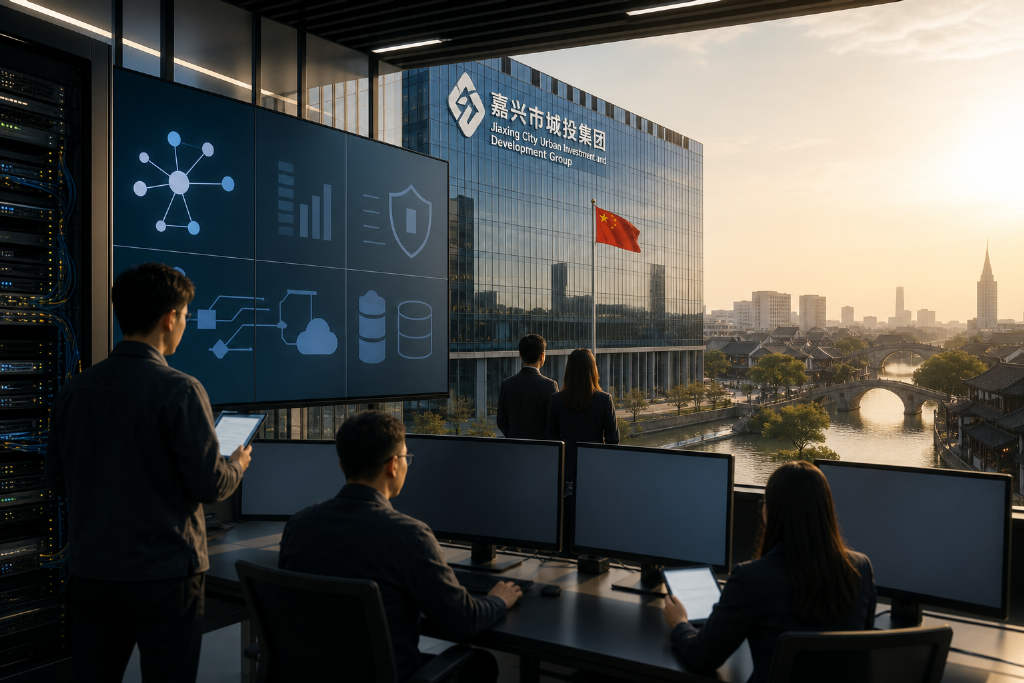
That is a notable move for a municipal investment platform best known for roads, bridges, gas networks and urban renewal. At a local inspection, city officials asked the question on many minds: why should the city’s investment arm do this?
According to the article, the center does not produce Tokens or build large GPU clusters. Its负责人, Ma Yinxiao, described the team as a “mover” that aggregates fragmented compute and models, acting like a model wholesaler.
The Jiaxing setup is built around five unifications: a unified API gateway, unified Token metering, unified fee settlement, unified policy rebates and unified security audits. Once connected, companies can call more than 100 mainstream models on demand, including DeepSeek and Qwen, through three service tiers: inclusive packages, usage-based packages and customized services.
The article places the move inside a familiar Chinese infrastructure pattern. When a new infrastructure layer is treated as public service, private capital often tests demand first, then state-backed platforms take over operations, and the service eventually becomes utility-like. Water, electricity, gas and broadband all followed that path.
Jiaxing, the article says, is now at that same “state capital takes over” stage for compute infrastructure.
The city’s backing is not small. As a national compute hub node, Jiaxing hosts four large-scale compute centers at the 10,000-card level, run by Runze, Alibaba, China Telecom and China Mobile, with compute scale ranked first in Zhejiang. On the industrial side, the city has 6,327 industrial firms above designated size and more than 230 AI technology companies.
The article also argues that Jiaxing is not entering an empty field. In spring 2026, the three major telecom operators all moved into what it calls the “Token era.” China Telecom chairman Ke Ruiwen said its smart-cloud system is “a token operations system.” China Mobile aims for “double high growth in Byte plus Token,” and Shanghai Mobile launched a general-purpose service priced at 1 yuan for 400,000 Tokens, which can even be paid with phone credit.
The article cites 2025 revenue growth of 0.9% for China Mobile, 0.07% for China Telecom and 0.68% for China Unicom, and says the legacy traffic business is nearing a ceiling. That is pushing operators to look for a new unit of measurement to support growth.
Higher up and further down the stack, the same pattern is spreading. Alibaba Cloud, Tencent Cloud and Baidu Smart Cloud are selling Tokens. DeepSeek, Zhipu and KIMI are selling Tokens. Silicon Flow and other Token factories are selling Tokens. Even relay stations are selling Tokens. The article groups them into one crowded table: model companies, cloud vendors, Token factories, telecom operators and local government-backed capital, all competing in the same business of selling compute units.
That crowding, the article says, is precisely why margins should keep shrinking. As AI access gets cheaper and the user barrier falls, bare Token sales will look more and more like a utility business: low margin, high capital intensity, and increasingly dominated by large platforms and state-backed players.
The article extends that logic to products and applications. ByteDance’s Jimeng, for example, consumes Tokens from the SeedDance video generation model, but users pay for a finished video. Coding assistants such as Cursor and Windsurf run on code-model Tokens, but developers are buying output efficiency rather than raw compute.
The closer a product is to the end user, and the better it can translate Token consumption into something users will pay for, the higher the margin, the article says. Raw Token selling sits at the other end of the spectrum.
Jiaxing already has one local example. Pinghu Shejie Technology’s AI Zhihui intelligent design platform, built on standardized Token services, has cut the design cycle for down jackets, bags and children’s clothing from weeks to hours, raised development efficiency by as much as 30 times and cut image-generation costs by at least 50%. The company consumes Tokens, but sells design capability.
That, the article suggests, may be the point of Jiaxing’s model: the operations center is not only selling bare Tokens, but also “Token plus industrial scenarios,” anchored in local textile new materials, smart terminals and high-end equipment.
Once Tokens are embedded into real workflows — pricing assistants, bestseller forecasting tools or AI systems that can read circuit diagrams for quality control — they stop being just a metering unit and become a production tool. That is where the premium sits, the article says.
In the article’s closing line, the distance from “metering unit” to “production tool” — from tap water to cola — is the real value range of this new business for local government capital.